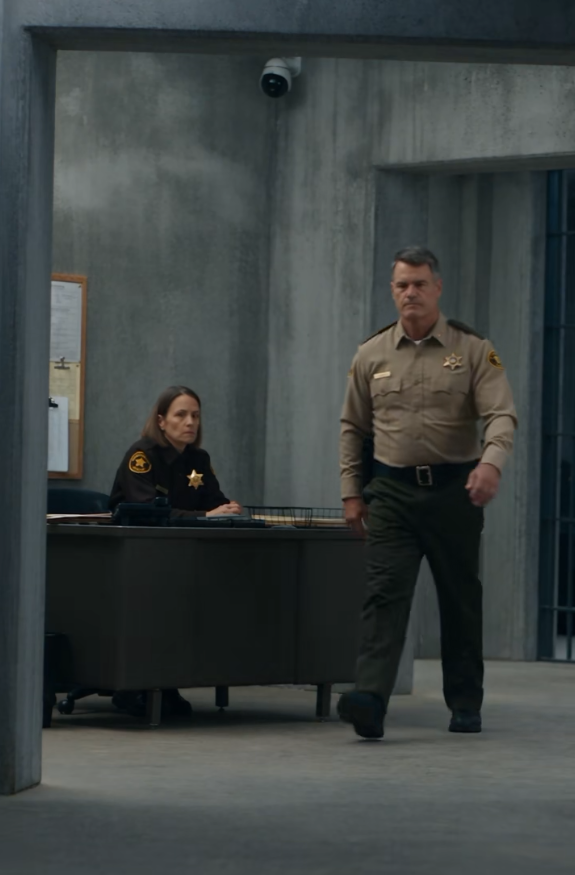
She had never been given any rights notification at 4:19.
Brenda continued.
“But the officer who supposedly entered it was not in the building at 4:19.”
A commissioner leaned forward.
“How do you know?”
“He was transporting a prisoner to the regional jail. Dispatch GPS confirms it.”
The room stirred.
Brenda said, “The entry was made using his login.”
Ryker stood.
“That’s enough.”
The commission chair struck the table.
“Sheriff, sit down.”
Brenda finally looked at him.
“I checked the access audit.”
Ryker’s face hardened.
“The terminal used was inside the sheriff’s office.”
Sarah stopped breathing for a moment.
Not because the revelation was dramatic.
Because it connected.
The denial of counsel.
The later need to show procedure.
The Saturday report edits.
The claim that everything had been handled properly.
One act might be explained.
A pattern was harder.
Brenda finished quietly.
“I copied nothing. I changed nothing. I only asked county IT to preserve the audit.”
The county attorney rose.
“Madam Chair, based on that statement, I recommend immediate forensic preservation of department systems.”
Ryker pushed his chair back.
“This is a witch hunt.”
The chair said, “Sheriff.”
“No. You bring federal pressure into this town and suddenly twenty-three-year employees decide they’re investigators—”
Brenda interrupted.
“No, Thomas.”
It was the first time Sarah heard anyone in the meeting call him by his first name.
Brenda’s voice remained steady.
“You decided the record needed help.”
The room went quiet.
Ryker stared at her.
The chair recessed the meeting.
Sarah closed the laptop.
Evelyn sat across from her.
“So?”
Sarah looked toward the dark window.
“So now it’s bigger than my arrest.”
Part VII — The Harder Choice
The state investigation began two days later.
Not federal.
State.
Sarah insisted on that distinction whenever anyone asked.
The state bureau of investigation opened a case into possible record tampering, false reporting, and misconduct connected to the arrest.
The Department of Justice made no public announcement.
The Pentagon issued no accusation.
Sarah returned to Washington.
For the first time since the stop, she resumed the schedule that had existed before Oak Haven.
Briefings.
Logistics reviews.
Personnel decisions.
A dinner she skipped.
A promotion ceremony she attended.
The machinery of government continued.
But the case followed quietly.
Every few days, Shaw sent updates.
County servers imaged.
Bodycam authenticated.
Booking footage preserved.
Audit logs recovered.
Miller interviewed.
Brenda interviewed.
Ryker interviewed with counsel present.
Then, two weeks after the arrest, Sarah received a request from the state investigator.
They wanted her to give a recorded statement in person.
She returned to Georgia.
The interview lasted three hours.
The investigator, Special Agent Nathan Cole, asked the same questions several different ways.
“What did Sheriff Ryker say before ordering you out?”
“What exact command did you believe was unlawful?”
“Did you physically pull your arms away?”
“Did you ever identify yourself as military?”
“Why not?”
Sarah answered each one.
At the end, Cole closed his notebook.
“One thing I’m struggling with.”
“What?”
“You had opportunities to make this go away.”
“Yes.”
“You could’ve told him your rank roadside.”
“Yes.”
“You could’ve accepted release and let the charges die quietly.”
“Yes.”
“You could’ve let the county settle.”
Sarah looked at him.
“There hasn’t been a settlement offer.”
Cole nodded.
“Not formally.”
She understood.
“What are you asking?”
“I’m asking why you kept pushing.”
Sarah was silent for a moment.
Then she said, “I didn’t.”
Cole raised an eyebrow.
“I preserved evidence. Other people made decisions based on it.”
“You requested records.”
“Yes.”
“You retained counsel.”
“Yes.”
“You gave an interview.”
“After the case was dismissed.”
“You knew all that would create pressure.”
Sarah leaned back.
“Agent Cole, there is a difference between pressure created by evidence and pressure created instead of evidence.”
Cole considered that.
Then he asked, “What outcome do you want?”
Sarah looked at the table between them.
That question was harder than the others.
“I want the record to be true.”
“That’s not an outcome.”
“It’s the only one I control.”
Cole closed his notebook.
A month after the arrest, the county offered Sarah a settlement.
The number was large enough to become a headline.
Her civilian attorney, whom she had hired once the criminal matter ended, slid the document across a Washington conference table.
“No admission of liability,” he said. “Standard confidentiality on settlement discussions, but not on underlying public facts.”
Sarah read the amount again.
“You think I should take it.”
“I think litigation takes years.”
“That wasn’t my question.”
He smiled slightly.
“Yes. I think you should take it.”
“Why?”
“Because the video is already public. The sheriff is already under investigation. The county is revising policy. You gain little from discovery except more pain and more headlines.”
Sarah looked at Lieutenant Colonel Shaw, who was present only as an observer.
Shaw said nothing.
The attorney continued.
“They’re also willing to issue a statement acknowledging the detention lacked sufficient legal basis.”
“That language is already implicit in dismissal.”
“Yes.”
“And Ryker?”
“The county cannot promise discipline in a civil agreement.”
Sarah turned another page.
The confidentiality clause was narrow.
The release of claims was broad.
She stopped at one paragraph.
“What is this?”
The attorney leaned over.
“Mutual non-disparagement.”
Sarah read it again.
It would prevent her from making public statements accusing county personnel of intentional misconduct beyond established official findings.
“What happens if the state investigation finds falsification?”
“You could discuss the finding.”
“But before then?”
“You would be constrained.”
Sarah closed the document.
“No.”
Her attorney sighed.
“Sarah.”
“No.”
“You’re not buying silence. You’re resolving civil exposure.”
“I’m not signing language that makes accuracy dependent on timing.”
“The county wants protection from accusation.”
“So do I.”
He leaned back.
“This is the harder path.”
“I know.”
“Litigation may require you to sit for deposition. They’ll ask about your career, your judgment, your motives, your history with law enforcement. They may argue you engineered escalation.”
“I know.”
“They’ll say you had unusual power available and chose not to disclose it.”
Sarah looked at him.
“Then they can say it under oath.”
The state case moved faster than the civil one.
Forensic examination established that the detainee-rights notification had been entered after Sarah’s release, backdated to 4:19, using credentials assigned to another officer.
The login originated from a terminal in Ryker’s office.
No camera showed who typed it.
But the terminal required a key-card entry.
Ryker’s card had opened his office eleven seconds before the record was created.
His counsel argued others could have been present.
Possible.
Then investigators found the earlier autosaves of his incident report.
No physical resistance.
No reckless-driving arrest basis.
Those details appeared only after the Pentagon call.
Still, Ryker insisted he had merely clarified the narrative.
The case turned on intent.
Intent was difficult.
Sarah knew that better than most people watching from outside.
Then Jared Miller made his second major decision.
He returned to investigators with something he had not disclosed before.
A text message.
Sent by Ryker Saturday morning at 8:14.
Need your report consistent. She resisted after cuffs. Reckless from outset. Don’t hand DC a rope.