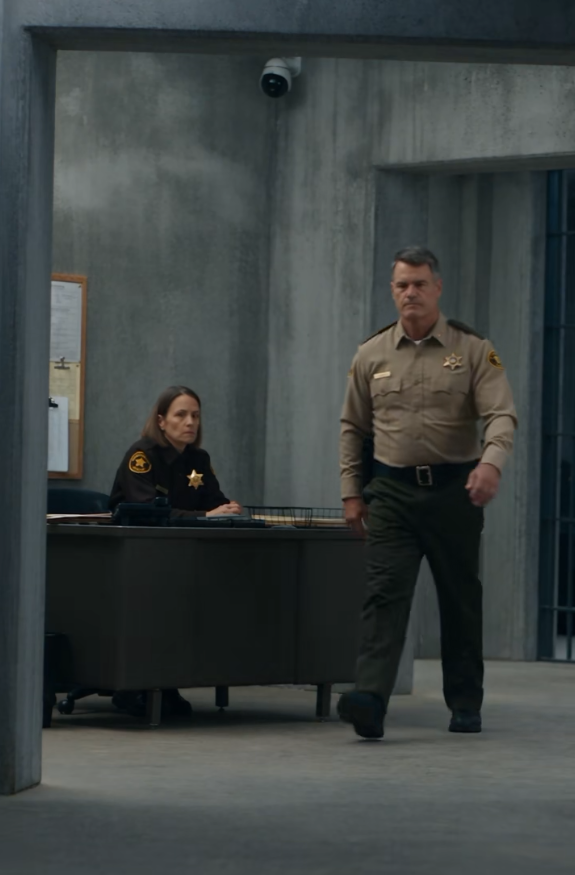
Sarah looked at Miller.
His body camera faced her.
“What is the charge?”
Ryker answered.
“Disorderly conduct.”
Sarah waited.
Nothing else.
“Deputy Miller,” she said, “did you hear me threaten anyone?”
Miller’s lips parted.
Ryker cut in.
“She’s resisting.”
“I am standing still.”
“Now you’re resisting.”
Sarah turned her face enough to see him.
The sheriff was no longer smiling.
Miller looked uncomfortable.
Good, Sarah thought.
Not because discomfort would save her.
Because discomfort meant he knew.
Ryker opened the SUV’s rear door.
“Get in.”
Sarah lowered herself into the seat.
The door slammed.
Through the glass she watched Ryker take the keys from her rental.
Miller said something to him.
Ryker answered sharply.
Sarah could not hear the words.
She watched their mouths.
Miller gestured toward his body camera.
Ryker’s head turned.
Then he reached out and tapped the front of the deputy’s vest.
Miller’s hand rose reflexively.
Sarah could not tell whether the camera remained recording.
She memorized the gesture.
At 3:44, the sheriff’s SUV pulled away from the roadside.
Her rental car remained behind with Deputy Miller.
Sarah sat cuffed in the back seat and watched the pines pass outside.
Ryker drove without speaking.
She listened to the radio.
Unit identifiers.
A domestic call.
A license check.
Then Miller’s voice.
“County, thirty-seven. Vehicle will be secured roadside pending inventory.”
Sarah stored the wording.
Inventory.
Not search.
Interesting.
Ryker picked up his microphone.
“Thirty-one, transport one female.”
A dispatcher answered.
“Copy.”
Female.
No charge stated.
Sarah looked through the partition.
“Sheriff.”
He glanced into the mirror.
“I want an attorney.”
He returned his eyes to the road.
“You can ask at booking.”
“I am asking now.”
“No phones in my vehicle.”
“I didn’t ask for a phone in your vehicle. I’m stating that I want counsel.”
“You know, for someone who says she’s visiting family, you sure talk like a lawyer.”
Sarah leaned back.
“No.”
Ryker waited.
She did not finish the sentence.
He looked at her in the mirror again.
“No what?”
“Nothing.”
The road narrowed as they entered Oak Haven.
A courthouse rose beyond a line of pecan trees, red brick and white columns, with a sheriff’s office attached to one side.
Sarah checked the SUV clock.
3:51.
Nine minutes.
She closed her eyes for two seconds.
Not from fear.
From fatigue.
She had spent most of her professional life planning for systems to fail.
Aircraft broke.
Weather changed.
Ports closed.
Orders arrived late.
People misunderstood.
Communications disappeared.
Good planning meant assuming some piece of the system would go wrong at the worst time and deciding in advance what would happen next.
But there was another kind of system failure, one harder to quantify because it required people to admit that the process itself could become the threat.
Sarah opened her eyes as Ryker turned into the sheriff’s lot.
The cuffs hurt.
She said nothing.
Inside, the air smelled of floor cleaner, paper, and burnt coffee.
Dispatcher Brenda Lawson sat behind a reinforced window with three monitors angled toward her.
She looked to be in her fifties, gray-blond hair pinned back, reading glasses low on her nose.
She glanced up as Ryker entered with Sarah.
“What’ve we got?”
“Disorderly.”
Ryker guided Sarah toward the booking counter.
Brenda looked at Sarah’s clothes, then at the handcuffs.
“Anything else?”
“Resisting.”
Sarah turned her head.
“That accusation was made after I was already handcuffed.”
Ryker pushed a clipboard onto the counter.
“See?”
Brenda’s eyes moved from Sarah to him.
She said nothing.
A corrections officer came through the inner door.
Ryker began dictating.
“Female, Sarah Reynolds. Virginia license. Disorderly conduct, resisting arrest.”
The officer typed.
Sarah watched the screen reflected faintly in the glass behind him.
Then Ryker added, “Reckless driving.”
Sarah looked at him.
“That was never stated at the stop.”
Ryker did not look back.
“You crossed the center line.”
“Your deputy said he observed one lane deviation.”
“Sounded reckless to me.”
Sarah said, “I want that statement documented.”
Ryker finally turned.
“You’re in no position to give instructions.”
“No. I’m in a position to make a request.”
“That attitude is exactly why you’re here.”
Brenda looked down at her desk.
Sarah saw her jaw tighten.
The booking officer removed Sarah’s handcuffs.
Red marks circled both wrists.
“Personal property.”
Sarah placed her wallet, watch, earrings, and personal phone in a gray plastic tray.
The officer looked toward Ryker.
“Vehicle property?”
Ryker produced a small locked black case and set it down.
Sarah’s gaze went to it.
Ryker noticed.
“What’s in this?”
“Government property.”
His eyebrows rose.
“You work for the government?”
“Yes.”
“Doing what?”
“I’m not discussing my employment with you.”
Ryker smiled again.
“There it is.”
Sarah said nothing.
He examined the case.
A plain federal property label was fixed near the hinge.
No rank.
No unit.
No classification marking visible from the outside.
“Open it.”
“No.”
“You carrying contraband?”
“No.”
“Then open it.”
“It contains government equipment. I am not authorized to provide you access.”
Ryker looked at the booking officer.
“Property box.”
The officer hesitated.
Then placed the case beside Sarah’s phone and wallet.
Sarah watched him seal everything in a clear evidence bag and write a number across the top.
Property 24-861.
She memorized it.
“I want to call an attorney,” she said.
Ryker signed the booking sheet.
“You can cool off first.”
“I am requesting counsel.”
“You’ve said that.”
“And you are refusing?”
Ryker rested the pen on the counter.
“You’re being processed. When we’re done, we’ll see.”
“Please document that I requested counsel at approximately 3:56 p.m.”
Ryker’s face sharpened.
“Put her in four.”
The corrections officer looked uncertain.
“She hasn’t been printed yet.”
“Four.”
Sarah met Brenda’s eyes briefly as she was led away.
The dispatcher looked back at her.
No expression.
But she was listening.
Cell four was six feet wide, perhaps ten feet deep, with painted concrete walls, a stainless-steel toilet, a narrow bench, and a camera dome in the upper corner.
Sarah entered.
The door shut behind her.
Lock engaged.
She sat on the bench.
3:59, she estimated.
Somewhere in Washington, a secure meeting would begin without her.
Sarah rested her forearms on her knees.
She had no idea how long Oak Haven intended to hold her.
She also knew something Ryker did not.
The Pentagon noticed missing generals.
Especially generals who were supposed to be briefing the deputy chief of staff at sixteen hundred hours.
Sarah looked up at the camera.
Then at the door.
And waited.
Part II — Five Minutes
At 4:04 p.m., the front desk phone rang.
Brenda Lawson almost ignored it.
Three other lines were blinking, a deputy was requesting a tow authorization, and Sheriff Ryker was standing beside the booking desk telling Jared Miller how he wanted the roadside narrative written.
Brenda answered on the fourth ring.
“Oak Haven County Sheriff’s Office.”
A man spoke with the clipped precision of someone who expected his words to be recorded accurately.
“This is Colonel Daniel Hart, United States Army, calling from the Pentagon duty office. I need to speak with Major General Sarah Reynolds.”