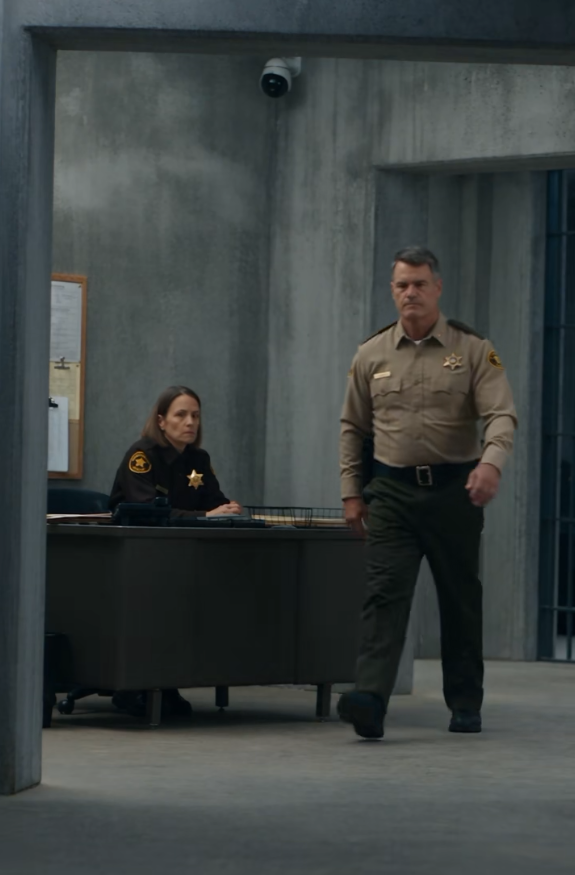
Brenda looked toward the holding corridor.
She had worked dispatch for twenty-three years.
She had heard drunks claim to be federal judges, suspects claim to be senators, husbands claim diplomatic immunity, and teenagers insist their fathers owned half the county.
She had developed a reliable sense for nonsense.
The voice on the line was not nonsense.
“Could you repeat the name?”
“Major General Sarah Reynolds.”
Brenda removed her glasses.
“One moment, sir.”
She covered the receiver.
“Sheriff.”
Ryker kept speaking to Miller.
“Put that she became verbally aggressive after being advised—”
“Sheriff.”
He glanced over.
“What?”
Brenda heard the change in her own voice.
So did Miller.
“There’s a colonel from the Pentagon asking to speak with Major General Sarah Reynolds.”
For several seconds, nobody moved.
Then Miller looked toward the holding corridor.
Ryker stared at Brenda.
“The Pentagon.”
“Yes.”
“Which Pentagon?”
Brenda almost asked him how many he thought existed.
Instead she said, “Washington.”
Ryker’s face emptied.
Miller whispered, “Jesus.”
Ryker crossed the room and took the phone.
“This is Sheriff Thomas Ryker.”
Colonel Hart did not introduce himself again.
“Sheriff, do you currently have Major General Sarah Reynolds in custody?”
Ryker looked toward the booking officer.
Then down the corridor.
“We have a Sarah Reynolds.”
“What lawful grounds do you have for holding the general?”
The room changed.
Sarah could not hear the words from cell four, but she could hear the silence that followed them.
Ryker turned away from the desk.
“She was arrested during a traffic investigation.”
“On what charge?”
“Disorderly conduct. Resisting. Reckless driving.”
“Was she injured?”
“No.”
“Has she been given access to counsel?”
Ryker’s mouth opened.
Brenda watched him decide how to answer.
“She’s being processed.”
“That did not answer my question.”
Ryker looked at Brenda.
She did not help him.
“No.”
Colonel Hart’s voice remained level.
“Sheriff, General Reynolds was scheduled for a secure Department of Defense briefing four minutes ago. Her government device was last active before her traffic stop. We have verified that her rental vehicle is under your department’s control. You will preserve all property associated with her detention.”
Ryker straightened.
“Now, hold on. You don’t give orders to this office.”
“I am not directing your law-enforcement decisions.”
“Sounds like you are.”
“I am telling you that United States government property may be in your evidence room, and I am placing you on notice that destruction, alteration, or unauthorized access to that property may create federal issues separate from whatever local charges you believe you have.”
Ryker looked toward the sealed property bag.
The black case sat inside.
His face lost a shade of color.
Colonel Hart continued.
“I also need to speak with General Reynolds.”
“She can’t take outside calls yet.”
“Why?”
“She’s in custody.”
“Sheriff, is she prohibited from speaking with counsel?”
Ryker lowered his voice.
“You people calling from Washington don’t know what happened out there.”
“Then preserve the recordings.”
Miller looked at his chest.
Brenda saw it.
So did Ryker.
Colonel Hart said, “Every body-camera file, vehicle-camera file, dispatch recording, booking-area recording, holding-area recording, property log, radio transmission, and report connected to this event should be preserved in its original form.”
Ryker’s fingers tightened around the receiver.
“You threatening me?”
“No.”
The answer came immediately.
“I am making sure nothing disappears because people later disagree about what happened.”
Brenda looked at Miller again.
The deputy swallowed.
Ryker said, “I need to verify who you are.”
“You should.”
Hart gave him a main Pentagon switchboard number, an office extension, and a callback verification procedure.
Ryker wrote none of it down.
Brenda did.
When the call ended, Ryker set the receiver down carefully.
Nobody spoke for a moment.
Then Ryker pointed at Miller.
“Office.”
Miller followed him.
The sheriff closed the door.
Brenda looked toward cell four.
The booking officer said quietly, “Is she really a general?”
Brenda replaced her glasses.
“Apparently.”
Inside the office, Ryker shut the blinds.
“What did she tell you?”
Miller blinked.
“What?”
“At the stop.”
“Nothing about being military.”
“What did you see in the car?”
“Normal stuff. Purse. Bag. That black case.”
“You open anything?”
“No.”
“Camera.”
Miller’s hand touched his vest.
“It was running.”
“All of it?”
“I think so.”
Ryker stepped closer.
“You think so?”
“I turned it off after transport left.”
“Before or after I told you to inventory the vehicle?”
Miller hesitated.
Ryker’s eyes narrowed.
“Jared.”
“After.”
“What’d you say on camera?”
“I don’t know.”
“Yes, you do.”
Miller looked toward the wall.
“I said I didn’t think she looked impaired.”
Ryker stared at him.
Miller kept talking, faster now.
“And I said the lane drift wasn’t much.”
Ryker’s voice became very quiet.
“How much?”
“One tire touched the line.”
“Crossed it?”
Miller did not answer.
Ryker leaned toward him.
“Did she cross it?”
“I thought maybe she did when I first saw her.”
“That’s not what I asked.”
Miller looked down.
“No.”
Ryker turned away.
He rubbed one hand over the back of his neck.
Then he said, “You’re going to write the report from what you observed, not from what you remember saying casually on the roadside.”
Miller looked up.
“What does that mean?”
“It means careless talk on camera doesn’t become the official record.”
Miller’s face tightened.
“She didn’t resist.”
Ryker turned.
“You want to be careful.”
“I’m just saying—”
“I know what you’re saying.”
“No, Sheriff, I mean she literally didn’t resist. She put her hands back when you told her.”
“She interfered.”
“Verbally.”
“Which led to the arrest.”
Miller’s face changed.
Not defiance.
Fear.
Not of Sarah.
Of the man standing in front of him.
Ryker lowered his voice.
“You called me because she wouldn’t cooperate.”
“I called because she asked if she was being detained and I didn’t know how far I wanted to take it.”
“You called for backup.”
“Yes.”
“And I arrived.”
“Yes.”
“Then trust my experience.”
Miller said nothing.
Ryker opened the office door.
“Write your report.”
Out front, Brenda pretended to be reading an incident queue.
Miller returned to the terminal.
He did not begin typing immediately.
Ryker looked toward the holding corridor.
“Bring her to interview.”
The booking officer hesitated.
“Interview?”
“I said bring her.”
Sarah entered the small room three minutes later.
No handcuffs this time.
Ryker sat across from her at a metal table.
A camera was mounted high in the corner.
Sarah looked at it once before sitting.
Ryker noticed.
“You know,” he said, “most people in your situation would’ve mentioned something.”
“What situation?”
“That they were a general.”
Sarah rested her hands on the table.
“You didn’t ask my rank.”
Ryker gave a short laugh.
“You know what I mean.”
“Yes.”
“Could’ve saved everybody a lot of trouble.”
Sarah looked at him.
“No.”
The word landed quietly.
Ryker leaned back.
“No?”
“My rank should not determine whether your deputies follow the law.”
He studied her.
“So this was some kind of test?”
“It was a traffic stop.”
“You deliberately hid who you were.”
“I gave Deputy Miller my valid identification.”