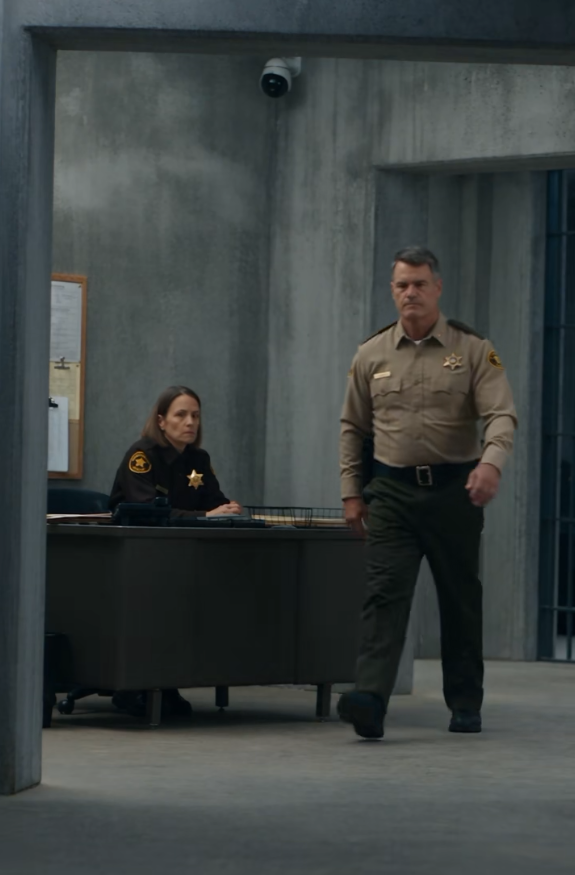
Ryker touched Miller body camera roadside after Miller appeared to mention it.
Sarah saved the note and emailed it to herself and military counsel.
Only then did she start the engine.
At the sheriff’s office, Jared Miller still had not completed his report.
The cursor blinked beside the sentence:
Driver crossed center line while traveling southbound on Route 119.
He deleted “crossed.”
Typed “drifted over.”
Deleted that too.
Sheriff Ryker appeared beside him.
“You’re still on that?”
“I want to get it right.”
“You saw her driving erratically.”
Miller looked at the screen.
“I saw her tire touch the yellow.”
“You told dispatch lane violation.”
“I said possible lane violation.”
Ryker leaned on the desk.
“Jared, you’re twenty-six years old.”
Miller did not answer.
“I’ve been doing this since before you were in middle school.”
“I know.”
“You called for me because something felt wrong.”
“I called because she was asking questions and I wasn’t sure if I had enough to extend the stop.”
Ryker’s voice cooled.
“Same thing.”
“No, sir.”
The sheriff looked at him.
Miller’s breathing became shallow.
He disliked confrontation. Ryker knew that. Everyone did.
That was one reason Miller had been easy to hire.
“You planning to make me the bad guy in your report?” Ryker asked.
“No.”
“Then tell the truth.”
“I’m trying.”
Ryker pushed himself upright.
“You write that she was combative, repeatedly challenged lawful commands, refused to cooperate with an investigation, and became physically resistant when taken into custody.”
Miller stared at him.
“She didn’t become physically resistant.”
“You had to assist.”
“I touched her elbow.”
“You assisted.”
“That’s not resisting.”
Ryker’s face changed.
He lowered his voice.
“You know what happens if Washington decides this department violated some three-star general’s rights?”
Miller said nothing.
“They don’t stop with me. They pull everything. Every stop. Every arrest. Every report. Every deputy.”
Still nothing.
“You got a family?”
“Yes.”
“A mortgage?”
“Yes.”
“Then think farther than the next sentence.”
Ryker walked away.
Miller sat motionless.
Across the room, Brenda Lawson had heard every word.
She kept her eyes on her screen.
Ten minutes later, when Ryker went outside, Brenda stood, crossed to the evidence terminal, and checked the automatic upload queue for Deputy Miller’s body camera.
File 214-0917-01.
Uploaded 4:12 p.m.
Duration: 18:43.
She stared at the record.
Then she wrote the file number on the back of a grocery receipt and slipped it into her shoe.
The next morning, Sarah woke at 5:18 in the guest room of her aunt’s house.
For a few seconds, she did not know where she was.
Then her wrists hurt when she pushed herself upright.
She sat on the edge of the bed.
The room was dim, curtains blue with early light.
On the dresser, her aunt had left a glass of water and two aspirin.
Sarah did not take the aspirin.
She walked to the window.
Her aunt’s property sat beyond Savannah in a quiet area where live oaks leaned over the road and Spanish moss moved even when the air seemed still.
Sarah had come because her aunt had recently turned seventy-nine and had finally agreed to sell the old house.
The visit was supposed to be uncomplicated.
One night.
Breakfast.
A discussion about movers.
Maybe a walk through the rooms where Sarah had spent summers as a girl.
Instead, her phone contained three messages from military counsel, one from Colonel Hart, and two from unfamiliar numbers.
She opened the message from counsel first.
Ma’am, local prosecutor has not yet received formal charging packet. Recommend no public statements. We are preserving government records. Please call when available.
Sarah dialed.
Lieutenant Colonel Emily Shaw answered.
“Good morning, ma’am.”
“Morning.”
“You sleep?”
“Enough.”
Shaw did not comment.
“We’ve confirmed the sheriff’s office entered three charges into its local system, but nothing has been filed with the county solicitor yet. That gives them room to change course.”
“Or rewrite.”
“Yes.”
Sarah looked at the marks on her wrists.
“What do we have?”
“Pentagon call logs. Your briefing schedule. Travel profile. State operations logs. The tow company timestamp. We’ve requested preservation of bodycam, dashcam, booking video, holding-cell video, radio traffic, CAD entries, property logs, and reports.”
“Requested from whom?”
“The county counsel’s office and sheriff.”
“Response?”
“County counsel acknowledged. Sheriff did not.”
Sarah looked out the window.
“Do not escalate publicly.”
“I agree.”
“And I’m not filing anything today.”
Shaw was quiet.
“You may need to move quickly if footage disappears.”
“Preservation request is already on record.”
“Yes.”
Sarah turned from the window.
“Emily, this cannot become a story about a general getting special treatment.”
“I understand.”
“No. I need you to really understand. If the first question becomes ‘Why was a general arrested?’ then Ryker gets to argue this is about status.”
“And you want the question to be what legal basis existed before anyone knew your rank.”
“Exactly.”
Shaw paused.
“There’s another issue.”
“What?”
“The roadside stop may not be isolated.”
Sarah became still.
“What do you mean?”
“I did a preliminary public-record search last night. Ryker’s office has been named in four civil complaints over six years involving unlawful detention or searches.”
“Outcomes?”
“Two dismissed, one settled, one withdrawn.”
“That proves nothing.”
“I know.”
“Any disciplinary finding?”
“Not publicly available.”
Sarah sat at the small desk near the window.
“Then don’t use it.”
“Ma’am—”
“We are not building a story backward because we dislike what happened yesterday. We establish yesterday.”
Shaw exhaled softly.
“Yes, ma’am.”
“Get me the original stop.”
After breakfast, Sarah drove with her aunt to the old house’s detached garage and spent three hours sorting labeled boxes.
She did it deliberately.
Normal work helped.
Her aunt, Evelyn, was one of the few people in Sarah’s life who did not care about rank and had never been especially impressed by the Pentagon.
At eleven, Evelyn found Sarah kneeling beside a box marked KITCHEN—1998.
“You going to tell me what happened to your wrists?”
Sarah looked down.
The red bands had darkened.
“Traffic stop.”
Evelyn waited.
Sarah opened the box.
Inside were chipped plates wrapped in newspaper.
“I was arrested.”
Evelyn’s face tightened.
“For what?”
“They’re still deciding.”
“That sounds backward.”
“It is.”
“Did you do something?”
Sarah glanced up.
Evelyn held her gaze without apology.
“No.”
“Then what are you going to do?”
Sarah lifted out a plate.
“Make sure the record stays intact.”
Her aunt nodded as if this were the only sensible answer.
Then she took the plate from Sarah.
“You always did hate broken inventories.”
Sarah almost smiled.
At 1:17 p.m., Colonel Hart called.
“Ma’am, county counsel contacted Defense legal. Sheriff Ryker is claiming you failed to comply with roadside instructions and physically pulled away during arrest.”
Sarah stopped moving.
“Exact wording?”
Hart read from his notes.
“‘Subject repeatedly refused lawful commands, became increasingly agitated, attempted to turn toward officers, and physically resisted placement into custody.’”
Sarah looked at the garage floor.
“Who signed that account?”
“Ryker.”
“Miller?”
“His report has not been submitted.”
That interested her.
“When was Ryker’s supplemental narrative entered?”