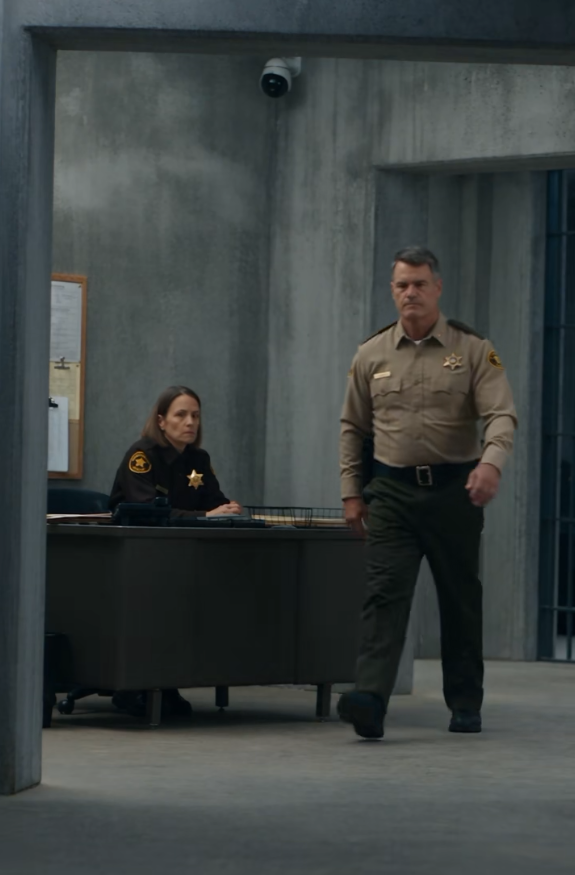
“Ten forty-two this morning.”
Sarah checked her own contemporaneous notes.
“Any mention that he knew my rank before release?”
“Yes. He states he released you after your military status was confirmed and after determining you did not pose a public-safety threat.”
Sarah’s mouth went still.
“He’s making the release discretionary.”
“That’s how I read it.”
“And the arrest?”
“Lawful based on conduct.”
Sarah looked toward the garage door, where sunlight cut a hard rectangle across the concrete.
“Then we wait for the video.”
Part IV — Pressure
By Monday morning, Oak Haven had divided into two realities.
In the first, Sheriff Thomas Ryker had made a routine roadside arrest involving an uncooperative driver and then released her once questions about the underlying traffic offense could be reviewed.
In the second, a woman had been arrested because she refused a search and asked the sheriff to explain what authority he was using.
Which reality survived would depend on the record.
Ryker understood that before anyone else in his office seemed to.
At 7:40 Monday morning, he called Brenda Lawson into his office.
She sat in the chair opposite his desk.
He closed the door.
“You talk to anybody about Friday?”
“No.”
“State police?”
“No.”
“Federal people?”
“No.”
“Media?”
“No.”
Ryker studied her.
Brenda had worked in Oak Haven longer than he had. Her husband had been a volunteer firefighter until his death seven years earlier. She knew every road, every deputy family, every local judge’s temperament, and exactly which county commissioners returned calls only when elections approached.
Ryker had once described her as “the wiring inside the walls.”
Now he distrusted her because she had heard too much.
“The call from Washington,” he said. “What exactly did you tell them before I got on?”
“That you had a Sarah Reynolds in custody.”
“You tell them charges?”
“No.”
“You tell them she asked for a lawyer?”
“No.”
“You sure?”
“Yes.”
He leaned back.
“Did she ask you for anything?”
“No.”
“Did she make some kind of statement?”
“Not to me.”
Ryker drummed two fingers on the desk.
Brenda waited.
Finally he said, “Body-camera upload had a corruption error.”
Her face remained still.
“Whose?”
“Miller’s.”
“Whole file?”
“Part.”
“What part?”
Ryker looked at her carefully.
“The roadside segment.”
Brenda knew this was false.
She had seen the file duration.
“Backup?”
“We’re checking.”
She nodded.
Ryker leaned forward.
“Anything federal comes in, it comes to me first.”
“Policy says legal requests get logged.”
“Log them. Then bring them to me.”
“All right.”
“And Brenda?”
She stood.
“Yes?”
“You’ve been here long enough to know outsiders don’t care what happens to this department after they’re done making a point.”
Brenda held his gaze.
“Neither do people inside it sometimes.”
Ryker’s expression flattened.
Brenda opened the door.
Behind her, he said, “What’s that supposed to mean?”
She looked back.
“Means I’ll log the requests.”
Then she left.
At 9:12, Sarah joined a secure video conference from Fort Stewart.
She wore uniform for the first time since the arrest.
Three stars sat on each shoulder.
The sight of them in the monitor irritated her.
Not because she was ashamed of the rank.
Because she knew how quickly visible authority changed the behavior of people who had treated her differently without it.
Lieutenant Colonel Shaw appeared on one screen from Washington.
Colonel Hart occupied another.
A civilian Department of Defense attorney named Marcus Bell joined from the Office of General Counsel.
Bell was careful and precise, with the permanent tiredness of someone who spent his life explaining why possible and wise were not synonyms.
“We received partial records,” he said.
“What’s missing?” Sarah asked.
“Miller bodycam, sheriff vehicle camera, holding-cell interior video, and full CAD audio.”
“Reason?”
“Bodycam is listed as corrupted. Sheriff vehicle apparently has no camera. Holding-cell system was undergoing storage maintenance. CAD audio is pending.”
Sarah’s face did not change.
Hart said, “That’s convenient.”
Sarah looked at him.
He immediately corrected himself.
“Sorry, ma’am.”
Bell continued.
“We do have booking footage.”
“Does it have audio?”
“Yes.”
“Play the relevant section.”
The screen changed.
Sarah watched herself from three days earlier.
Jeans.
White blouse.
Hair slightly disordered from heat.
Wrists behind her.
Ryker stood at the counter.
The audio was tinny but clear.
Sarah heard herself say:
“I want to call an attorney.”
Then Ryker:
“You can cool off first.”
Sarah watched without expression.
Next came her request:
“Please document that I requested counsel at approximately 3:56 p.m.”
Then Ryker:
“Put her in four.”
Bell paused the footage.
“No ambiguity there.”
Sarah nodded.
“Continue.”
The video showed Ryker dictate the charges.
Disorderly.
Resisting.
Then reckless driving.
Sarah’s recorded voice responded:
“That was never stated at the stop.”
Bell stopped again.
Shaw said, “That directly conflicts with his weekend narrative claiming reckless driving was the initiating concern.”
“Not necessarily,” Sarah said.
They looked at her.
“He could argue the traffic conduct justified the stop even if the formal charge came later.”
Hart frowned.
“You’re defending him?”
“No. I’m refusing to overstate what evidence proves.”
Bell nodded once.
“That’s the right approach.”
They continued.
At the moment the property bag was sealed, the camera showed the black government case.
Ryker lifted it.
Audio captured him asking:
“What’s in this?”
Sarah:
“Government property.”
Bell paused.
“That matters.”
“How?” Hart asked.
“He knew she was a government employee before the Pentagon called.”
Sarah shook her head.
“Government property does not identify rank.”
“No,” Bell said. “But if his later claim becomes that the Pentagon call was the first indication this wasn’t an ordinary traveler, this complicates that.”
Sarah looked at the frozen image of herself.
“Do we have Deputy Miller’s report?”
“Still not final.”
“Three days?”
“No.”
Sarah leaned back.
“That concerns me more than Ryker’s.”
Shaw understood.
“Because Ryker committed early.”
“And Miller hasn’t.”
Bell said, “There’s another development. County counsel says the sheriff intends to present charges to the solicitor.”
Hart said, “He’s actually moving forward?”
Sarah remained quiet.
Bell looked at her.
“If charges are filed, military representation issues become more complicated because the alleged conduct occurred in personal status.”
“I’ll retain civilian counsel if necessary.”
“Ma’am, you also need to consider command optics.”
Sarah looked at him.
“Meaning?”
“A public criminal case involving a serving three-star officer becomes institutionally significant whether you want it to or not.”
“I know.”
“If the county offers immediate dismissal conditioned on no civil claim—”
“No.”
Bell stopped.
Sarah’s voice had not risen.
She folded her hands on the table.
“I won’t waive a claim in exchange for charges disappearing.”
“You have not decided to bring a claim.”
“No.”
“Then why rule it out?”
“Because tying dismissal to silence would make the dismissal about me.”
Bell studied her for a moment.
Then nodded.
“All right.”
At noon, Deputy Jared Miller finally submitted his report.
It was six hundred and twelve words.
Sheriff Ryker read it twice.
Then called him into the office.
Miller stood instead of sitting.
Ryker held the printed report.
“This is what you’re going with?”
“Yes.”
“You wrote that Ms. Reynolds ‘questioned the legal basis for extending the stop.’”