Part I — The Stop
By the time Sheriff Thomas Ryker realized the woman in cell four outranked almost everyone he had ever met, she had already memorized the location of every camera in his building.
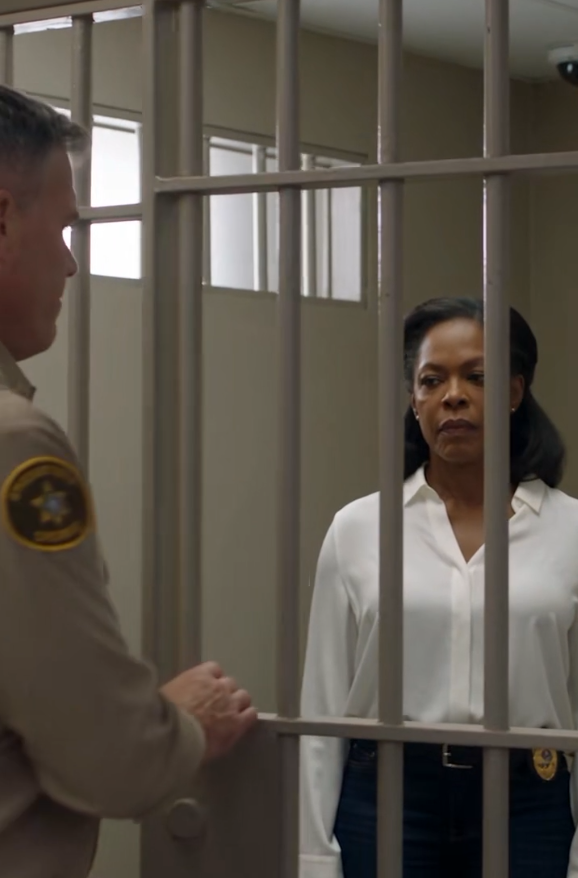
Sarah Reynolds sat on the narrow concrete bench with her hands folded loosely between her knees.
The fluorescent light above her buzzed in short, uneven intervals.
Camera over the corridor door.
Camera above booking.
One near the property counter.
Another angled toward the entrance to the holding area.
She had noticed all four before Deputy Jared Miller finished removing her handcuffs.
The fifth was inside the lobby, reflected faintly in a glass-fronted bulletin board.
Sarah had spent enough years inside secure facilities to notice cameras without appearing to look for them. She noticed exits, badges, clocks, access panels, radio traffic, names written on clipboards. She noticed who answered whose questions and who avoided them.
Most people called that vigilance.
In her profession, it was simply staying awake.
She checked the wall clock.
3:56 p.m.
Twenty-five minutes earlier, she had been driving south on Route 119 with the air-conditioning turned low, a paper cup of stale coffee in the center console, and seventy-two hours of Pentagon work settling into her bones.
She had expected the most difficult part of her Friday to be staying alert long enough to reach her aunt’s house outside Savannah.
Instead, she was sitting in a county holding cell.
And somewhere several hundred miles away, a secure briefing was about to begin without her.
Sarah leaned back against the painted block wall.
There was no reason to panic.
Panic obscured details.
She preferred details.
At 3:31 p.m., Deputy Jared Miller had activated his emergency lights behind her rented sedan.
She had been driving under the limit.
Her hands had been at ten and two.
No weaving.
No phone in her hand.
No alcohol in the car.
Miller had approached from the driver’s side, one hand resting near his belt.
“License and rental agreement.”
Sarah had passed them through the open window.
“Reason for the stop, Deputy?”
“You crossed the center line back there.”
“I don’t believe I did.”
Miller’s face tightened slightly.
Not anger.
Not yet.
Something closer to irritation at being questioned.
“You calling me a liar?”
“No. I’m asking where you observed it.”
That had been the first turn.
Sarah had recognized it immediately.
The conversation was no longer about a lane marking.
Miller stepped back.
“Stay in the vehicle.”
“I intend to.”
He walked toward his cruiser.
Sarah looked at the side mirror.
Badge number visible.
Unit number on rear quarter panel.
Timestamp on rental dashboard: 3:33.
She repeated them silently once.
When Miller returned seven minutes later, Sheriff Ryker was with him.
Ryker approached as if he had been summoned to settle an argument rather than conduct a traffic stop.
He was broad through the shoulders, early fifties, short graying hair, tan uniform pressed sharply enough to suggest he cared about how authority looked.
He glanced at Sarah’s license, then at her.
“Step out of the vehicle.”
“For what purpose?”
Ryker smiled.
It was a small smile.
Not friendly.
“Because I told you to.”
Sarah had opened the door and stepped onto the shoulder.
Cars passed behind them, tires making brief bursts of sound over sun-warmed asphalt.
Ryker pointed toward the back of the sedan.
“Stand there.”
She did.
Miller moved toward the driver’s door.
Sarah said, “I do not consent to a search.”
Miller stopped.
Ryker turned.
“You got something in there we should know about?”
“No.”
“Then you shouldn’t have a problem with us taking a look.”
“I’m telling you clearly that I do not consent.”
Ryker studied her.
Sarah had seen that expression before in different forms, in different institutions.
Someone trying to decide whether calmness was confidence or defiance.
Ryker made his choice.
“You seem to have a lot of attitude for somebody standing on the side of the road.”
Sarah looked at him evenly.
“I’m speaking respectfully.”
“See? That right there.”
“What?”
“That tone.”
Sarah had almost smiled, but she knew better.
“Sheriff, I am cooperating with your instructions. I am also stating that I do not consent to a search.”
Ryker stepped closer.
“You need to understand something. Out here, when an officer gives you an instruction, you follow it.”
“I have followed your instructions.”
“Turn around.”
There it was.
Sarah looked past him at Miller.
The deputy looked uncertain for the first time.
“Am I under arrest?”
Ryker said, “You are now.”
“For what?”
“Disorderly conduct.”
Sarah remained still.
“Turn around.”
She did.
The handcuffs closed over her wrists.
She did not resist.
She did not pull away.
She did not raise her voice.
She listened instead.
Miller muttered something near the cruiser.
Ryker said, “Put resisting on it if she keeps this up.”
Sarah turned her head slightly.
“I am not resisting.”
“Face forward.”
She faced forward.
One of the passing cars slowed.
Ryker noticed and shifted his body, placing himself between Sarah and the roadway.
Interesting.
She memorized that too.
At the sheriff’s office, the charges multiplied.
Disorderly conduct.
Resisting.
Then, during booking, reckless driving appeared on a form despite never being mentioned during the stop.
Sarah watched Brenda Lawson, the dispatcher at the front desk, pause while typing.
Her hands hovered above the keyboard.
“Reckless?” she asked.
Ryker stood behind her.
“That’s what I said.”
Brenda looked at Miller.
Miller looked away.
Sarah saw it.
So did Brenda.
Neither said anything.
During property intake, they took Sarah’s wallet, keys, rented-car documents, personal phone, and secure government device.
The government phone drew Ryker’s attention.
Black.
Plain.
No visible agency insignia.
He turned it over.
“What’s this?”
“A work device.”
“What kind of work?”
Sarah met his eyes.
“I would like to contact an attorney.”
Ryker placed the device in the property box.
“You can make calls after booking.”
“You have completed booking.”
“When I say you’re done.”
“I am requesting counsel.”
Ryker shut the lid.
“We heard you.”
Sarah said nothing else.
That decision mattered.
Later, everyone would have an opinion about why Major General Sarah Reynolds had not identified herself.
Some would call it restraint.
Some would call it pride.
Some would say she should have ended the entire situation the moment the handcuffs came out by telling Ryker exactly who he was arresting.
Sarah understood the temptation.
But rank was not immunity.
It was not a magic word.
It did not transform unlawful conduct into lawful conduct.
If she told him and he suddenly decided to behave properly, what would that prove?
That he respected a general?
Sarah had no interest in learning whether Thomas Ryker respected generals.
She wanted to know whether he respected strangers.
So she let him lock the door.
Now, at 3:58, Sarah looked again at the clock.
The Pentagon briefing would begin in two minutes.
Her executive officer knew her travel schedule.
He knew she had planned to dial in from the road before continuing to her aunt’s house.
He knew she was obsessive about secure meetings.
She had missed exactly two in the previous seven years.
One because the building housing the communications suite had been evacuated.