The other because she was in surgery.
Someone would notice.
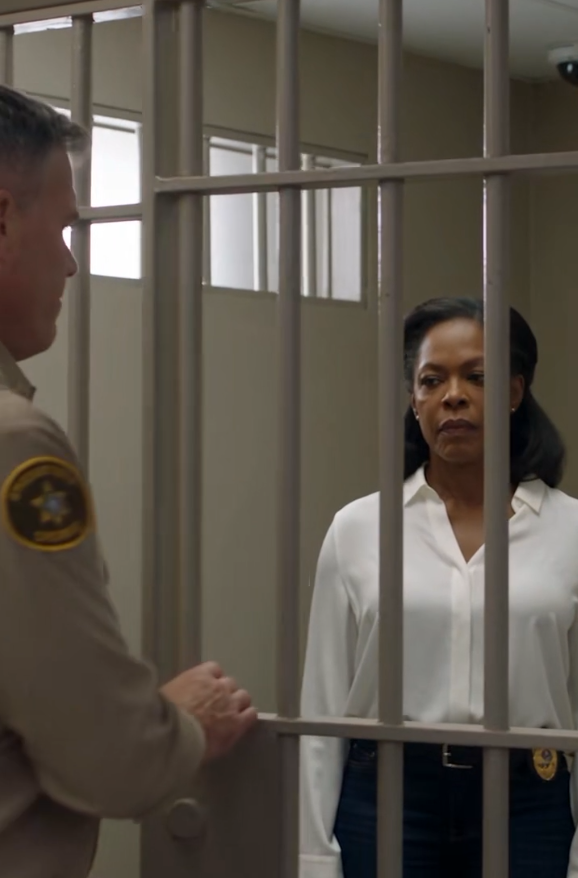
Outside the cell, footsteps crossed the corridor.
Ryker’s voice came from the front office.
Then Brenda’s.
Then the phone rang.
Once.
Twice.
Brenda answered.
“Oak Haven Sheriff’s Office.”
Sarah looked toward the narrow rectangular window in the cell door.
She could not see the desk from where she sat.
She could hear.
“Yes, sir.”
A pause.
“No, sir, I’ll check.”
Another pause.
Sarah tilted her head slightly.
Brenda’s footsteps stopped.
“Sheriff.”
Ryker sounded distracted.
“What?”
“There’s a colonel from the Pentagon asking to speak with Major General Sarah Reynolds.”
Silence.
Not the dramatic kind.
Just two seconds in which nobody knew what to say next.
Then a chair scraped.
Ryker said, “Who?”
“Major General Sarah Reynolds.”
Sarah lowered her gaze to her hands.
The corners of her mouth did not move.
Ryker’s footsteps came toward the corridor.
He stopped outside cell four.
Through the reinforced window, their eyes met.
For the first time since Route 119, the sheriff looked at her without the assumption that he already understood what he was seeing.
Then Brenda called after him.
“Sheriff. He’s asking what lawful grounds we have for holding her.”
Sarah watched the color shift in Ryker’s face.
Behind him, Miller appeared in the corridor.
“What’s going on?”
Ryker did not answer.
Brenda raised her voice from the desk.
“He says the general was scheduled for a secure Defense Department briefing four minutes ago.”
Miller looked through the window.
Then at Ryker.
Then back at Sarah.
The deputy whispered, “General?”
Sarah stood.
Slowly.
Not because she needed to make a point.
Because she had been sitting too long.
Ryker opened the slot in the door.
“You’re military?”
Sarah looked at him.
“Yes.”
“What branch?”
“That is not relevant to my detention.”
His mouth tightened.
“You could’ve said something.”
“I did.”
“You never told me you were a general.”
“You never asked whether I was a general.”
Ryker glanced back toward the desk.
“This is getting ridiculous.”
Sarah’s voice stayed level.
“No, Sheriff. It was already serious.”
The phone was still waiting.
And somewhere in Washington, someone was listening.
Part II — Pressure
Ryker did not release her.
That surprised Miller.
It surprised Brenda.
It did not surprise Sarah.
People rarely abandoned a bad decision the moment it became expensive. More often, they defended it harder.
Ryker returned to the desk and picked up the receiver.
“This is Sheriff Thomas Ryker.”
Sarah could hear only his side.
“Yes.”
“No, she is not being denied—”
He stopped.
Looked toward Brenda.
“Who told you that?”
Another pause.
“She was arrested during a lawful traffic stop.”
Pause.
“Disorderly conduct, resisting, reckless driving.”
Brenda’s eyes moved slowly toward the booking screen.
Ryker listened.
His jaw shifted.
“No, Colonel, I don’t need you explaining Georgia law to me.”
Miller stared at the floor.
Ryker’s voice became more careful.
“She’ll be processed like anyone else.”
Pause.
“No.”
Longer pause.
Then: “You do what you need to do.”
He hung up.
The receiver struck the cradle harder than necessary.
Brenda said quietly, “What did he say?”
Ryker ignored her.
He turned to Miller.
“Come into my office.”
The office door closed.
Sarah could see part of it through the corridor glass.
Not enough to hear everything.
Enough to hear tone.
Ryker low and fast.
Miller defensive.
Once, clearly:
“She didn’t resist.”
Then nothing for several seconds.
Sarah looked at the nearest corridor camera.
Small red indicator.
Recording.
Unless someone disabled it.
That possibility entered her mental ledger.
She sat again.
Across from her cell was an empty holding room.
The place smelled faintly of disinfectant, old coffee, and sun-heated concrete.
Her shoulders ached.
She had spent three days moving between conference rooms, secure operations floors, and late-night logistics calls coordinating a Defense Department movement problem that had consumed nearly everyone on her staff.
Her trip south had been personal.
Her aunt had called Wednesday.
“Are you actually coming this time?”
Sarah had smiled into the phone while reading an overnight briefing packet.
“I said I would.”
“You also said that at Christmas.”
“That was different.”
“Sarah, everything is different when you’re trying to get out of visiting.”
Her aunt was one of four people in the world who spoke to her as if military rank were an amusing administrative detail.
Sarah had promised.
Friday evening.
Dinner.
No aides.
No uniform.
No official schedule once she arrived.
Her aunt had said, “Wear something that doesn’t have stars on it.”
Sarah had looked down at her service uniform.
“I own normal clothes.”
“I’ve seen your closet.”
“You’ve seen half my closet.”
“That was enough.”
Now those normal clothes were wrinkled from a holding cell.
Sarah wondered whether her aunt had started dinner.
She checked the clock.
4:09.
The office door opened.
Miller came out first.
He looked pale.
Ryker followed.
“Bring her out.”
Miller hesitated.
“Sheriff—”
“Now.”
He opened the cell.
Sarah stepped into the corridor.
Miller held the handcuffs.
Sarah looked at them, then at him.
“Is that necessary?”
Miller’s face tightened.
“No.”
Ryker said, “She’s still in custody.”
Miller looked at him.
For a second, neither man moved.
Then Miller lowered the handcuffs.
Ryker’s eyes sharpened.
But he let it go.
“Interview room.”
Sarah walked ahead of them into a small room with a metal table, three chairs, and another camera mounted high in the corner.
She noticed the red indicator.
Good.
Ryker sat opposite her.
Miller remained near the door.
Ryker folded his hands.
“So.”
Sarah waited.
“You are Major General Sarah Reynolds.”
“Yes.”
“You work at the Pentagon.”
“Yes.”
“What exactly do you do?”
Sarah said, “That question has no bearing on my arrest.”
His expression hardened.
“You’ve got people calling my office from Washington.”
“I did not ask them to.”
“Well, somebody seems very interested in where you are.”
“I missed a scheduled briefing.”
Ryker leaned back.
“And instead of telling me who you were, you let this turn into a federal production.”
Sarah looked at him for a moment.
“That is an unusual way to describe your decision to arrest me.”
Miller shifted at the door.
Ryker noticed.
“Deputy, wait outside.”
Miller didn’t move.
Ryker looked at him.
“Outside.”
Miller left.
The door shut.
Ryker lowered his voice.
“You think you’re proving something?”
“I’m trying to understand what I’m charged with.”
“You know the charges.”
“I know what you typed into your system.”
“They’re valid.”
“I would like to understand the conduct supporting them.”
“You crossed the center line.”
“That explains a traffic stop, not disorderly conduct.”
“You became argumentative.”
“I disagreed with a search.”
“You refused lawful instructions.”
“I complied with every physical instruction you gave me.”
“You resisted arrest.”
“I did not.”
Ryker stared at her.
Sarah stared back.
No anger.
No satisfaction.
Just attention.
He had misread that attention once.
Now it made him uneasy.
“Do you always talk like this?”
“Yes.”
That almost made him laugh.
It didn’t.
Ryker said, “You know, most people would’ve handled this differently.”
“Most people should not need Pentagon employment to be treated differently.”