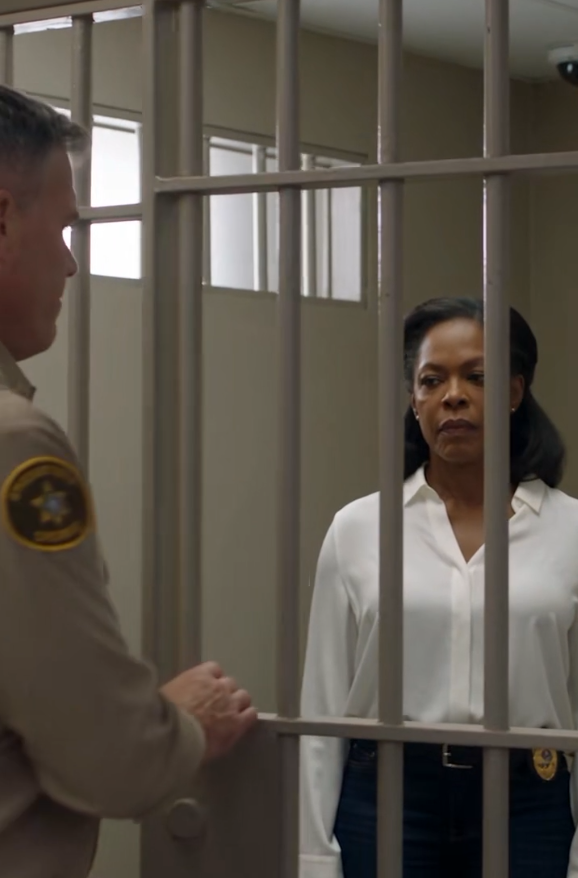
“You documented what you saw?”
Brenda glanced at him.
“Yes.”
“Then keep doing that.”
Outside, late-afternoon heat pressed against the parking lot.
Sarah stood for a moment beneath the flat blue Georgia sky and breathed air that did not smell like disinfectant.
Her civilian phone showed fourteen missed calls.
Seven from Colonel Whitfield.
Three from her aunt.
Two unidentified Washington numbers.
One from a Pentagon duty desk.
One from her deputy director.
She called Whitfield first.
The colonel answered before the first ring completed.
“Ma’am.”
“I’m out.”
A pause.
Not relief exactly.
Discipline reasserting itself.
“Yes, ma’am.”
“Status?”
“The briefing was delayed forty minutes, then conducted without your segment. Deputy director covered the immediate logistics piece.”
“Any mission impact?”
“No.”
“Good.”
Whitfield exhaled.
Then her voice changed.
“Ma’am, what happened?”
Sarah looked back at the sheriff’s office.
Ryker was visible through the glass.
So was Miller.
The GBI investigator had stepped aside to speak with the trooper.
Sarah said, “Traffic stop escalated.”
“That’s what they told me.”
“Evidence?”
“Preservation requests are out. Pentagon counsel is involved.”
“I did not ask for Pentagon counsel.”
“No, ma’am.”
“Dana.”
“Ma’am?”
“Do not turn this into a rank issue.”
Whitfield was quiet.
Sarah continued, “I was traveling personally. I was in civilian clothes. I was not performing official duties. I want the same process any civilian should get.”
“That may be difficult now that the office knows who you are.”
“I know.”
“Do you want us to back off?”
Sarah considered the question.
Across the parking lot, Miller came outside.
He stopped when he saw her on the phone.
Didn’t approach.
Just waited.
“No,” Sarah said. “I want preservation. Nothing else yet.”
“Yes, ma’am.”
“And Dana?”
“Yes?”
“Thank you.”
Another pause.
“You’re welcome, ma’am.”
Sarah ended the call.
Then called her aunt.
“You better have a very good reason.”
Sarah closed her eyes briefly.
“I do.”
“You sound tired.”
“I am.”
“Where are you?”
Sarah looked at the sheriff’s office again.
“Not far.”
Her aunt was quiet.
Then: “Sarah.”
“Yes.”
“What happened?”
“I got delayed.”
“That is not an answer.”
“No.”
“Are you hurt?”
“No.”
“Are you in trouble?”
Sarah looked at Miller.
He had finally started walking toward her.
“No,” she said. “But somebody may be.”
Her aunt sighed.
“You still coming?”
Sarah almost laughed.
“Yes.”
“Dinner’s getting cold.”
“I’m sorry.”
“I didn’t ask if you were sorry. I asked if you were coming.”
Sarah looked at the road.
“Yes.”
“Then come.”
The call ended.
Miller stopped six feet away.
Without the sheriff beside him, he looked younger.
Early thirties, perhaps.
Tired too.
“General.”
“Deputy.”
He glanced toward the building.
“I need to tell you something.”
Sarah waited.
“The original stop.”
“Yes?”
“I didn’t see you cross the center line.”
The words settled quietly.
Not dramatic.
Much worse than dramatic.
Sarah studied him.
“What did you see?”
Miller looked at the pavement.
“I thought you touched it.”
“You thought?”
“It was bright. Heat shimmer. I was behind you. I radioed in that I had a possible lane violation.”
Sarah said nothing.
Miller looked up.
“Sheriff heard it. He was nearby. He came over.”
“Why did you tell me I crossed the line?”
He swallowed.
“Because once I stopped you, I didn’t want to say I wasn’t sure.”
Sarah felt something colder than anger move through her.
Not because of the traffic stop.
Because she understood the chain.
Uncertainty became certainty because a young deputy did not want to look foolish.
Certainty became authority because a sheriff arrived.
Authority became confrontation because she asked questions.
Confrontation became arrest because someone needed to win.
Then paperwork was written backward to justify the outcome.
A dozen small decisions.
No single cinematic villainy.
Just people protecting themselves one step at a time.
Sarah asked, “Is that on your dash recording?”
“The first radio call is.”
“And your body camera?”
Miller’s face changed.
Sarah understood before he answered.
“It wasn’t on.”
“Why?”
“I forgot to activate it when I got out.”
“Department policy?”
“Requires it.”
“Ryker?”
“His was on.”
Sarah nodded slowly.
That mattered.
Miller said, “I’m going to tell the investigator.”
“Good.”
“I may lose my job.”
Sarah looked at him.
“That is possible.”
He seemed surprised by her lack of reassurance.
She continued, “But losing a job for telling the truth is not the same as losing it for hiding the truth.”
Miller nodded once.
Sarah started toward her rental car.
“General?”
She turned.
He said, “Why didn’t you tell us?”
“Tell you what?”
“Who you were.”
Sarah considered him.
“Would it have changed what happened?”
Miller opened his mouth.
Stopped.
That was answer enough.
Sarah got into the car.
The seat still held the afternoon heat.
For a minute, she did not start the engine.
She rested both hands on the steering wheel.
The secure device vibrated inside her bag.
Another message.
Another call.
Another system responding now that her name had activated it.
Sarah looked at herself in the rearview mirror.
White blouse.
Pulled-back hair.
No stars.
No uniform.
Just the woman who had been ordered out of a car.
That was the version of herself she intended to keep at the center of what came next.
Part IV — Reckoning
Sarah arrived at her aunt’s house after sunset.
There was no dramatic reunion.
Her aunt opened the door, took one look at her, and said, “You look terrible.”
Sarah stepped inside.
“Good to see you too.”
“Shoes off.”
Sarah obeyed.
The house smelled like roasted chicken, onions, and the lemon cleaner her aunt had used for as long as Sarah could remember.
On the dining table sat two plates covered with foil.
Her aunt watched her wash her hands.
“You want to tell me now?”
Sarah dried them.
“I was arrested.”
Her aunt stared.
“For what?”
“Disorderly conduct. Resisting. Reckless driving.”
“You?”
“Yes.”
Her aunt folded her arms.
“You resisted?”
“No.”
“Were you disorderly?”
“No.”
“Were you reckless?”
“No.”
Her aunt pulled out a chair.
“Sit.”
Sarah sat.
The foil came off the plates.
They ate before discussing anything else.
That, Sarah realized, was why she had come.
At the Pentagon, every crisis created meetings.
At her aunt’s house, crisis created dinner.
Halfway through the meal, her aunt said, “You didn’t tell them you were a general.”
It wasn’t a question.
Sarah shook her head.
Her aunt kept eating.
“Good.”
Sarah looked up.
“You agree?”
“I didn’t say that.”
“You just said good.”
“I said good because now you know something you wouldn’t know otherwise.”
Sarah set down her fork.
“Which is?”
Her aunt looked at her.
“How they treat a woman when they think nobody important is watching.”
Sarah sat very still.
Her aunt reached for her tea.
“Now the hard part is figuring out what you do with knowing it.”
That night, Sarah slept six hours.
It was the longest uninterrupted sleep she had managed all week.
At 6:12 Saturday morning, she woke to thirty-one emails, twelve missed calls, and a message from Colonel Whitfield marked urgent.
CALL BEFORE MEDIA RESPONSE.
Sarah stared at the screen.