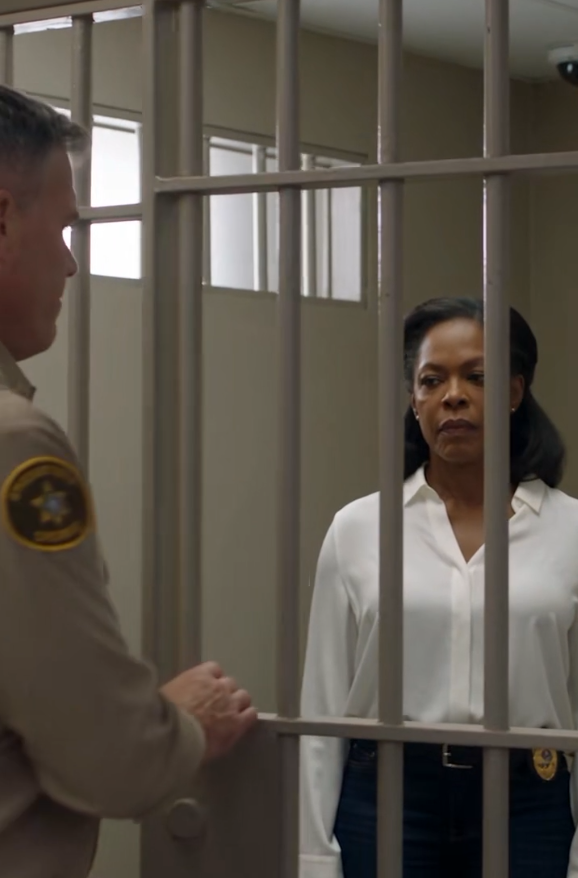
“Enough that we need to be careful.”
“Meaning?”
“Some are minor. Some are unsubstantiated. Two involve arrests after motorists challenged searches.”
Sarah’s expression did not change.
Price continued, “One was dismissed. One pleaded to a lesser offense.”
“Race?”
“Different people. Different facts.”
Sarah nodded.
Good.
She did not want a simple story if the facts were not simple.
Price leaned forward.
“There’s also a personnel issue.”
“With Miller?”
“No. Brenda.”
Sarah frowned.
“What about her?”
“She contacted the state investigator after your release.”
“What did she report?”
“That Ryker asked her to modify the booking note after the preservation request came in.”
Sarah sat back.
“And the system log?”
“Shows no change.”
“So she refused.”
“Yes.”
Sarah looked toward the window.
There it was again.
A quiet choice.
No speech.
No confrontation.
Just hands that did not touch a keyboard.
That evening Sarah called Colonel Whitfield.
“I need something.”
“Yes, ma’am.”
“I want the Department to stop commenting beyond the existing statement.”
“Already recommended.”
“And no one contacts the sheriff’s office except through counsel.”
“Understood.”
Whitfield hesitated.
“Ma’am, may I ask something?”
“You usually do.”
“Why are you protecting them?”
Sarah looked up.
“I’m not.”
“It looks like restraint.”
“It is restraint.”
“Why?”
“Because if the facts are strong, they don’t need me making them louder.”
Whitfield was quiet.
Sarah added, “And if the facts are weak, I have no right to make them stronger by rank.”
That ended the discussion.
But it did not end the pressure.
By Wednesday, national reporters were outside the sheriff’s office.
Ryker gave a brief statement.
He said his deputies “treat every citizen equally.”
He said Sarah had “failed to immediately disclose information that would have clarified the situation.”
He said the office would “not be intimidated by outside political pressure.”
Sarah watched the clip once.
Then turned it off.
Her aunt, sitting across the room, said, “He blamed you for not telling him you were important.”
“Yes.”
“You going to answer?”
“No.”
Her aunt looked at her.
“That’s probably wise.”
Sarah raised an eyebrow.
“Probably?”
“You’ve been irritatingly reasonable all week. I don’t want it going to your head.”
Sarah laughed.
It was the first time since Friday.
Then her attorney called.
The reckless-driving charge had been formally withdrawn.
The resisting charge was under review.
Disorderly conduct remained.
Price said, “They may offer dismissal in exchange for no civil claim.”
Sarah’s expression cooled.
“No.”
“I expected that.”
“Not because I want money.”
“I know.”
“Because dismissal should not be something I purchase by giving up a claim.”
“I know.”
Sarah stood.
“Then tell them no.”
Price did.
The next day, Miller resigned.
Not fired.
Resigned.
His letter was two paragraphs long.
He accepted responsibility for initiating a stop he could not fully support and for failing to activate his body camera.
He also wrote that he could not endorse statements in the arrest report describing resistance he had not witnessed.
Sarah read the letter privately.
Then called him.
He answered cautiously.
“General?”
“It’s Sarah Reynolds.”
“Yes, ma’am.”
“I read your resignation.”
Silence.
“I wanted to say one thing.”
“Yes?”
“You told the truth eventually.”
He exhaled.
“Yes.”
“Next time, do it sooner.”
A pause.
“Yes, ma’am.”
Sarah ended the call.
She did not tell him she forgave him.
Forgiveness was not something she could give on behalf of everyone who might have been stopped before her or after her.
But she respected what he had finally chosen.
Sometimes accountability did not arrive cleanly.
Sometimes it arrived late, carrying its own cost.
Part V — Final Confrontation
The public hearing took place nineteen days after the traffic stop.
It was not a trial.
Not yet.
The county commission had called an emergency session to address the sheriff’s department’s policies, the disputed arrest, and growing questions about records, body cameras, and supervisory practices.
Sarah had no obligation to attend.
She attended anyway.
Not in uniform.
That choice was deliberate.
Dark navy suit.
White blouse.
No ribbons.
No stars.
No visible military insignia.
Price sat beside her in the second row.
The meeting room was full before they arrived.
Reporters.
County residents.
Deputies.
Local officials.
Sarah recognized Brenda near the aisle.
The dispatcher gave her a small nod.
Sarah returned it.
Ryker entered through a side door.
He wore his full uniform.
Badge polished.
Campaign-style calm.
He did not look at Sarah.
The commission chair opened the meeting.
There were procedural statements.
Legal cautions.
A review of what could and could not be discussed because investigations remained active.
Then Ryker was invited to speak.
He stood at the podium.
“My office has served this county for twenty-three years under my leadership.”
His voice was steady.
“We make thousands of contacts with the public every year. Most are professional and uneventful. The incident involving Ms. Reynolds—”
Not General Reynolds.
Sarah noticed.
“—has been distorted by national attention and incomplete reporting.”
He described the traffic stop as based on an observed lane violation.
He said officers faced “an argumentative motorist.”
He said the arrest had been based on behavior at the scene, not identity.
Then he said something that made Price glance sideways at Sarah.
“I regret that Ms. Reynolds felt she was treated unfairly. But no citizen, regardless of title, should expect special treatment.”
Sarah looked at him.
Not angry.
Almost curious.
He still believed that was the argument.
After Ryker finished, several commissioners asked questions.
Why had reckless driving been added later?
Why had counsel been delayed?
Why had Miller resigned?
Why had the body-camera reports differed from video?
Ryker answered each carefully.
Administrative confusion.
Incomplete reporting.
Stressful circumstances.
Personnel disagreement.
No evidence, he said, of intentional wrongdoing.
Then Brenda testified.
She did not make a speech.
That was what gave her testimony weight.
She described the booking.
Sarah’s request for counsel.
The Pentagon call.
Ryker asking about the reckless charge.
The preservation request.
Then the request to “clarify” the note.
“Did you believe he was asking you to change the record?” a commissioner asked.
Brenda looked down at her hands.
“Yes.”
“Why didn’t you?”
“Because it had already happened.”
The commissioner waited.
Brenda looked up.
“You can’t clarify something backward.”
Sarah watched Ryker.
His face remained composed.
Only the muscle near his temple moved.
Miller testified next.
He wore a plain blue shirt.
No badge.
No uniform.
He admitted the initial traffic stop had been based on uncertainty.
He admitted telling Sarah she crossed the line as if he were certain.
He admitted failing to turn on his body camera.
Then came the harder part.
“Why didn’t you correct the sheriff during the stop?”
Miller looked toward Ryker.
“Because he was the sheriff.”
The commissioner said, “That’s not an answer.”
“It is.”
Miller swallowed.
“I thought if I contradicted him in front of the driver, I’d look incompetent.”
“And later?”
“I was afraid of losing my job.”
“Did you believe Ms. Reynolds resisted arrest?”
“No.”
“Was she disorderly?”
Miller paused.
“She disagreed with us.”
The commissioner repeated, “Was she disorderly?”
“No.”
Ryker stared straight ahead.
Then Sarah was called.
She had prepared remarks.