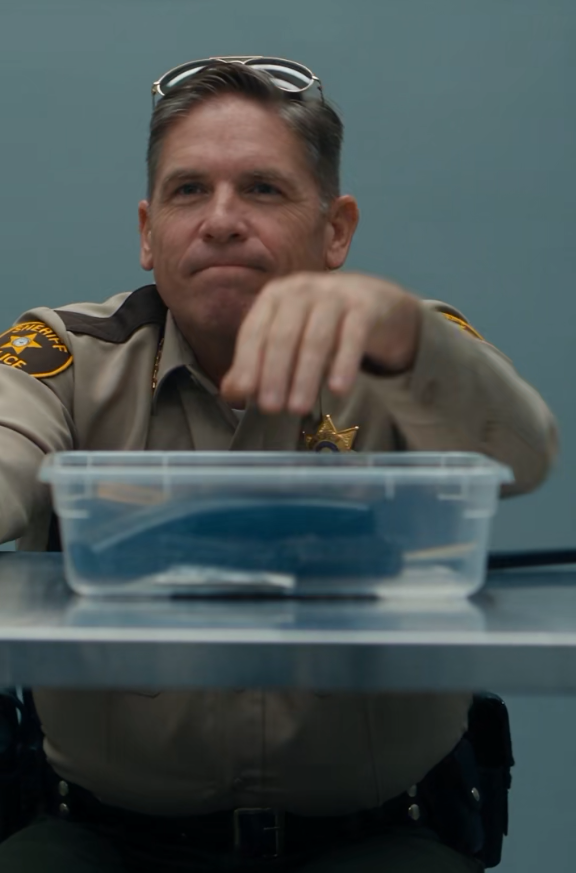
Toby said nothing.
Boyd turned to Sarah.
“Brigadier General, huh?”
“Yes.”
“Where’s the uniform?”
“I was traveling.”
“Where’s the military ID?”
“In my wallet.”
Boyd’s head snapped toward the evidence tray.
He opened the wallet.
He had looked through it earlier.
He had seen credit cards, driver’s license, airport credentials.
Now he inspected every sleeve.
Behind the driver’s license was a federal identification card he had not bothered to examine.
He pulled it out.
His smile weakened.
Toby stepped closer.
The card carried Sarah’s photograph.
United States Department of Defense.
Military identification.
Name: HAYES, SARAH E.
Rank: BG.
Boyd stared at the letters.
“Could be fake.”
Toby looked at him.
“Sheriff—”
“I said it could be fake.”
Sarah folded her hands.
“You are free to verify it.”
“I don’t take orders from you.”
“That was not an order.”
The red telephone rang.
The sound cut through the building.
Once.
Twice.
Toby turned toward the back wall.
Oak Haven’s emergency line was an old red instrument mounted beside the dispatch station. It had been installed decades earlier for state-level emergency coordination and almost never used.
Toby had been with the department nine years.
He had never heard it ring.
A dispatcher emerged from the next room.
“What the hell?”
Three rings.
Four.
Boyd walked over and picked it up.
“Sheriff Cleary.”
Sarah watched his face.
At first, irritation.
Then confusion.
Then something quieter.
“Yes.”
Pause.
“Yes, this is Sheriff Boyd Cleary.”
His shoulders changed.
“No, sir.”
Another pause.
“I understand what you’re saying, but—”
His gaze flicked toward Sarah.
“Yes, sir, she’s here.”
Longer silence.
“No. No injuries that I’m aware of.”
His mouth opened.
Closed.
“Yes.”
He listened.
“No, sir, the device has not—”
Sarah watched Toby glance toward the evidence tray.
Boyd looked at the device too.
“I handled it.”
Pause.
“No, sir, I did not attempt to—”
His face tightened.
“That’s not what happened.”
The voice on the line continued.
Boyd straightened.
“This is my jurisdiction.”
Toby shut his eyes briefly.
Boyd listened again.
Then, quieter:
“Yes, sir.”
He placed the receiver back on its cradle.
No one moved.
Toby asked, “Who was it?”
Boyd looked at Sarah.
“The Pentagon.”
The building seemed smaller.
Sarah spoke first.
“Sheriff, I recommend that you release me from custody and preserve every record associated with this detention.”
Boyd’s fear appeared only for an instant.
Then pride covered it.
“No.”
Toby turned.
“What?”
Boyd pointed toward Sarah.
“No. If I let her walk because somebody calls claiming to be the Pentagon, I look like an idiot.”
Sarah’s expression did not change.
Toby said carefully, “Sheriff, her ID—”
“She was arrested under state law.”
“For what?”
Boyd looked at him.
Toby immediately regretted the question.
But he did not withdraw it.
Boyd stepped closer.
“You got a problem with my arrest?”
“I’m asking what keeps her here.”
“Resisting.”
“She was already arrested when—”
“Toby.”
That one word carried nine years of hierarchy.
Toby fell silent.
Sarah watched the exchange.
There it was again.
The second test of power.
Boyd no longer needed Sarah to submit.
Now he needed Toby to.
A low vibration entered the building.
The dispatcher's head came up.
“What’s that?”
The windows trembled.
A plastic cup moved across a desk by half an inch.
The vibration deepened into a mechanical thunder.
Toby went to the front window.
“Oh, God.”
Boyd pushed past him.
Beyond the parking lot, dust swirled across the county lawn.
Two black helicopters descended from the sky.
Their rotors flattened the grass and filled the air with grit.
Sarah remained at the booking counter.
She did not smile.
She did not look triumphant.
That frightened Toby more than anything else.
The aircraft settled fifty yards from the building.
Side doors opened.
Uniformed military personnel emerged and moved quickly toward the sheriff’s department.
Boyd turned.
“You called helicopters?”
Sarah looked at him.
“No, Sheriff.”
The front doors opened.
A tall officer entered first, flanked by two uniformed military police.
He was in his late fifties, silver showing in his hair, posture straight, expression controlled.
General Thomas Reed.
His eyes found Sarah immediately.
Then the cuffs marks on her wrists.
Something passed across his face and disappeared.
He walked forward.
Boyd stepped between them.
“Hold it. Nobody comes into my jail making demands.”
Reed stopped.
His gaze shifted to Boyd.
“Sheriff Cleary?”
“That’s right.”
“I’m General Thomas Reed.”
“I don’t care if you’re the President.”
Reed glanced once at Sarah.
“General Hayes, are you injured?”
“No.”
“Were you restrained?”
“Yes.”
“Any medical attention required?”
“No.”
Boyd looked from one officer to the other.
“You don’t get to conduct an interrogation in my facility.”
Reed turned toward him.
“This is not an interrogation.”
“What is it?”
“A welfare confirmation.”
Boyd planted his feet.
“She’s under arrest.”
Reed’s voice remained level.
“For what?”
“Disorderly conduct. Resisting arrest. Failure to comply. Traffic violations.”
Sarah spoke.
“I asked whether I was being cited or detained.”
Boyd snapped toward her.
“Nobody asked you.”
Reed’s eyes hardened.
He still did not raise his voice.
“Sheriff, I suggest you choose your next sentence carefully.”
Boyd laughed once.
“There it is. Federal intimidation.”
“Military personnel have no general authority to order you to dismiss state charges,” Reed said. “I am not doing that.”
Boyd hesitated.
He had expected force.
Reed gave him law.
“What I am telling you,” Reed continued, “is that General Hayes has a protected command function, her secure device is government property, and her unexplained loss of contact triggered mandatory procedures. You are preserving that device and every record associated with its seizure.”
“My evidence.”
“Government property.”
“My case.”
“Your case does not transfer ownership.”
Toby looked at Sarah.
She was watching Reed with an expression suggesting this argument had been anticipated.
Boyd pointed toward the door.
“You can wait outside.”
Reed did not move.
One of the military police officers handed him a folder.
Reed opened it.
“This is documentation verifying General Hayes’s identity and establishing federal ownership of the communications equipment. Your county counsel has also been contacted.”
Boyd’s face changed.
“Who contacted county counsel?”
“I did.”
“You’ve been here two minutes.”
“I called from the aircraft.”
Toby looked toward the helicopter visible through the window.
For perhaps the first time in Boyd Cleary's professional life, someone had entered his building more prepared than he was.
Boyd reached for the secure device.
Reed said, “Don’t.”
His tone was quiet.
Boyd froze.
“Set the device down.”
Boyd placed it back into the evidence tray.
A military technician stepped forward but did not touch it.
Reed looked at Sarah.
“We can have counsel here within twenty minutes.”
Sarah shook her head.
“I don’t want an extraction by pressure.”
Boyd stared at her.
Reed understood immediately.
“You want local process.”
“I want the record clean.”
“Sarah.”
It was the first time he used her first name.
The relationship beneath the ranks showed for only a second.
“You have a command obligation tomorrow morning,” Reed said.
“I know.”
“We can resolve that.”
“Not if we contaminate this.”