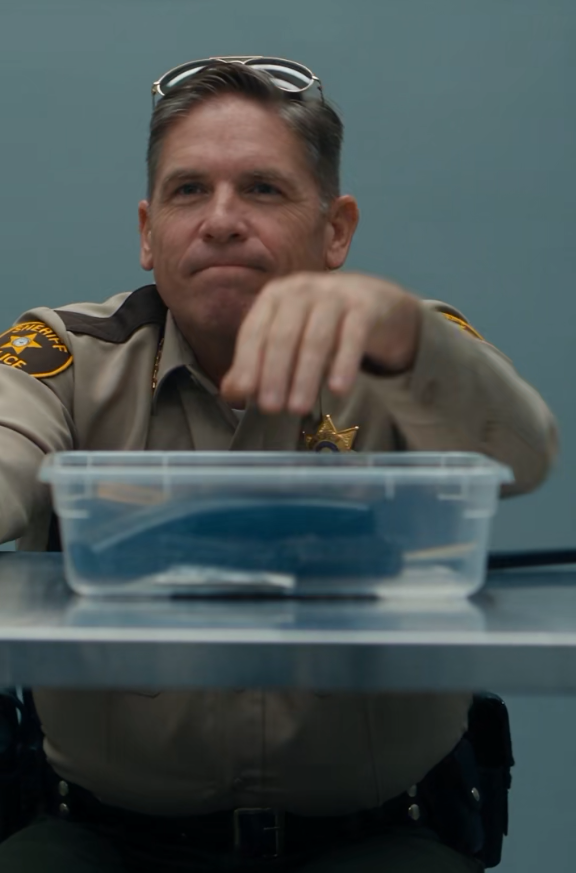
Boyd looked between them.
“Contaminate what?”
Sarah turned toward him.
“The evidence.”
The word landed hard.
Toby’s face tightened.
Sarah looked at the ceiling camera.
“Sheriff Cleary arrested me for offenses that did not occur. Your department has video systems. Your vehicle has recording equipment. The booking area has cameras. The property log should show when my government device entered your custody.”
Boyd’s eyes moved toward Toby.
Sarah continued.
“If I leave because a general arrives with helicopters, you will later say military power interfered with a lawful local arrest. I prefer that the legality of your conduct be decided through evidence.”
Reed watched her for a long moment.
Then nodded.
“All right.”
Boyd actually looked relieved.
He mistook her restraint for retreat.
“Good,” he said. “Then everybody military gets out of my building.”
Reed turned.
“Fine.”
Toby stared at him.
Reed pointed to the secure device.
“My personnel will remain outside until a lawful transfer is arranged. Nobody manipulates that device.”
Boyd said, “You can’t tell me—”
“Call your county attorney.”
Boyd stopped.
Reed looked once more at Sarah.
“We’ll be outside.”
Sarah nodded.
The soldiers left.
The helicopters remained.
Boyd watched them through the glass.
Then he turned toward Sarah.
“You think this makes you special?”
“No.”
“You bring military aircraft into my town, fill my parking lot with troops—”
“I made one phone call.”
“You think people are afraid of you now?”
Sarah looked at him.
“No, Sheriff.”
She glanced toward the evidence tray.
“You’re afraid of the record.”
Part III — The Missing Minutes
By six o’clock, the helicopters were still sitting on the county lawn.
So were three television vans.
Nobody inside knew who had called the stations.
It hardly mattered.
People in Oak Haven had seen the aircraft.
Phones had come out.
Videos had traveled.
A sheriff’s department that rarely attracted attention beyond school-zone complaints now had reporters standing across the street.
Boyd closed the blinds.
“Vultures.”
Toby sat at the booking desk staring at a computer screen.
Sarah had been returned to the holding cell.
General Reed remained outside.
County counsel had called twice.
The first conversation had been brief and tense.
The second had lasted twelve minutes.
Afterward, Boyd had stopped joking.
He had not released Sarah.
Instead he had ordered Toby to “get the records together.”
That was when Toby found the problem.
“Sheriff.”
Boyd was in his office.
“What?”
Toby did not answer loudly.
“Can you come here?”
Boyd appeared.
Toby angled the monitor.
“The cruiser upload.”
“What about it?”
“It stops.”
Boyd stared at the file list.
The automated dash-camera system stored each patrol event by timestamp.
The stop began at 3:28 p.m.
Video duration: seven minutes, fourteen seconds.
Then nothing.
Toby clicked.
The footage showed the initial approach, Sarah’s car slowing, Boyd’s cruiser stopping behind her.
The image continued as Boyd left the patrol car.
Audio captured his first command.
Then, at 3:35:18, the video ended.
No error message.
No corruption.
Just termination.
Boyd folded his arms.
“Battery issue.”
Toby looked at him.
“Engine was running.”
“System glitches.”
“It’s never done that.”
“It did today.”
Toby said nothing.
Boyd leaned closer.
“What are you implying?”
“I’m not implying anything.”
“Good.”
Boyd walked away.
Toby watched him.
Then he opened the administrative log.
His stomach sank.
At 3:52 p.m., someone with sheriff-level credentials had accessed the cruiser recording system.
Seventeen minutes after the roadside file ended.
Toby clicked the entry.
USER: BCLEARY.
He stared at it.
A shadow fell across the desk.
Sarah stood behind the bars at the end of the corridor.
She could not see the screen.
But she could see Toby.
“Deputy Miller.”
Toby minimized the window.
“Ma’am.”
“Is something wrong?”
“No.”
Sarah studied him.
“Then you’re a very bad liar.”
He looked toward Boyd’s office.
“He can hear you.”
“He already knows that.”
Toby stood.
“I’ll bring you water.”
He left the desk.
When he reached the cell, Sarah accepted the paper cup.
“You saw something,” she said.
Toby kept his voice low.
“I didn’t say that.”
“No.”
She drank.
Toby started to leave.
Sarah said, “Deputy.”
He stopped.
“If you saw something important, don’t tell me.”
He turned.
She stood a few feet behind the bars.
“Preserve it.”
Toby stared.
Sarah continued.
“If this becomes an investigation, what matters is not what you tell me tonight. What matters is what exists tomorrow.”
He swallowed.
“That sounds like advice.”
“It is.”
“Legal?”
“No.”
She sat again.
“It’s institutional.”
Toby almost smiled.
Then footsteps approached.
He moved away from the cell.
Boyd came down the hall.
“You two becoming friends?”
“No, Sheriff.”
Boyd looked at Sarah.
“County attorney says bail can be set.”
Sarah said, “For invented charges.”
“He didn't say invented.”
“What amount?”
Boyd named it.
Sarah nodded.
“I can pay it.”
Boyd’s expression flickered.
He had expected resistance.
“I’ll arrange processing.”
He turned away.
Sarah said, “Sheriff.”
He stopped.
“Did your dash camera capture the stop?”
Toby's spine stiffened.
Boyd faced her.
“Camera malfunction.”
Sarah watched him.
“Before or after you accessed the recording system?”
Silence.
Toby looked sharply toward her.
Boyd stepped closer to the bars.
“What did you say?”
Sarah remained seated.
“My secure device continuously records certain environmental threat events.”
That was true, although not in the way Boyd immediately imagined.
His face drained.
“You recorded me?”
“I said the device records certain events.”
“Was it recording the stop?”
Sarah let the silence answer without answering.
Boyd walked away.
Toby watched him go.
Then he looked back at Sarah.
She met his eyes.
For the first time, Toby understood what she had been doing from the beginning.
She had never needed to overpower Boyd.
She had needed him to keep making choices.
At 6:41 p.m., Sarah was released on bond.
The handcuffs were gone.
The charges remained.
General Reed waited outside beside one of the aircraft.
Reporters shouted questions from behind the temporary barrier deputies had established.
“General Hayes!”
“Were you arrested because of your race?”
“Did the sheriff know who you were?”
“Is the Pentagon investigating?”
Sarah stopped.
Reed leaned toward her.
“You don’t have to say anything.”
“I know.”
She turned toward the cameras.
The noise quieted.
Sarah stood in civilian clothes with faint red marks still visible around her wrists.
“I will not comment on the motives of Sheriff Cleary or any member of this department. Facts should be established through evidence, not assumption.”
Several reporters began shouting again.
Sarah raised her hand slightly.
“I was stopped, detained, arrested, and charged. Those events are documented. I expect the appropriate authorities to review them.”
A reporter called, “Are you saying the arrest was illegal?”
“I am saying I intend to challenge it.”
Another voice:
“Did you call the Pentagon?”
“I contacted my chain of command because secured government communications equipment had been confiscated.”
“Did you request military intervention?”
“No.”
Sarah looked toward the sheriff’s department.
“I requested notification and protective procedures related to the device. I did not request that military authority replace civilian law.”
That mattered.
Reed knew it.
So did the lawyers who would hear the clip later.