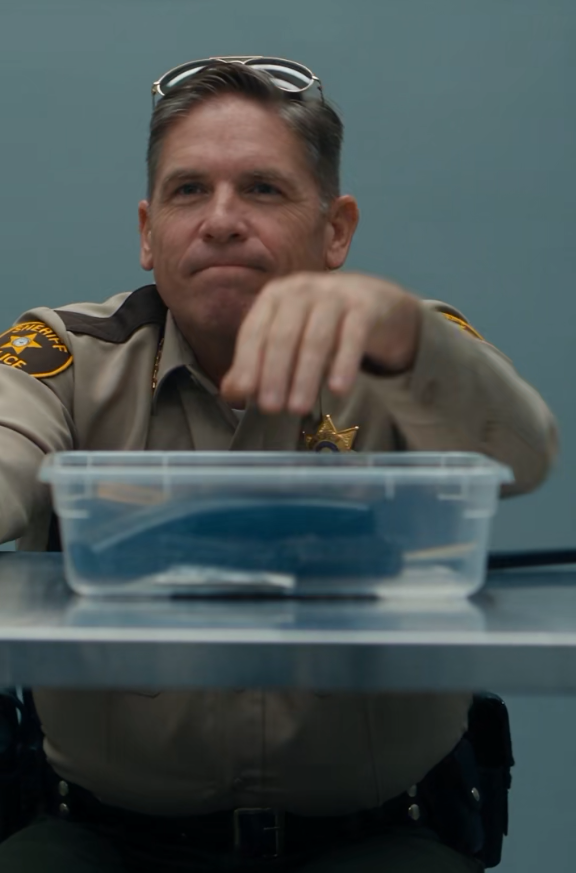
He continued.
“At the stop. Not the stop itself. I wasn’t there. But booking. When he said the attitude thing. When he tossed the device. I knew something was wrong.”
“You documented the property.”
“That doesn't feel like enough.”
“It wasn’t.”
He looked up.
Sarah did not soften the answer.
Toby absorbed it.
Then nodded.
“No.”
“But enough is not the only standard.”
He frowned.
Sarah continued.
“You called county counsel when records disappeared.”
“Yes.”
“You preserved what you could.”
“Yes.”
“You are testifying.”
“Yes.”
“Then tell the truth. Don’t improve yourself in the story and don’t destroy yourself either.”
Toby stared at her.
“Does that work?”
“What?”
“Just telling the truth.”
“Not always.”
The answer surprised him.
Sarah looked toward the courtroom door.
“But it is the only part you control.”
A bailiff opened the doors.
They entered separately.
Boyd Cleary arrived through a side entrance.
For the first time since Sarah had seen him, he was not wearing his sheriff’s uniform.
Dark suit.
White shirt.
Tie slightly too tight.
His attorney sat beside him.
Boyd avoided Sarah’s eyes.
The hearing began with the remaining traffic charge.
The prosecutor stood.
“Based on review of available evidence, the state moves to dismiss.”
The judge looked over his glasses.
“Reason?”
“No reliable evidence supports the alleged lane violation.”
Boyd shifted.
His attorney rose.
“My client maintains that he personally observed—”
The judge cut him off.
“The state is dismissing its own charge. I don’t need argument from the arresting officer.”
Sarah watched Boyd's face.
The charge disappeared in less than a minute.
The hearing then moved to preservation issues because Sarah's counsel had requested judicial confirmation that all department records remain secured pending separate investigation and civil proceedings.
Sarah's attorney laid out the timeline.
3:28 — traffic stop initiated.
3:35 — dash camera recording terminates.
3:35 — system later shows manual shutdown.
3:52 — sheriff-level administrative access to recording database.
4:17 — Sarah’s authenticated call.
4:22 — federal contact reaches department.
6:41 — release on bond.
Following morning — printed access logs missing.
Boyd stared straight ahead.
Then Toby took the stand.
His testimony was restrained.
That gave it weight.
He described the booking.
The secure device.
Sarah’s warnings.
The red telephone.
The helicopters.
Then the system log.
“What did you observe?”
“The sheriff’s administrative account accessed the video system.”
“Did you print that information?”
“Yes.”
“What happened to the printed pages?”
“They were missing the next morning.”
“Did you remove them?”
“No.”
“Do you know who did?”
“No.”
Boyd looked at him then.
Toby kept his eyes on the attorney.
“Were your export permissions changed?”
“Yes.”
“When?”
“Overnight.”
“By whom?”
“I don't know. The administrative system would show it.”
A pause.
“Who possessed administrative-level privileges?”
Toby hesitated.
“The sheriff.”
“Anyone else?”
“No.”
Boyd’s lawyer rose.
“Objection. Implication.”
“Sustained.”
Sarah watched Toby.
He had followed her advice.
He was not improving the story.
He did not need to.
The facts were doing enough.
Then the technical specialist testified.
The camera had not failed.
It had been disabled.
There was no evidence proving which hand pressed the control.
Boyd’s attorney emphasized that point.
“So you cannot testify Sheriff Cleary disabled the camera.”
“No.”
“You cannot testify he deleted footage.”
“No.”
“You cannot testify he removed printed records.”
“No.”
“Then what exactly can you establish?”
The specialist remained calm.
“That the recording ended due to manual input while the sheriff was conducting the stop. His account later accessed the system. The file remained incomplete. Printed logs documenting that access subsequently disappeared. Export permissions for the deputy who printed them were later revoked through an administrator account.”
The attorney sat down.
No one needed the implication explained.
Then came the secure communications device.
The judge restricted the hearing.
Several reporters were removed.
A government attorney explained that no classified information would be disclosed. The device had activated a passive security record after repeated unauthorized biometric and access attempts.
Boyd leaned toward his lawyer.
His lawyer whispered something back.
The audio itself would not be played publicly in full.
A government-prepared transcript of nonclassified portions could be considered.
The judge read silently.
His face did not change.
Then he passed the pages to counsel.
Sarah had already read them.
She knew which lines Boyd was seeing.
TOBY MILLER: Sheriff, maybe leave that thing alone.
BOYD CLEARY: It’s evidence.
TOBY MILLER: She says it’s federal equipment.
BOYD CLEARY: She says a lot.
Later:
TOBY MILLER: What if she is who she says she is?
BOYD CLEARY: Then she can learn the same lesson everybody else learns. Out here, badges mean more than titles.
And after Sarah’s authenticated call:
TOBY MILLER: We should probably let county know.
BOYD CLEARY: I ought to keep her overnight just so she learns who runs this county.
Then the final passage.
The one Sarah believed mattered most.
TOBY MILLER: What about your dash footage?
BOYD CLEARY: There doesn’t need to be footage. My report is the footage.
Boyd stopped reading.
For the first time since the roadside, he looked directly at Sarah.
She met his gaze.
There was anger in his face.
But beneath it was something else.
Betrayal.
He looked at her as though she had tricked him.
As though his own words had belonged to him and she had somehow stolen them.
The judge called a recess.
Outside the courtroom, reporters surged.
Sarah's attorney urged her toward a private room.
She stopped when Boyd approached.
His lawyer grabbed his arm.
“Sheriff, don’t.”
Boyd ignored him.
“You knew.”
Sarah stood still.
“You knew that thing was recording.”
“I knew it had security functions.”
“You set me up.”
“No.”
“You could’ve told me who you were.”
“I did.”
“At the stop.”
“You had my identification.”
“You know what I mean.”
People nearby stopped talking.
Boyd lowered his voice.
“You let me put cuffs on you.”
Sarah’s face remained unreadable.
“You made that decision.”
“You could have stopped it.”
“With rank?”
“With the truth.”
Sarah took one step closer.
“The truth was that I was a driver going forty-four in a forty-five.”
Boyd’s jaw tightened.
“You think you're better than everybody here.”
“No.”
“You brought the Pentagon down on a traffic stop.”
“You confiscated Pentagon property during an arrest unsupported by evidence.”
“There. That. You talk like every sentence belongs in a courtroom.”
Sarah glanced through the courthouse glass toward the street.
“No, Sheriff.”
She looked back.
“I learned a long time ago that people who expect to be misquoted become precise.”
Boyd’s lawyer tried again.
“We’re done here.”
Boyd jerked his arm away.
“You want to destroy my life because you didn't like how I talked to you.”
Sarah looked at him for several seconds.
Then she said, “This is the first conversation we’ve had where you seem to understand that actions have consequences.”
Boyd’s face reddened.
Sarah continued before he could answer.
“But you’re still wrong about one thing.”
“What?”
“This is not about my life.”
She walked away.
The county investigation expanded that afternoon.
Not because Sarah demanded it.
Because Toby’s testimony created a question the county could not ignore.
If Boyd believed his report could replace footage in Sarah’s case, had the same thing happened before?