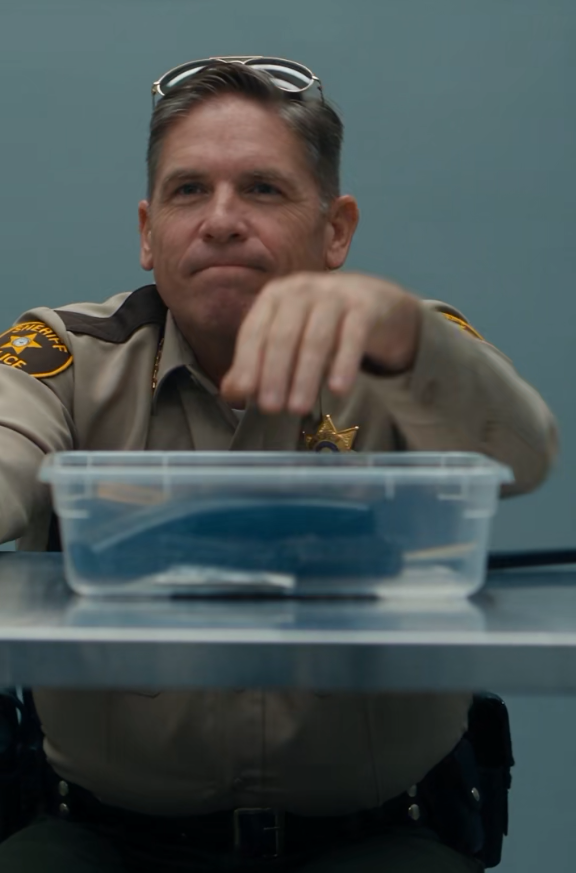
Cameras gathered in front of the sheriff’s department beneath a punishing sun.
Boyd wore a fresh uniform and no sunglasses.
“I will not be intimidated,” he began.
Sarah watched the broadcast from Reed’s office.
Boyd stood behind a portable podium.
“This department treats every individual equally regardless of race, profession, military status, or political connections.”
Sarah muted the television.
Reed looked at her.
“You don’t want to hear the rest?”
“I know the rest.”
She unmuted it.
Boyd continued.
“General Hayes was stopped based on observed traffic behavior. During the encounter she became uncooperative and failed to follow lawful instructions.”
A reporter interrupted.
“Sheriff, your dash camera cuts out before the alleged resistance. Why?”
Boyd blinked.
That detail was not supposed to be public yet.
“Equipment failure.”
“Why did you access the recording system afterward?”
The press conference changed.
Boyd’s face tightened.
“I routinely review footage.”
“County records indicate your administrative account accessed that specific file seventeen minutes after the recording stopped.”
Sarah leaned forward.
Reed said, “That got out fast.”
Another reporter shouted.
“Did you remove printed system logs from a departmental packet?”
Boyd pointed at the crowd.
“There is an ongoing attempt to turn a routine arrest into a federal spectacle.”
The questions intensified.
“Did you delete the video?”
“No.”
“Did you arrest General Hayes because she questioned the traffic stop?”
“No.”
“Why did you write ‘attitude’ in your preliminary field notes?”
Boyd froze.
Sarah turned toward Reed.
“That’s new.”
Reed's expression sharpened.
On-screen, Boyd said, “Those notes are being mischaracterized.”
“What does ‘attitude package’ mean?”
Boyd stepped away from the podium.
The press conference ended.
Sarah muted the screen.
Reed said, “He wrote it down.”
“Apparently.”
“Who writes that down?”
“Someone who never expected anyone important to read it.”
Reed looked at her.
“Important?”
Sarah caught herself.
She hated the word as soon as she heard it.
She corrected it.
“Someone he thought could make him answer for it.”
Reed nodded.
“That’s different.”
“Yes.”
Sarah stood.
“What happens to the criminal charges?”
“County prosecutor reviews them this afternoon.”
“I want them reviewed normally.”
“They’re not normal anymore.”
“No. But I don’t want special dismissal.”
“Sarah.”
“If the evidence supports dismissal, dismiss them. If not, let counsel litigate.”
Reed leaned back.
“You realize nobody believes you are just defending yourself anymore.”
“I am defending myself.”
“You’re also building a case about the department.”
Sarah looked at him.
“No.”
She picked up her folder.
“Boyd is doing that.”
That afternoon, the county prosecutor dismissed the resisting-arrest charge.
Then the failure-to-comply charge.
Then the disorderly-conduct charge.
The stated reason was simple: available video, dispatch, and booking evidence did not establish probable cause.
The traffic allegation remained under review.
Sarah read the notice once.
No satisfaction.
The arrest still existed.
The roadside conduct still existed.
The missing video still existed.
The question of race could not be resolved by one corrupted recording.
That evening, another fact emerged.
The dash camera had not malfunctioned.
A technical audit showed it had been manually disabled from the patrol console.
Time: 3:35 p.m.
The approximate moment Boyd ordered Sarah out of the car.
Reed called her.
“Now we have him.”
Sarah sat alone at a small desk in temporary quarters.
“No.”
“No?”
“We have evidence the camera was manually disabled.”
“By the sheriff.”
“By someone with physical access to his console.”
“Who else was there?”
“That’s not how investigations work.”
Reed was silent.
Sarah rubbed a faint mark on her wrist.
“We don’t skip from obvious to proven because we dislike him.”
“Fine.”
“Anything else?”
“Yes.”
Reed sounded different now.
Sarah heard it.
“What?”
“The secure device.”
She straightened.
“What about it?”
“The casing shows repeated access attempts.”
“Accidental?”
“No.”
“How many?”
“Eleven.”
Sarah closed her eyes briefly.
“When?”
“Between booking and your call.”
“Biometric breach?”
“No. Device locked itself after the third unauthorized attempt and triggered passive capture.”
Sarah’s eyes opened.
“Passive audio?”
“Yes.”
Silence.
That changed everything.
“What did it capture?”
“The entire booking-room interval after activation.”
Sarah said nothing.
Reed continued.
“Legal is determining what can be released and what must remain protected. But some of it is clear.”
“Boyd?”
“Yes.”
“What does he say?”
Reed took a breath.
“Among other things, he tells Toby he likes teaching D.C. people that ‘out here, badges mean more than titles.’”
Sarah stared at the wall.
Reed added, “And later, after your phone call, he says he ought to keep you overnight just so you learn who runs the county.”
Sarah’s jaw tightened.
“Anything racial?”
“Nothing explicit.”
“That matters.”
“I know.”
“He’ll say it proves this had nothing to do with race.”
“He’ll say a lot.”
Sarah looked toward the dark window.
“What matters most?”
Reed did not answer immediately.
“When Toby asks why there’s no traffic footage, Boyd says, ‘There doesn’t need to be. My report is the footage.’”
Sarah sat back.
There it was.
Not a slur.
Not a confession.
Something more useful.
A statement of how Boyd Cleary believed the system worked.
His word became the event.
Everything else was decoration.
“Preserve it,” Sarah said.
“Already done.”
“And Tom?”
“Yes?”
“Nothing leaks.”
He gave a humorless laugh.
“Have you seen the news?”
“I mean from us.”
“I know.”
Sarah ended the call.
Then she sat in the quiet room for a long time.
She had imagined vindication would feel clean.
It did not.
Because she kept thinking about the phrase.
My report is the footage.
How many people had heard some version of that without helicopters arriving?
How many had paid a fine because missing a shift cost more than fighting a charge?
How many had apologized just to go home?
Sarah had refused to identify herself because she wanted to know what Boyd did when he thought she had no power.
Now she knew.
The harder question was what to do with that knowledge.
Part V — The Record
Three days after the arrest, Sarah returned to Oak Haven.
Not in uniform.
Not by helicopter.
She drove another rental car.
General Reed objected.
“You know this is an unnecessarily symbolic decision.”
“I’m aware.”
“You could fly.”
“I could.”
“You could send counsel.”
“I could.”
“And?”
“I was arrested there. I’ll go back there.”
The county had scheduled an evidentiary hearing concerning the remaining traffic citation and preservation of records related to the arrest.
Sarah could have allowed attorneys to handle it.
Instead she attended.
Oak Haven looked exactly the same.
That irritated her.
The highway still narrowed.
The faded billboard still stood.
The same speed sign waited beside the road.
Sarah reduced speed early.
This time, no cruiser pulled out.
Outside the county courthouse, reporters crowded the sidewalk.
Sarah entered through the front.
No military escort.
No visible security.
Inside, Toby Miller sat on a wooden bench.
He stood when he saw her.
“General.”
“Deputy.”
He looked exhausted.
He had not worn his uniform.
“You’re testifying?”
“Yes, ma’am.”
“You don’t need to call me ma’am.”
He nodded.
Then said, “Yes, ma’am.”
Sarah almost smiled.
Toby looked at the floor.
“I should’ve done something sooner.”
Sarah waited.