The Silent Rancher and the Ghost of Bitter Creek: How Four Words at an Auction Block Shattered a Frontier Empire.
The Silent Rancher and the Ghost of Bitter Creek: How Four Words at an Auction Block Shattered a Frontier Empire
Chapter 1: The Weight of Hemp and Silence
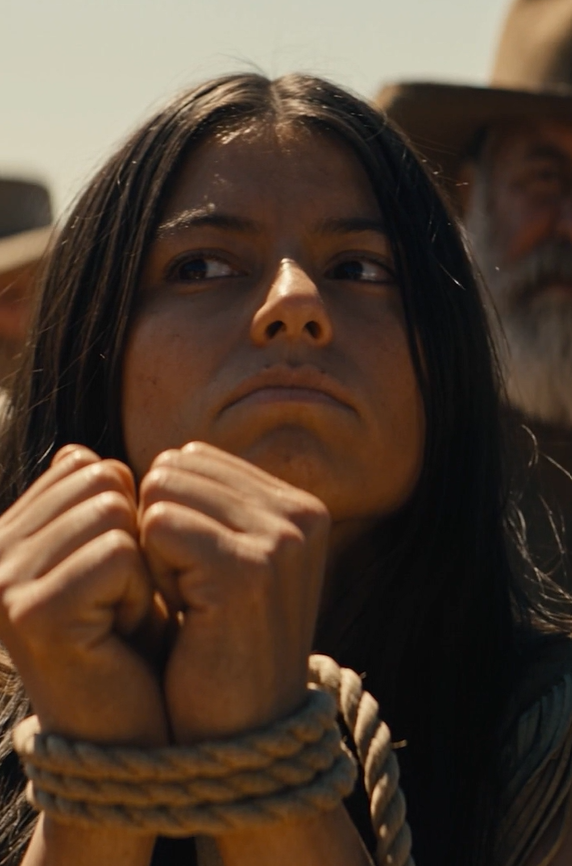
The rope was thick, braided from coarse Mexican hemp that had been soaked in brine to prevent fraying, and it smelled of sheep dip, old sweat, and stable dirt.
It was bound around Nia’s wrists in a crude, biting square knot, cinched so fiercely that the circulation had died in her fingers hours ago, leaving her nails the pale, chalky blue of winter ice. But she did not shift her hands. She did not roll her shoulders. She stood barefoot upon the creaking yellow-pine scaffold in the center of the town square of Asheford Creek, her chin lifted toward the jagged crimson rimrock of the Peloncillo Mountains thirty miles to the west.
She refused to look down. To look down was to see them: forty or fifty white men gathered in the choking dust of three o’clock, their wool vests stained with grease, tobacco juice pooling in the ruts between their boot heels, their eyes glassy with the dull, idle cruelty common to men who had nothing better to do on a Tuesday afternoon than watch a human life appraised like a broken-down mule.
“Look at them teeth! Show ’em, girl!” a drover shouted from the shadow of the livery stable, his voice thick with corn liquor. A ripple of low, guttural laughter answered him.
The auctioneer, Hutch Riley, wiped the back of his sun-scalded neck with a rag that had once been red. He was a small man with the nervous, darting eyes of a ferret and a belly that spilled over his brass belt buckle. He rapped the head of his ironwood cane against the pine boards near Nia’s bare feet.
“Quiet down, boys, quiet down!” Riley barked, his voice climbing above the dry wind. “Now, what we have here is legal and proper under the territorial vagrancy and salvage statutes of seventy-four. Found wandering off-reservation without federal papers down in the boot-heel country. She’s healthy, she’s sound, and she’s the last full-blood Chiricahua you’ll see crossing these flats without a cavalry escort behind her! The blue-coats down at Fort Bowie called her Alice, and she’s got five good years of scrub-board and kitchen work in her before her joints give out!”
Alice.
Inside her chest, behind ribs that felt like dry cedar kindling, Nia held her real name like an ember shielded from a gale. Nia. It had been given to her beside the living waters of the upper Gila, spoken into her ear by a grandmother who had known the great Cochise before the blue-coats had brought the smallpox and the iron rails. They could brand her with their butcher names; they could drag her behind an army buckboard on a ten-foot tether; but they could not touch the breath inside her marrow where her real name lived.
Thirteen years. It had been thirteen years since the canyon of the red willows had filled with black powder smoke at dawn. She had been sixteen then, carrying a woven willow water jug to the creek, her heart full of the morning birds. Then the carbines had cracked from the high ridge. The screams of her cousins, the thrashing of the ponies in the brush, the smell of burning skin and scorched cornmeal—it had all collapsed into a single, roaring dark. She had run. She had hidden in the wolf-caves; she had dug for roots with her fingernails; she had been traded from border cantinas to copper-mine washhouses like a sack of green hides.
She had survived because she had made herself stone.
“Do I hear one hundred?” Riley hollered, raising his hand. “One hundred dollars for five years of domestic indenture! You couldn’t hire a washerwoman from Saint Louis for that in three seasons!”
“Seventy-five!” shouted a red-faced man named Coyle, who ran the slaughter-pens behind the railhead. “And she sleeps in the lean-to with the dogs!”
“Seventy-five to Mr. Coyle! Do I hear one hundred? One hundred?”
“One hundred,” called a voice from the steps of the salting house.
“One hundred from Frank Miller! One hundred and twenty-five? One hundred and twenty-five?”
“One-fifty!” Coyle spat, glaring around the circle, his thumb hooked in his greasy galluses. “And that’s my final dollar, Riley! Ain’t no squaw worth more than a good plow horse!”
“One-fifty to Coyle!” Riley’s cane tapped frantically against the planks. “One-fifty once! One-fifty twice! Going to the meat-house, boys, unless someone here knows what good labor looks like—”
“Two hundred.”
The voice did not shout. It did not carry the tavern rasp of Coyle or the oily wheedle of Riley. It was low, flat, and absolute, cutting through the hot glare of the square like a cold blade drawn across leather.
The crowd went dead still.
Every head swung toward the corner of the feed-store awning.
Nia turned her eyes.
A man was standing in the deep, narrow strip of shadow cast by the cedar porch. He was broad-framed, deep in the chest, wearing an unwashed canvas duster that hung straight to his boot-tops. His black felt hat was pulled low, its brim dusted with the gray caliche of the backcountry. Beneath the shadow of that brim, his eyes were the color of wet river slate—clear, pale, and entirely devoid of the hungry malice that marked the faces around him.
Thaddius Colton.
Even in the squalor of her captivity, Nia had heard his name whispered in the wagon camps. The silent rancher of Black Timber Creek. A man who lived five miles beyond the town line where the rocks began to turn vertical, who had no hands on his payroll, who spoke three words where other men spent twenty, and who had buried his young wife five winters ago in a solitary grave beneath an ancient cottonwood.
Coyle turned redder, the veins in his temple swelling like earthworms. “You’re a fool, Colton! You got no use for a woman out on that rock pile! What’re you gonna do, teach her to mend harness?”
Thad Colton did not answer. He did not even look at Coyle. He stepped out of the shadow into the white-hot sunlight, his spurs giving a faint, iron chink against the dry dirt. He reached into the breast pocket of his duster, pulled out a stack of four fifty-dollar greenbacks—crisp territorial script—and slapped them onto the pine platform at Riley’s feet.
Riley stared at the bills, his jaw slack. He looked up at Colton, swallowed once, and dropped his cane.
“Sold,” Riley squeaked, grabbing the money before the wind could take it. “Sold to Mr. Colton for two hundred dollars.”
Nia felt a sudden, sickening drop in her belly.
Cruelty she understood. When Coyle looked at her, she saw the butcher’s knife, the fist, the starvation; she had lived with those things for thirteen winters, and her body knew how to endure them. But in this tall, broad-shouldered man with the slate eyes, there was nothing to read. His face was a mask of gray granite.
He climbed the three steps of the platform. He did not pull on the hemp lead. He did not lay a hand upon her arm.
“Come on,” he said.
He turned his back on the crowd and walked.