Chapter 2: The Four Words
Nia followed him because the town behind her was a den of wolves, and because she had learned long ago that when a new master takes the tether, running on open ground is how a woman catches a rifle ball between the shoulder blades.
They passed the blacksmith’s forge, where the hammer rang against an anvil with a sharp, sickening cadence. They passed the clapboard church with its crooked tin cross, and the last row of shanties where the Mexican washerwomen stopped their scrubbing to stare through the brushwood fences with wide, frightened eyes.
At the edge of town, where the wagon ruts thinned into the rocky trail that led into the foothills, Colton stopped.
The scrub mesquite hissed in the dry wind. The heat mirage wavered over the white alkali flats below like boiling grease.
Colton turned around. His hand moved toward the inside of his duster.
Nia’s breath hitched. Her knees bent half an inch, her weight shifting onto the balls of her bare feet. If he pulled a hide-whip, she would drive her forehead into the bridge of his nose. If he pulled a pistol, she would force him to shoot her in the chest rather than take her back into a dark cellar.
His hand emerged.
In his grip was a bone-handled skinning knife, its six-inch carbon blade ground down to a razor-thin needle point.
“Hold still,” he said.
His voice was not harsh; it sounded like dry stones shifting in a mountain creek.
He stepped around her, his movements methodical and slow, giving her every chance to see what he was doing. He slipped the flat of the cold blade between her wrists, turning the cutting edge away from her flesh. With a single, sharp upward draw, the hemp fibers parted with a loud snap.
The heavy cord fell into the yellow dust.
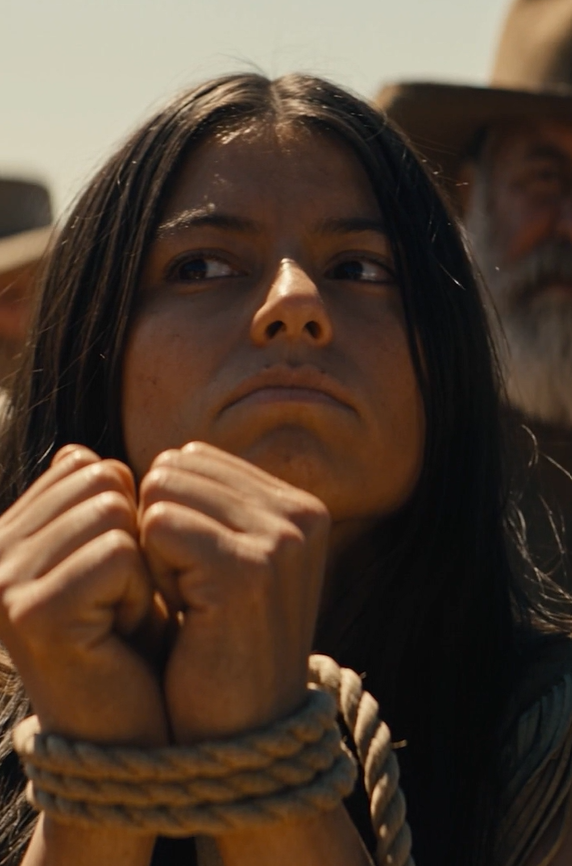
Nia stared at her hands. The blood rushed back into her fingertips with an agonizing, needle-like burn that made her teeth clench. Deep purple troughs ran around her wrists where the rough rope had sawed through the skin, weeping clear lymph and sweat.
She looked up at him, her dark eyes flashing with wild, feral suspicion.
Colton wiped the blade against the leg of his trousers, slid it back into its leather sheath, and looked directly into her eyes.
He did not smile. He did not puff his chest. He stood with his hands hanging loose at his sides, three feet away, giving her the whole western horizon behind him.
“You belong to yourself.”
Four words.
They hung in the dry, burning silence of the desert like a gunshot that carried no echo.
Nia’s lips parted. Her chest heaved against her dirty calico tunic. For thirteen years, men had called her squaw, half-breed, dog, Alice, property, salvage. No one had ever spoken those words to her in the white man’s tongue.
“What?” she whispered, the English word cracking like dry leather in her throat.
“I said, you belong to yourself,” Colton repeated, his voice level and immovable. “I’m not your master. I’m not the army. The trail behind us goes to the border. The trail ahead goes to my ranch.”
He unslung the five-pound canvas canteen from his shoulder and held it out.
She did not take it. Her eyes searched his face, hunting for the trap, the hidden condition, the game white men played when they wanted to break an Indian’s spirit before they broke her body.
“You paid two hundred dollars,” she said, her voice hoarse from dust.
“I did.”
“Why?”
A muscle in Colton’s jaw bunched once, hard as an iron nut. His slate-gray eyes shifted past her shoulder, toward the jagged black maw of Bitter Creek Canyon, five miles to the north. A shadow passed behind his pupils—not anger, but something old, crushed, and festering beneath fifteen years of silence.
“Because someone owed you that,” he said quietly.
“Who?”
He looked back at her, his gaze locking with hers until she felt the heat of it.
“I did.”
He dropped the strap of the canteen onto the dust between them. Then he turned on his heel and began to walk up the rocky incline toward the mountains, his long, slow stride eating the ground, not once looking back to see if she was behind him.
Chapter 3: The Sanctuary of Ashes
Nia stood alone on the trail for a long time.
To her left lay the south—two hundred miles of waterless creosote, Mexican cavalry patrols, and the scalp-hunter gangs who still took fifty pesos for an Apache ear in Sonora. To her right lay the town of Asheford Creek, where Coyle was likely already drinking whiskey and cursing the rancher who had outbid him.
Ahead was Thaddius Colton.
She reached down, picked up the canvas canteen, and shook it. It was heavy, ice-cold from deep well water, and sloshed with life. She uncorked the pewter cap, drank three small, disciplined swallows, and wiped her mouth with the back of her bruised wrist.
She followed his dust.
The Colton ranch was not an empire; it was a fortress built by a man who wished to be forgotten by the world.
Tucked into a high, granite amphitheater beneath the shadow of the Black Timber ridge, it consisted of a low-slung cabin of squared pine logs, chinked with dry clay and roofed with sod. Behind it stood a barn built of hand-split cedar shakes, a stone spring-house where mountain water bubbled endlessly through a granite trough, and an eight-pole corral holding four sleek, short-backed Morgan work horses.
Everything was clean. Everything was repaired. But over the entire five hundred acres hung a stillness so profound it felt like a graveyard after a frost.
On the front porch, hung from an iron square-headed nail beside the lintel, was a woman’s shawl.
It had once been bright indigo wool, trimmed with white silk fringe. Now it was bleached to the pale, milky blue of a robin’s egg by five years of mountain sun. The wind had frayed its edges, but no one had moved it. It hung there like an open wound upon the cedar logs.
Colton unsaddled his gelding, turned the beast into the corral, and carried his saddlebags to the porch. He saw Nia standing thirty paces back, near the edge of the cottonwood grove, her bare feet planted in the wild mint that grew beside the overflow ditch.
He glanced at the faded blue shawl, then at her.
“Her name was Martha,” he said, speaking without turning around. “Fevers took her. Five years back come November.”
He pushed open the heavy plank door and stepped inside.
Nia waited three breaths, then stepped onto the porch.
The interior of the cabin smelled of cured cedar, cold stone, lard, and the sharp, medicinal tang of dried sage hanging from the rafters. There was a single cast-iron cookstove, an ironwood table with two ladder-back chairs, and a narrow hallway leading to a back room where an iron bedstead was made up with a clean patchwork quilt.
Colton set a tin plate on the table. Beside it, he laid half a loaf of sourdough bread, a cold roasted beef shank, and a bowl of stewed yellow beans.
“Eat,” he said.
Nia sat. She did not eat like a starving captive; she broke the bread with her fingers, chewing slowly, her eyes tracking every movement he made.
Colton did not sit with her. He walked to the corner of the room, pulled a straw tick mattress from behind the flour barrel, and threw it onto the floor beside the hearth. He took an old woolen cavalry blanket—its yellow stripe faded to dirty gray—and tossed it across the mattress.
He pointed toward the bedroom with the iron bedstead.
“You sleep back there,” he said. “The window has an inside bolt. The door has an iron drop-latch. When you go in, drop it.”
Nia frowned, her spoon hovering above the beans. “Where will you sleep?”
“Right here,” he said, tapping the floor beside the front door with the toe of his boot. “Across the sill.”
“Why?”
Colton looked down at the raw, bloody rings around her wrists, where the hemp had bitten down to the tendon. For the first time, a dark, terrible anger flickered in the corners of his gray eyes—not directed at her, but at the world that had put those marks there.
“Because you’ve spent enough nights sleeping where some bastard told you to,” he said.
That night, Nia lay upon the soft feather ticking of Martha Colton’s bed.
The room was pitch-black, save for the blue moonlight that bled through the small, four-paned window. Outside, an owl called once from the high pines of the ridge.
Through the crack beneath the bedroom door, she could see the faint, red glow of the hearth fire. And beyond the pine boards, she heard the slow, heavy creak of a chair.
Thaddius Colton did not sleep.
For seven hours, through the dead, freezing hours of the mountain night, he sat in the ladder-back chair tilted against the front door, an old Model 1866 Winchester carbine resting across his thighs, his eyes open in the dark, watching the valley trail.