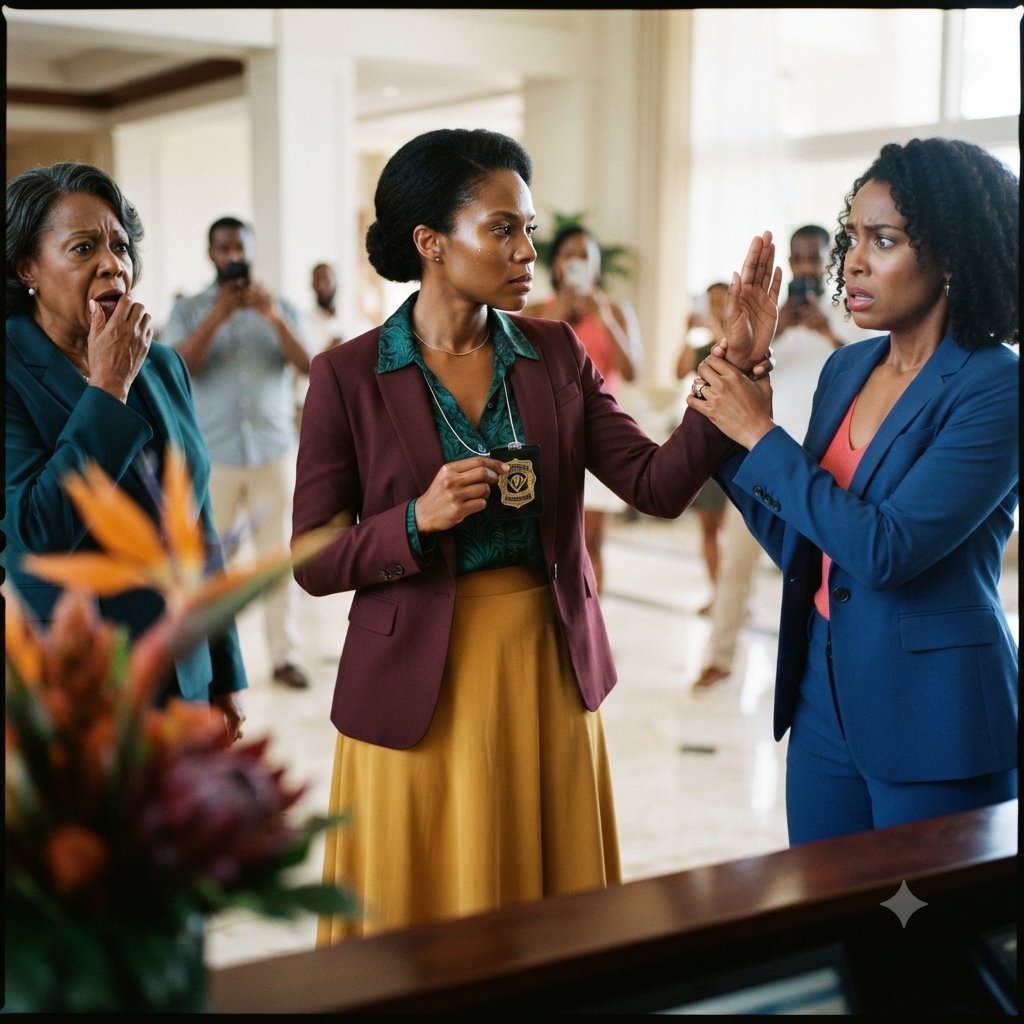
The man near the exit set his glass down on a passing tray and walked toward the doors with no urgency at all — just a man leaving a party early, nothing worth noticing.
Carver noticed.
He didn't move himself.
Instead he touched the earpiece at his right ear and said two words.
Somewhere near the exit, another member of Vincent's team stepped smoothly into the man's path.
Emma watched the man stop.
Watched him smile pleasantly at the security guard, say something, gesture toward the door.
The guard smiled back and did not move.
The woman in the dark blazer had already crossed half the ballroom.
She moved the way people move when they have done this before — direct line, no hesitation, no eye contact with anyone she passed.
"Who is she?" Emma asked, to no one in particular.
The older gentleman standing nearest to her — silver-haired, a congressman's pin on his lapel — answered without looking away from the scene unfolding across the room.
"Diane Marsh," he said.
"She runs Moretti's legal affairs.
Has done for twelve years."
Emma looked at Diane again with new understanding.
At the center of the room, Vincent had not moved.
He was still facing Victoria, and his patience was the most dangerous thing about him.
Victoria had rearranged her expression twice in the last minute — first into wounded dignity, then into something approaching boredom — and neither had landed.
"The footage," Victoria said finally, "will show exactly what I told you.
An elderly woman who was distressed, and me attempting to assist her."
"It will show your hand at approximately four inches from my mother's face," Vincent said.
"And it will show that the woman in the wheelchair did not ask for your assistance."
"She was in a restricted area—"
"She was in a corridor that has been part of this venue's accessible route for eleven years." He paused.
"I know because I had it built."
A few people nearby heard that.
The ripple was small but visible.
Victoria changed direction.
"Vincent, whatever you think happened here, we can discuss it privately.
This is not the place—"
"You chose the place."
Her mouth closed.
"You knew my mother would be here tonight.
You knew which corridor she uses because her mobility requirements are accommodated on the east side of this building.
You knew the timing because someone with access to her schedule told you." He took one step closer.
"And when you found her alone, you decided to use that moment.
So yes, Victoria.
This is the place."
Across the room, Diane had reached the man near the exit.
Emma couldn't hear what was being said, but she could read the shape of it — Diane speaking in short, precise sentences, the man responding with the same pleasant smile, Diane not returning it.
Then Diane held up her phone.
Showed him something on the screen.
The pleasant smile disappeared.
Emma felt a hand at her elbow — light, careful.
She turned.
Isabella Moretti was looking up at her from the wheelchair, her expression no longer frightened.
Something steadier had replaced it.
"Sit with me," Isabella said.
Emma looked around for her manager.
She couldn't see him anywhere in the reorganized crowd.
She sat.
"You didn't let go," Isabella said.
"No, ma'am."
"You knew who I was?"
"No," Emma said.
"I didn't know anything about you."
Isabella studied her for a moment.
"Then why?"
Emma thought about it honestly.
"Because you were shaking," she said.
"And nobody else was doing anything."
Isabella was quiet for a moment.
Then she reached out and placed her hand over Emma's.
Her fingers were cool and thin, but the pressure was deliberate.
"My son is going to want to speak with you again," Isabella said.
"When this is finished."
"I'll probably be fired by then."
"You won't be fired." Isabella said it the way someone states a fact they are certain of.
"Not tonight."
Across the room, the pleasant-faced man had stopped smiling entirely.
Diane was on a call now, turned slightly away from him, one hand pressed to her other ear to block the noise of the ballroom.
The security guard had been joined by a second.
The man looked once toward Victoria.
Just once.
Victoria did not look back.
Emma watched his expression in that moment — the calculation in it, the rapid reassessment — and understood that whatever arrangement had existed between them, he had just decided it was no longer worth defending.
That, she would learn later, was the first mistake he made that evening.
The second was the text message he sent thirty seconds later, to a number that Diane Marsh had been monitoring for six weeks.