His name was Richard Hale.
Diane said it quietly to Vincent at the edge of the cleared space, her phone angled so only he could see the screen.
Vincent read whatever was on it without any change in his expression.
Then he handed the phone back and turned to look at Richard Hale directly for the first time.
Richard was still near the exit, still flanked by two members of Vincent's security team, still maintaining the posture of a man who had done nothing wrong and found the whole situation mildly inconvenient.
He was sixty-one years old, a senior partner at one of Chicago's oldest investment firms, and he had been on the board of three Moretti-adjacent companies for the better part of a decade.
He was also, Diane had discovered six weeks ago, quietly moving money in ways that required Isabella Moretti's signature — a signature that had been appearing on documents Isabella had never seen.
Vincent crossed the ballroom toward him.
The crowd parted.
Richard extended his hand.
"Vincent.
I'm not sure what's happening here, but I want you to know—"
"Don't." Vincent didn't take the hand.
"I've seen the text you just sent."
Richard's arm lowered slowly.
"I don't know what you think you—"
"You told Victoria my mother would be in the east corridor at nine-fifteen.
You told her the security rotation.
You told her which staff member was assigned to my mother's chair." Vincent's voice was completely level.
"You gave her a window."
"That's a serious accusation."
"It's a documented one."
Richard glanced at Diane.
Something passed across his face — a rapid calculation, the kind that happens when a man realizes the conversation he prepared for is not the one he's in.
"Whatever Diane has shown you," Richard said carefully, "I'd encourage you to consider the source and the context before—"
"The source is your own phone records," Diane said.
"The context is a six-week financial audit." She didn't raise her voice.
"Would you like me to continue, or would you prefer to have this conversation with your attorney present?"
Richard straightened his jacket.
"I think that would be wise."
"Your attorney," Vincent said, "is currently being contacted by mine.
I'd suggest you call him before he hears from us first."
For the first time, Richard Hale had nothing to say.
He looked once more at Victoria.
She was standing fifteen feet away, her arms crossed, her expression carefully composed into something that was supposed to look like calm.
It didn't.
Her eyes were moving too fast — across the crowd, toward the exits, back to Vincent — the eyes of someone calculating how much of this could still be contained.
Richard looked at her for exactly two seconds.
Then he looked away.
Victoria saw it.
The color that had returned to her face drained out again.
Emma watched all of this from beside Isabella's wheelchair.
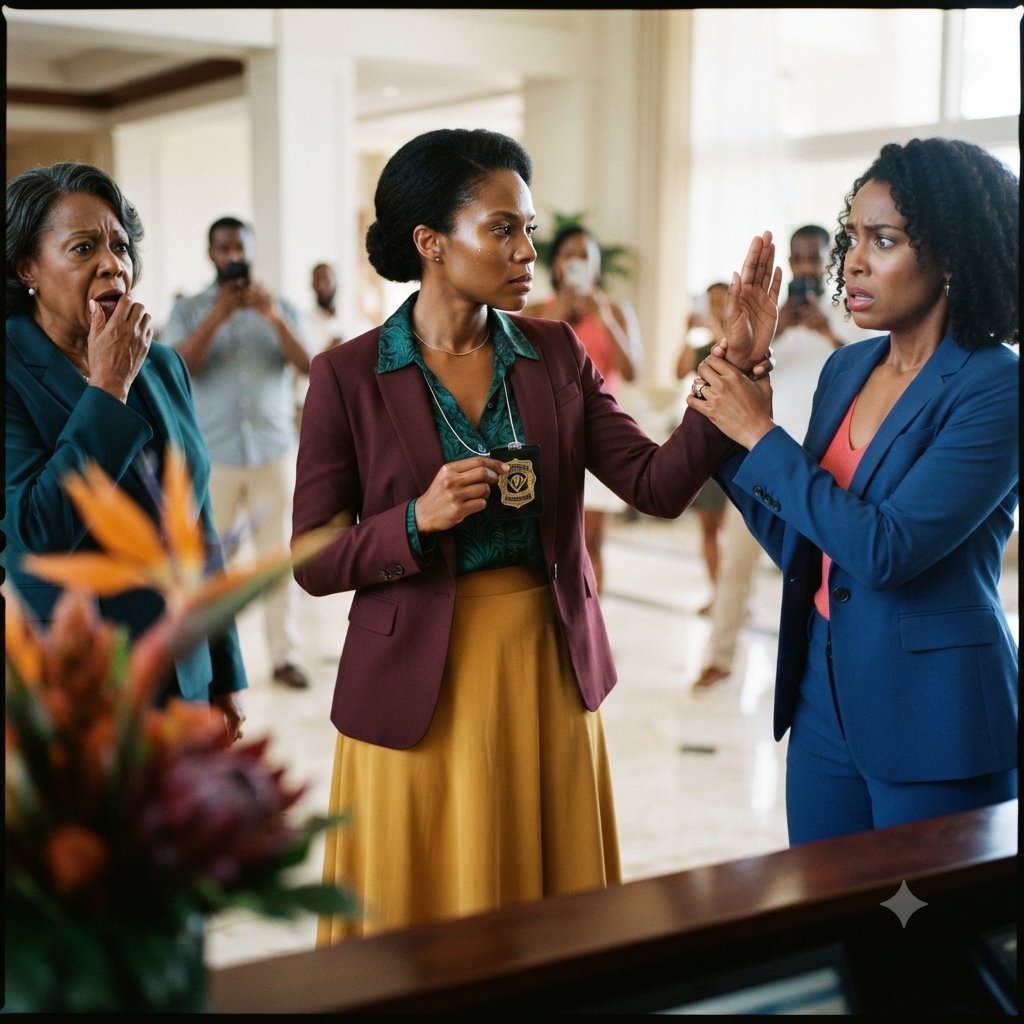
She had stopped trying to understand the full shape of what was happening and had started simply watching the details — the way Diane moved, the way Vincent stood, the way the room had reorganized itself around a conflict that had started with a wrist caught in midair and had become something much larger and much older.
Isabella's hand was still resting over hers.
"How long has this been going on?" Emma asked quietly.
She wasn't sure she should ask.
She asked anyway.
"Richard has been on three of Vincent's boards for nine years," Isabella said.
"He was trusted.
That is the most expensive kind of mistake — the ones you make about people you trusted."
"Did you know?
Before tonight?"
"I suspected," Isabella said.
"I am old, not blind.
Documents arrived for my signature that I did not recognize.
I asked questions.
The questions were redirected." She paused.
"That is why Vincent brought me tonight.
He wanted me somewhere he could watch, while Diane finished what she needed to finish."
Emma looked at her.
"He used you as—"
"He protected me," Isabella said firmly.
"There is a difference.
He knew something would happen tonight.
He did not know what, or when, or who would be the one to act." Her hand pressed slightly on Emma's.
"He did not expect you."
Across the room, Vincent had turned away from Richard Hale.
Carver and one other guard remained positioned on either side of him — not restraining, simply present.
Richard had taken out his phone.
His hand, Emma noticed, was not entirely steady.
Victoria had not moved.
She was watching Vincent walk back toward her, and her expression had finally settled into something honest: she was afraid.
"I want to explain," she said, before he reached her.
"You'll have the opportunity," Vincent said.
"Not here."
"Vincent—"
"Not here, Victoria."
She closed her mouth.
The ballroom, which had been holding its breath for the better part of an hour, finally began to exhale.
Conversations restarted in low murmurs.
A few guests near the edges quietly collected their things.
The musicians, receiving no instruction to the contrary, began to play again — something soft and entirely wrong for the mood.
Emma became aware, for the first time in a long while, that her feet hurt.
She had been standing, then crouching beside Isabella, and now sitting on the edge of a chair that belonged to someone else, in a ballroom where she had come to serve dessert.
She thought about her father.
She thought about the hospital bills on the counter.
She thought: I still don't know if I have a job.
Vincent stopped in front of her.
He looked at his mother first, checking her — a quick, thorough look, the kind that had been practiced over years of worry — and then he looked at Emma.
"Are you all right?" he asked.
The question was so ordinary after everything that had happened that Emma almost didn't know how to answer it.
"Yes," she said.
"I think so."
"Good." He held her gaze for a moment.
"Don't leave yet."
Then he turned and walked toward the private rooms at the back of the venue, and Carver, and Diane, and two security guards — and Richard Hale, no longer looking pleasant — followed him.
Victoria stood alone in the center of the ballroom for exactly four seconds before one of the guards returned for her.
She walked without being touched.
But she walked.