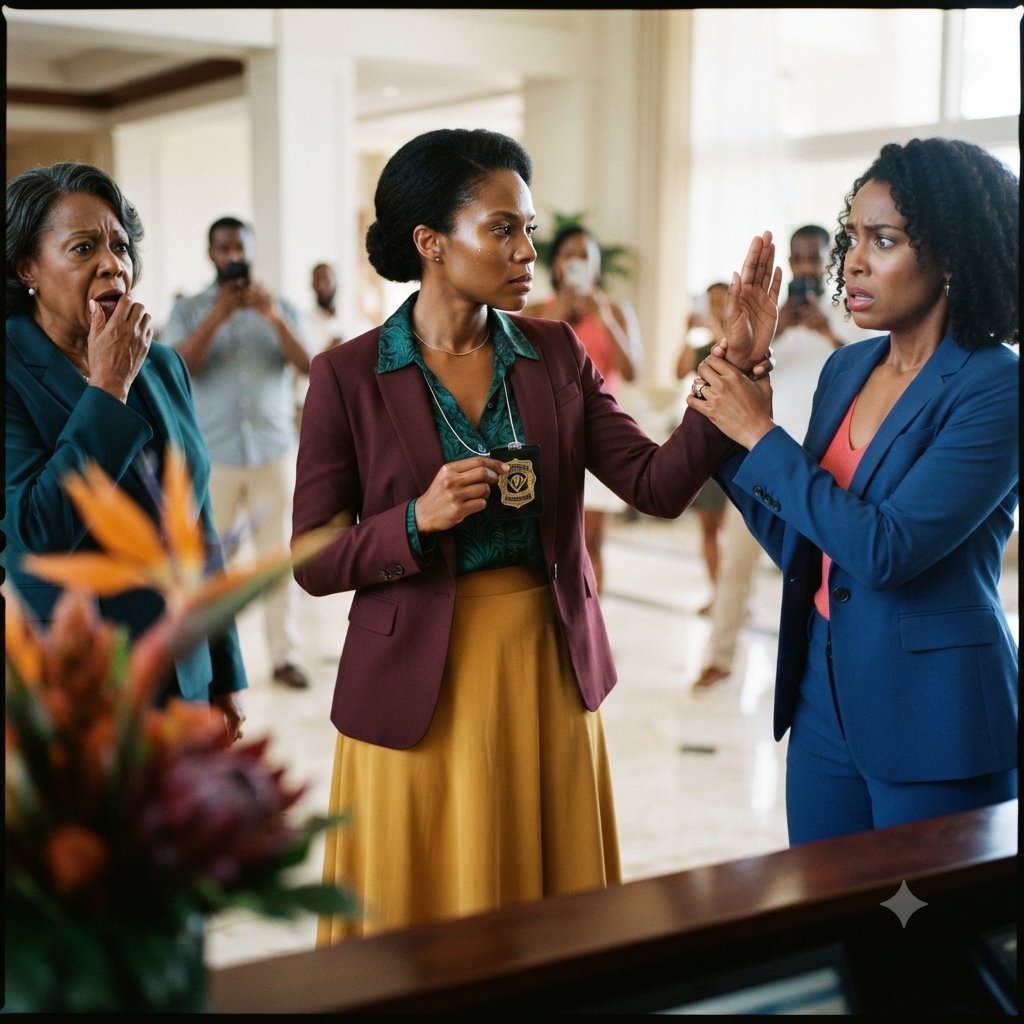
The party had ended by the time they emerged from the private room.
The venue staff were clearing tables, collecting glasses, folding linens.
The musicians had packed up.
The grand space that had held hundreds of Chicago's most powerful people now held only the quiet industry of people cleaning up after them.
Emma found her serving tray where she had left it, on a side table near the east corridor.
She picked it up.
Set it down again.
It seemed beside the point now.
Diane appeared at her side.
"Vincent would like a word before you leave."
"I should get back to—"
"Gerald has been spoken to," Diane said.
"You're covered for the rest of the evening."
Emma looked at her.
"You spoke to my manager?"
"Vincent did." Diane's expression was neutral but not unkind.
"He wanted to make sure you weren't penalized for what happened tonight."
Emma didn't know what to do with that.
She followed Diane to a quieter corner of the venue, where Vincent was standing with Isabella's wheelchair beside him.
The security team had pulled back to a respectful distance.
For the first time all evening, it was almost private.
Vincent looked at Emma directly.
"I owe you an apology."
Emma blinked.
"For what?"
"For the position you were put in.
My mother was in that corridor because I believed she would be safe.
I was wrong about that, and you paid the cost of my miscalculation." He paused.
"You shouldn't have had to make that choice."
"I'm glad I did," Emma said.
"So am I." He held her gaze.
"But that doesn't change the fact that it was a twenty-four-year-old waitress who acted, and not one of the forty people in that room with far more resources and far less to lose."
Emma thought about the faces she had seen in the crowd — the discomfort, the curiosity, the careful non-involvement of people who had decided the risk wasn't worth it.
"People protect what they can afford to protect," she said.
"Yes." Something shifted in his expression.
"And sometimes people protect things they can't afford to protect.
That's rarer.
And worth more."
Isabella reached up and touched Emma's hand again.
"Sit with me a moment."
Emma sat on a nearby chair, level with the wheelchair.
The ballroom around them was quiet now, just the distant sounds of the cleanup crew.
"My son tells me you have a father in hospital," Isabella said.
Emma went still.
"I mentioned it to my manager.
I don't know how—"
"Diane is thorough," Isabella said simply.
"It is not an intrusion.
It is information that matters." She looked at Emma steadily.
"What is his condition?"
Emma hesitated.
Then: "Heart.
He's been in and out for eight months.
The bills are — " She stopped.
"We're managing."
"You're working double shifts and managing," Isabella said.
"Yes."
"And your sister's tuition."
Emma looked at her hands.
"She doesn't know how close it is.
I didn't want her to worry."
Isabella was quiet for a moment.
Then she said, "You held a stranger's wrist in the air in front of five hundred people because she was frightened and alone.
You did not know who I was.
You did not know what it would cost you.
You simply — acted."
"Anyone would have—"
"No," Isabella said firmly.
"They would not.
We both know that."
Emma didn't argue.
Vincent spoke from behind her.
"I'd like to offer you something, Miss Carter.
Not as payment.
I want to be clear about that.
What you did tonight cannot be paid for, and I won't insult it by treating it that way."
Emma turned to look at him.
"My company runs a foundation that covers medical costs for families in financial hardship.
Your father's bills — all of them, from the beginning — will be handled through that foundation.
Your sister's tuition will be covered for the remainder of her degree." He paused.
"This is not conditional on anything.
It is not a transaction.
It is simply what I am able to do, and what I want to do."
Emma's throat closed.
She had been holding herself together all evening — through the confrontation, through the private room, through Victoria's apology and Richard's cold exit — and she had managed it all without breaking.
But this — this ordinary, specific, practical kindness, directed at the exact weight she had been carrying — undid something she hadn't known was held so tightly.
Her eyes filled.
She pressed her lips together.
"I don't—" she started.
"You don't have to say anything," Isabella said gently.
"I don't know how to—"
"You already did," Isabella said.
"Tonight.
You already did."
Emma looked down at her hands.
One tear fell onto her knuckle.
She didn't wipe it away immediately.
When she looked up, Vincent was watching her with an expression she hadn't seen on him all evening — not the controlled authority of the ballroom, not the precise coldness of the private room.
Something quieter.
Something that looked, she thought, like relief.
"There's one more thing," he said.
"If you're willing."
Emma waited.
"I'd like to offer you a position.
Not in catering." He glanced at Diane, who gave a small nod.
"My foundation's community outreach team has an opening.
The work involves connecting families in hardship with resources — medical, educational, legal.
It requires someone who understands what it means to need help and to ask for it anyway." He paused.
"It requires someone who acts when other people don't."
Emma stared at him.
"You don't have to decide tonight," he said.
"You don't have to decide at all.
But I wanted you to know the offer exists."
The cleanup crew moved quietly in the distance.
A glass clinked somewhere.
The lights above the empty ballroom were lower now, the grand space returned to something ordinary.
Emma thought about the double shifts.
The kitchen counter covered in envelopes.
Her father's voice on the phone saying he was fine, he was improving, don't worry.
Her sister's careful cheerfulness that fooled no one.
She thought about the moment in the corridor when she had felt Isabella trembling through the wrist she held, and had made a choice she couldn't afford.
"I don't need until tomorrow," Emma said.
Vincent waited.
"Yes," she said.