8:53.
Empty corridor.
8:54.
The service door opened.
A figure entered pushing a gray equipment cart.
Baseball cap.
Dark jacket.
Face turned away.
The door closed.
The figure moved out of frame.
No badge visible.
No escort.
Caleb said, “Track him.”
Reeves switched cameras.
Second angle.
The figure moved down the corridor.
Third angle.
Gone.
Reeves clicked again.
Nothing.
“There’s a blind zone,” he said.
Vane closed his eyes.
Caleb turned.
“You knew?”
“Camera upgrade was scheduled.”
“When?”
“Offseason.”
Caleb looked at the map.
The blind zone touched three storage rooms, a utility corridor, and a stairwell leading toward suite-service areas.
He felt no panic.
Panic narrowed thinking.
He had spent too many years training himself out of it.
“Lock internal service doors around the zone. Quietly.”
Reeves moved.
“Notify law enforcement liaison. Small team. No public response unless we find something.”
Mallory stepped forward.
“I know that corridor.”
Caleb looked at him.
“So does half your staff.”
“I know which doors stick.”
Lena said, “So do I.”
Caleb shook his head.
“You both stay here.”
Mallory frowned.
“You need people who know the layout.”
“I need people who aren’t part of the search command.”
“You think I’m involved?”
“I think you made bad decisions this morning.”
Mallory took that without flinching.
Then he said, “And I told you why.”
Caleb studied him.
Mallory continued.
“Let me help fix one.”
Caleb almost refused.
Then he remembered something.
Gate C.
The catering case.
Mallory had recognized it after first denying he knew the man.
Not because he was part of the arrangement.
Because he had learned to stop seeing exceptions.
That was different.
Maybe useful.
Caleb looked at Lena.
She said, “There’s a utility crossover that isn’t on the visitor map.”
Reeves looked up.
“She’s right.”
Caleb made the decision.
“Fine. You come with me. Both of you stay behind law enforcement. You do not freelance.”
Mallory nodded.
Lena did too.
Vane said, “And me?”
Caleb looked at him.
“You stay exactly where I can find you.”
Part V — The Blind Zone
The lower west corridor did not feel like a stadium.
Above them, tens of thousands of fans shouted as player introductions began.
Down here, fluorescent lights hummed over concrete block walls.
Pipes ran along the ceiling.
A faint vibration moved through the floor whenever the crowd reacted to something on the field.
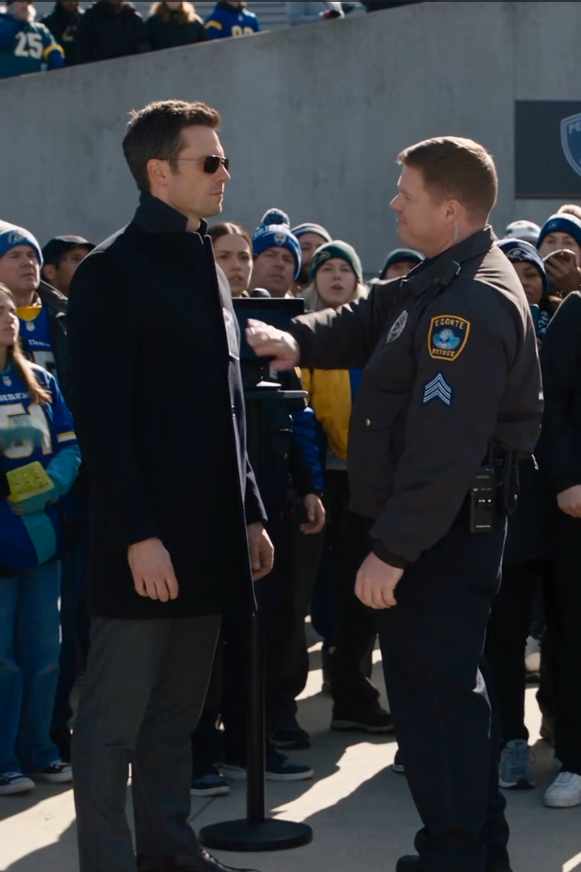
Caleb walked behind two law-enforcement officers from the stadium detail.
Mallory and Lena followed.
Reeves remained in command, feeding camera updates through radio.
The unidentified entry had occurred nearly three hours earlier.
That bothered Caleb more than if it had happened ten minutes ago.
Ten minutes left urgency.
Three hours left possibilities.
They reached the service door from the footage.
No damage.
Mallory pointed to the latch.
“That door doesn’t close clean unless you pull it.”
Caleb looked at the sensor.
“So someone could exit without noticing it stayed open?”
“Or enter if somebody left it unsecured.”
Lena crouched slightly near the lower frame.
“There.”
A strip of folded plastic had been wedged near the latch plate.
Thin.
Nearly invisible.
The law-enforcement officer removed it with gloves.
The door had been deliberately prevented from locking.
Caleb keyed his radio.
“Reeves, service door was defeated manually. Preserve every access record for this area.”
“Copy.”
Vane’s voice came over another channel in the background, arguing with someone.
Caleb ignored it.
They moved deeper.
First storage room.
Clear.
Second.
Clear.
Third door was locked.
Lena said, “That room should be open on game day.”
Mallory nodded.
“Cleaning equipment.”
The lead officer tested the handle.
Locked.
“Key.”
Mallory reached toward his belt.
Caleb stopped him.
“Officer does it.”
The law-enforcement officer used a master key.
Door opened.
Mops.
Chemical containers.
Paper products.
Nothing unusual.
Then Lena pointed.
The back wall.
“Those shelves are wrong.”
Caleb looked at her.
“What?”
“They’re usually against that side.”
Mallory stepped closer.
“She’s right.”
The shelving unit had been moved eighteen inches away from the wall.
Behind it was a narrow maintenance panel.
The screws had been loosened.
The officer opened it.
Inside ran electrical conduits and network cabling.
One small black device was clipped to a data line.
No one touched it.
Caleb looked at the officer.
“Call technical response.”
Mallory whispered, “What is that?”
Caleb answered carefully.
“I don’t know yet.”
He did know one thing.
It did not belong there.
His radio crackled.
Reeves.
“Caleb.”
The use of his first name told him something had changed.
“Go.”
“We found another camera match.”
“Where?”
“Same individual. 9:12. Premium service stairwell.”
“Then?”
“Camera catches him entering a suite-service prep area.”
“Exiting?”
Pause.
“No.”
Caleb looked toward the ceiling.
Above them was a premium seating level.
Private suites.
Corporate guests.
Team executives.
League personnel.
He keyed the radio.
“Which suite zone?”
“West twenty through thirty.”
“Clear staff from service corridors in that section. Quietly. Don’t move guests yet.”
Mallory looked at him.
“You think he’s still here?”
“I think we haven’t seen him leave.”
They moved.
The stairwell door opened onto a carpeted service corridor lined with catering carts, linen stations, and storage alcoves.
The contrast was immediate.
Below: concrete and pipes.
Here: soft lighting and polished trim, designed so wealthy guests never had to see how the building worked.
A catering employee stood near a prep station.
The officer showed her the surveillance still.
“Seen him?”
She squinted.
“Maybe.”
“When?”
“This morning.”
“Where?”
She pointed down the hall.
“He asked where Suite Twenty-Seven was.”
Caleb’s stomach tightened.
“Did you tell him?”
“Yes.”
“Why?”
“He had an equipment cart.”
That was the answer.
Not because he had a badge.
Not because he had identification.
Because he looked like he belonged.
Caleb looked at Mallory.
Mallory understood.
Same mistake.
Different uniform.
They approached Suite Twenty-Seven from the service side.
The door was closed.
According to Reeves, the suite had not yet been occupied by guests. It belonged to a corporate sponsor whose group typically arrived shortly before kickoff.
The lead officer opened the service door.
Empty room.
Leather seats.
Countertop.
Refrigerators.
Large glass opening toward the field.
Television screens showed pregame coverage.
No equipment cart.
Lena walked toward the counter.
“Storage closet.”
Mallory opened it.
Empty.
Caleb looked at the floor.
A faint dark streak ran toward another door.
Wheel mark.
The misaligned caster from a cart.
He followed it.
The door led into a shared mechanical passage behind adjacent suites.
The passage was narrow.
No public cameras.
At the far end, another door stood slightly open.
Caleb signaled.
The officers moved first.
Beyond it was a communications closet.
And inside, crouched beside an open rack, was the man from the surveillance footage.
He froze.
For half a second nobody moved.
Then his hand shifted toward a backpack.
“Hands.”
The command was immediate.
He stopped.
Both hands came up.
The backpack remained on the floor.
The officers secured him.
Caleb stayed back until they cleared the space.
No weapon was found on his body.
Inside the backpack were tools, cable adapters, two small electronic devices, a tablet, and several cloned stadium credentials.
Mallory stared.
Lena’s face had gone pale.
Caleb looked at the open communications rack.