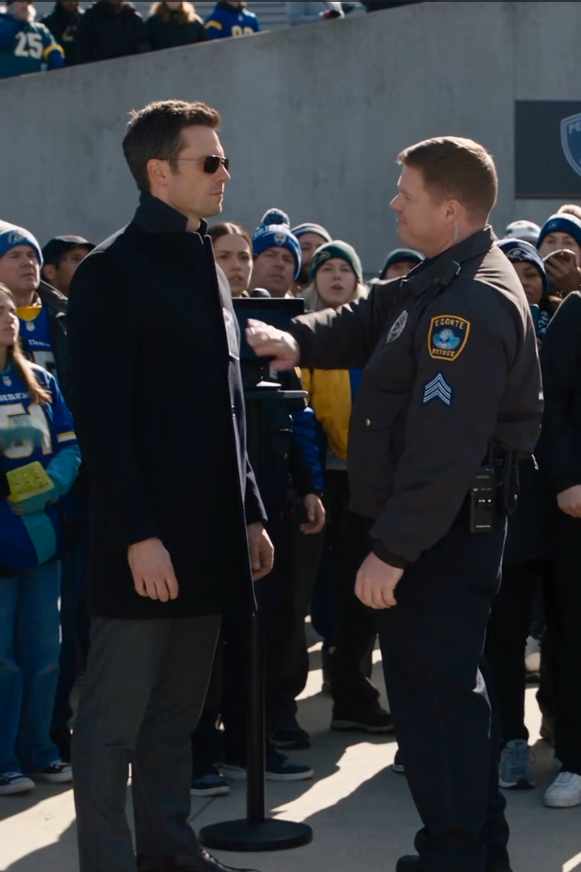
A cable had been disconnected.
Another device, similar to the one downstairs, had been attached between network components.
This was no hospitality shortcut.
No harmless vendor exception.
Reeves came over the radio.
“What do you have?”
Caleb answered.
“Unauthorized person in custody. Electronic devices attached to stadium network. Initiate cyber incident protocol.”
Silence.
Then Reeves:
“Copy.”
A second voice came through.
Vane.
“Caleb, listen to me before you—”
Caleb switched channels.
He did not want Vane in his ear.
The detained man looked at him.
“You don’t know what this is.”
Caleb said, “That makes two of us.”
The man smiled faintly.
“No. You really don’t.”
Caleb did not engage.
He had learned that people in custody often mistook mystery for leverage.
He stepped into the corridor.
Mallory followed.
“I spent eleven years telling people those doors were secure.”
Caleb looked at him.
“They are secure when the process around them is secure.”
Mallory rubbed his face.
“All those times we waved somebody through…”
“This didn’t happen because of one officer waving one person through.”
Mallory looked at him.
“It happened because enough people learned that exceptions didn’t need explaining.”
For once, Mallory had no response.
Lena came out behind them.
“They found his real ID.”
Caleb turned.
She gave him the name.
It meant nothing to him.
“Any connection to the hospitality supplier?”
“Not yet.”
That was when Caleb understood the most dangerous possibility.
Maybe there was no connection.
Maybe the supplier had not brought this man in.
Maybe Vane’s hidden exception had done something worse than allow a questionable vendor.
It had trained the system to accept unexplained access.
Once staff became accustomed to bad credentials being waved through, anyone who observed long enough could imitate the pattern.
The vulnerability was cultural.
Not personal.
That made it larger.
His radio crackled again.
Reeves.
“Technical team says the devices may have been used to capture credential data and internal network traffic.”
“May?”
“They need time.”
“How much?”
“Unknown.”
Caleb looked toward the suite glass.
Players were gathering at midfield.
Kickoff was less than twenty minutes away.
“What systems could be affected?”
“Access control. Internal cameras. Some operations communications.”
“Public safety?”
“Possibly.”
The word hung there.
Possibly.
Caleb closed his eyes for one second.
Then opened them.
This was the choice Vane had warned about.
Stop the event and create one kind of danger.
Continue the event while uncertain of another.
There would be no perfect answer.
Only a defensible one.
He keyed the radio.
“Reeves, I want an immediate segmentation of affected network systems. Move access control to local verification where possible. Law enforcement at all restricted transitions. No manual overrides.”
“We can do that.”
“Can you isolate public-address and life-safety systems?”
“Yes. Those are separate.”
“Confirm, don’t assume.”
“Understood.”
Vane’s voice cut in on a different channel.
“You’re not stopping the game.”
Caleb switched back.
“Marcus, this is no longer your decision.”
“You stop it, people outside will surge gates.”
“Most fans are already inside.”
“You’ll create panic.”
“Not if we manage it.”
“You have no evidence he intended physical harm.”
“I have evidence your access system was penetrated.”
“That’s not the same thing.”
“No.”
Caleb looked down the corridor.
“That’s why I’m not evacuating.”
Vane went quiet.
Mallory stared at him.
Lena did too.
Caleb continued into the radio.
“But kickoff is delayed until the affected systems are isolated and every restricted-access point is under manual control.”
Vane came back immediately.
“You cannot delay a nationally broadcast game based on a cyber theory.”
Caleb’s voice remained calm.
“Watch me.”
The announcement to the stadium did not mention security.
A technical delay.
That was all.
Most fans booed.
Then music started.
The scoreboards showed highlights.
People bought food.
The world did not end.
Behind the walls, two hundred security employees shifted assignments.
Law-enforcement officers moved to internal access points.
Credential scanners were disconnected from network synchronization and placed into limited local verification.
Vendor movement stopped.
Suite-service corridors were checked.
The affected network segment was isolated.
Every open service door was physically inspected.
At 12:57, technical response confirmed that life-safety systems were independent and uncompromised.
At 1:04, they confirmed the attached devices had captured credential traffic.
At 1:11, they found that three cloned credentials in the detained man’s backpack corresponded with employees who had worked Gate C during previous events.
At 1:16, they found something worse.
One credential belonged to Lena Ortiz.
She stared at the printout.
“I’ve never lost my badge.”
“You didn’t need to,” the technician said. “If the device captured the data…”
She looked at Caleb.
Her face told him she understood.
Someone could have entered as her.
Mallory sat heavily in a chair.
The technician continued.
“We think the individual was testing whether cloned credential data could be accepted at local readers after capturing valid scans.”
Caleb asked, “Did he succeed?”
“One access record suggests yes.”
Vane, standing against the far wall under supervision, looked up.
“Where?”
The technician named a door near the communications level.
Vane closed his eyes.
Caleb looked at him.
“Still clerical?”
Vane did not answer.
At 1:24, after all restricted zones had been swept and network isolation was confirmed, Caleb authorized resumption.
The game began thirty-eight minutes late.
The stadium roared when the teams took the field.
From the command office, Caleb watched the crowd rise.
Nobody in the stands knew how close the building had come to continuing under an access system they could not trust.
That was fine.
Security did not require applause.
Sometimes success looked exactly like nothing happening.
Behind him, Marcus Vane said, “You got lucky.”
Caleb turned.
Vane’s voice was tired now.
The polish was gone.
“If that crowd had panicked outside—”
“They didn’t.”
“If the league had refused the delay—”
“They didn’t.”
“If the device had affected emergency systems—”
“It didn’t.”
Vane shook his head.
“You’re proving my point. Every decision is compromise.”
Caleb walked toward him.
“No. Every decision has tradeoffs.”
“What’s the difference?”
“A compromise can be documented, reviewed, challenged, and corrected.”
Caleb pointed toward the audit report.
“What you did was hidden.”
Vane’s jaw moved.
“You think hiding something makes it different?”
“Yes.”
“Why?”
“Because once nobody can see the exception, nobody can measure what it costs.”
Vane looked away.
The crowd thundered beyond the glass.
Caleb continued.
“You didn’t create today’s intruder.”
Vane looked back, surprised.
“No,” Caleb said. “But you created the environment that made him harder to detect.”
That was worse.
They both knew it.
Part VI — After the Noise
The stadium was nearly empty by midnight.
Cleaning crews moved through the aisles.
Discarded cups rolled beneath seats.
The giant video boards had gone dark.
Without sixty thousand people inside it, the building felt less like a monument and more like machinery.
Caleb returned to Gate C.
The exterior barricades had been pulled aside.
Cold air moved through the entrance.
Lena Ortiz sat on a folding chair beside the scanner station, finishing a statement.
Brent Mallory stood nearby without his security jacket.
He held it folded over one arm.
Caleb approached.
Lena looked up.
“Mr. Stone.”
“Caleb is fine.”