Part I — The Stop
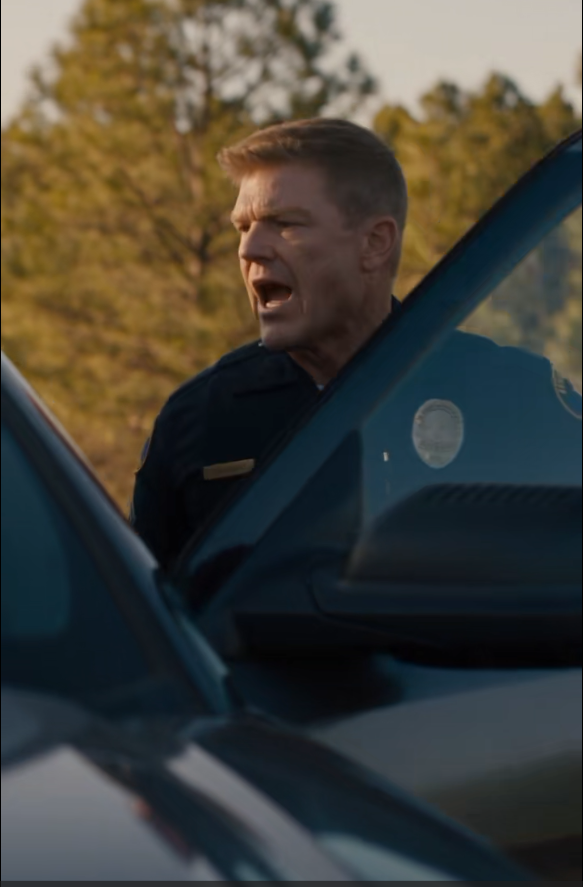
The first thing Officer Travis Mercer did after ripping open Renee Lawson’s SUV door was grab her hard enough to make a choice necessary.
Not a difficult choice.
Not yet.
Renee had made harder ones in darkness, under fire, with exhausted people watching her face for an answer she did not have. She had made them with seconds left and bad options multiplying. She had learned years ago that panic wasted time, anger narrowed vision, and pride got people hurt.
So when Mercer’s hand closed around her forearm and he barked, “Out,” she did not pull away.
She stepped out.
That difference mattered to her.
It did not seem to matter to him.
Deputy Cole Barrett came around the front of the SUV and shoved Renee toward the hood, one palm pressing high between her shoulders and the other briefly catching the back of her neck.
“People like you need to learn when to follow orders.”
The words were low enough that they might have disappeared into the wind if Renee had been anyone else.
She wasn’t.
She heard everything.
The tick of cooling metal from her engine. The hiss of tires from a passing sedan. The faint electrical crackle as Mercer drew his taser. The scuff of Barrett’s boot in loose gravel. The change in Mercer’s breathing when he realized cars behind them were slowing instead of moving on.
Renee planted both palms flat against the hood.
“I am cooperating,” she said.
Mercer stepped into the edge of her vision.
“Then stop talking.”
Twenty minutes earlier, she had been alone with the road.
That had been the point of the drive.
Late-afternoon sunlight moved in bands between tall Alabama pines, warm across the windshield and then gone again as the road curved. Renee had driven with the radio off. No secure handset on the passenger seat. No briefing packet open beside her. No aircraft waiting with rotors turning. No one asking her to decide whether six people should move left, right, forward, or not at all.
Just the muted hum of tires over pavement.
For someone who had spent years treating silence as a warning, ordinary silence had become a luxury.
She noticed the first patrol car in the rearview mirror without thinking much about it.
The second appeared two minutes later.
Then both remained.
Five minutes.
Ten.
Fifteen.
Whenever Renee eased off the accelerator, they eased off too. When the highway opened and she held steady, they kept their distance.
She checked the speedometer twice.
Under the limit.
She checked her mirrors.
Nothing loose. No broken light reflected strangely off the pavement. No reason for attention she could identify.
Still, she did what experience had taught her to do in unfamiliar situations: give no one an excuse to misread movement.
Hands visible.
Speed constant.
No sudden reach toward the center console.
Then both cruisers accelerated.
The first moved around her left side.
The second closed behind.
The lead car swerved abruptly across the lane.
Renee braked hard.
Her SUV dropped onto the shoulder, suspension dipping as gravel sprayed beneath the tires.
“Keep your hands where we can see them!”
The order came through a loudspeaker, distorted by static.
Renee placed both hands high on the wheel.
Mercer approached the driver’s side with his right hand near his holster. Barrett went to the passenger side.
Renee lowered her window three inches.
“Is there a problem, officers?”
“Window all the way down.”
“I’m happy to cooperate, but I’d like to know why I’ve been stopped.”
Barrett struck the passenger window twice with his knuckles.
“You heard him.”
“I heard him clearly. I’m asking for the reason for the stop.”
Mercer bent toward the opening.
His face was flushed beneath the brim of his hat.
“You don’t ask the questions here.”
That was the first moment Renee understood that the stop might not resolve through ordinary procedure.
Not because his tone offended her.
Tone was noise.
Procedure was signal.
No stated reason for the stop.
No request for license or registration.
No explanation of a traffic violation.
No instruction that made sense beyond submission itself.
Renee’s attention sharpened.
She looked at Mercer’s badge number.
Then Barrett’s.
She memorized the patrol unit numbers.
Their faces.
The location.
The position of the vehicles.
She checked the small dark squares centered on their uniforms.
Neither body camera showed the indicator she expected.
“Are your body cameras recording?”
For half a second, no one spoke.
Mercer straightened.
“Unlock the vehicle.”
“Before I exit, I need you to state clearly why I was stopped.”
He pulled the handle.
“Unlock it now.”
A sedan rolled past slowly.
Renee saw a phone raised in the passenger window.
Another vehicle stopped farther back.
Witnesses changed behavior.
That was another signal.
Mercer looked toward them.
His mouth flattened.
“Last chance.”
“I am not resisting you. I am asking you to explain why I was stopped.”
He reached through the narrow window opening.
Found the interior lock.
Pulled.
The door came open hard enough to bounce against its hinge.
Then his hand closed around her arm.
Now, standing against the hood with Barrett behind her and Mercer’s taser crackling near her side, Renee replayed the sequence once.
Not emotionally.
Chronologically.
That habit had saved her before. Facts first. Interpretation later.
She turned her face slightly.
“Officer, lower the weapon.”
Mercer laughed once.
“You think you’re giving orders now?”
“I’m telling you there is no need for that.”
He stepped closer.
The taser dropped lower.
For an instant Renee thought he might holster it.
Instead he reached up with his free hand and seized her chin.
He forced her face toward him.
Something inside Renee became very still.
Not rage.
Rage was useless unless given a job.
This was assessment.
Distance.
Balance.
His right foot forward.
Weight loaded unevenly.
Barrett’s grip high and sloppy.
Witnesses to the rear.
Traffic to the left.
Gravel underfoot.
Taser in Mercer’s right hand.
Renee looked directly at him.
“Take your hand off me.”
Barrett shifted.
“Mercer.”
Mercer did not look away.
Barrett glanced toward the cars gathering behind the cruisers.
“Maybe we should just cuff her.”
“No.”
Mercer stepped back.
The movement was small.
But Renee saw his shoulder rotate.
His weight settled.
His fist tightened.
“She needs to understand how this works.”
Renee’s voice lowered.
“Don’t.”
Mercer swung.
Renee moved.
The motion was compact enough that several witnesses later disagreed over exactly what they had seen.
She turned sideways, broke Barrett’s grip with a controlled rotation of her shoulder, and drove one precise punch into Mercer before his fist reached her.
No follow-up.
No chase.
No attempt to control him after he stumbled backward into his cruiser.
His taser dropped into the gravel.
Renee stepped away immediately.
Both hands open.
Visible.
“Do not touch me again.”
The quality of her voice changed.
Barrett heard it.
So did Mercer.
It was not louder.
It was worse for them than loud.
It carried the effortless certainty of someone who had spent years giving instructions in places where hesitation cost lives.
Barrett’s right hand moved instinctively toward his holster.