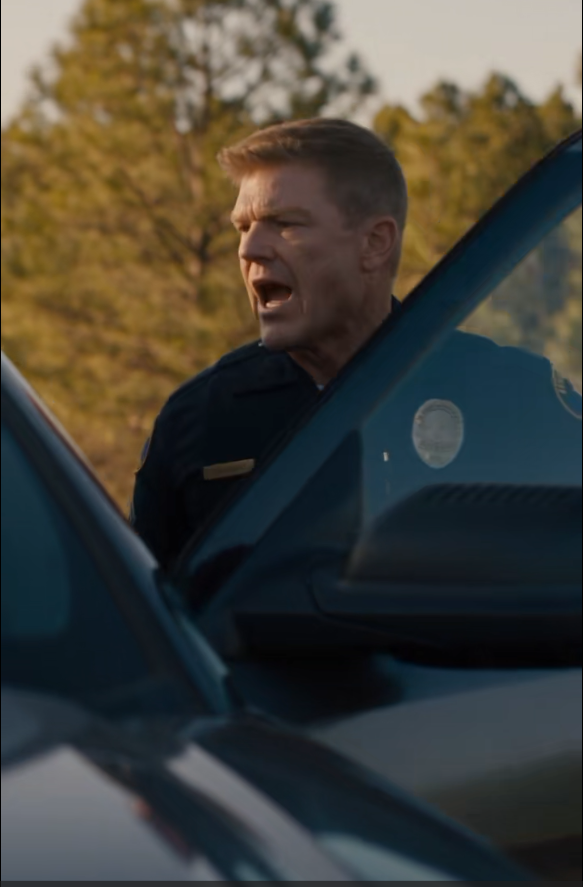
Renee saw it.
She did not move.
Then Barrett’s gaze dropped.
Something lay on the gravel beside the SUV.
A leather identification case.
It had slipped from inside Renee’s jacket when Barrett shoved her forward.
The case had fallen open.
Barrett stared at it.
His hand stopped halfway to his weapon.
Mercer held one palm against his jaw.
“What?”
Barrett did not answer.
The insignia inside the case caught the late sun.
His face changed.
“Mercer.”
“What?”
“You need to see this.”
Renee’s eyes moved from Barrett to the case.
She knew exactly what he was seeing.
And she hated that it had become necessary.
Mercer took one step closer.
Then engines sounded around the bend.
Not one.
Several.
Fast.
All three of them looked toward the highway.
Three dark government vehicles appeared between the trees.
The lead SUV flashed concealed emergency lights.
The second stayed tight behind it.
The third moved wide enough to block approaching traffic.
For the first time since the stop began, Mercer did not look angry.
He looked uncertain.
Renee watched the realization form slowly across his face.
The woman he had pulled from the SUV might not have been what he had decided she was.
The lead government vehicle braked hard behind the patrol cars.
Doors opened.
Renee did not look back.
Her eyes remained on Mercer.
“Now,” she said quietly, “you’re going to tell me why you stopped me.”
Part II — Pressure
The first man out of the lead vehicle wore no visible insignia.
He did not need one.
His posture identified him before anything else did: economical movement, eyes checking hands before faces, attention sweeping the shoulder in sections.
Two others moved with him.
None drew a weapon.
All three immediately recognized Renee.
The first man stopped several yards away.
“Commander.”
Mercer’s eyes flicked toward her.
The word seemed to land harder than the punch had.
Renee looked at the government team.
“I’m fine.”
The team leader’s gaze dropped briefly to the taser in the gravel, then to Mercer’s reddening jaw, then to Renee’s open identification case.
His expression gave away almost nothing.
“Ma’am?”
“I said I’m fine.”
That settled his posture, if not his concern.
Renee pointed toward the stopped civilian vehicles.
“Get names and contact information from anyone who recorded the stop. Do not take anyone’s phone. Do not ask anyone to delete anything. Just preserve what they’re willing to provide.”
“Yes, Commander.”
Mercer stared.
Barrett looked toward the road as though he were considering whether he could somehow step out of the last ten minutes and return to the beginning.
He could not.
Renee crouched and picked up her identification case.
She wiped a smear of dust from the leather with her thumb.
The small act brought the entire scene back into proportion.
Road.
Cars.
Witnesses.
Two officers.
A team that had arrived because Renee had missed a routine security check-in after her vehicle abruptly stopped moving.
Nothing supernatural.
No rescue descending from nowhere.
Systems had simply noticed something they were designed to notice.
That mattered.
Renee did not want Mercer later claiming federal force had materialized because she had secretly summoned it to intimidate him.
She closed the case and slipped it back into her jacket.
“Officer Mercer,” she said.
He stared at her.
“Why did you stop me?”
Mercer glanced at Barrett.
Barrett said nothing.
“Vehicle matched a description.”
“What description?”
“Suspicious vehicle.”
“That is not a description.”
Mercer’s jaw tightened.
“Dark SUV.”
Renee waited.
Mercer looked past her.
“That’s what we had.”
“A dark SUV?”
“There’d been reports.”
“Of what?”
Mercer exhaled through his nose.
“Possible theft activity.”
“Where?”
No answer.
Renee glanced toward Barrett.
“Deputy?”
Barrett shifted his weight.
“Dispatch put out a notice.”
“What exactly did dispatch say?”
Another silence.
The team leader had moved far enough away to speak with the witnesses. Renee saw one woman pointing back toward Mercer while holding her phone with both hands.
Renee returned her attention to Barrett.
“What exactly did dispatch say?”
Barrett rubbed the heel of his hand across his mouth.
“It was vague.”
Mercer turned toward him sharply.
“Cole.”
Barrett ignored him.
“Possible vehicle connected to theft complaints. Dark color. SUV.”
“Plate?”
“No.”
“Make?”
“No.”
“Model?”
“No.”
“Number of occupants?”
Barrett looked down.
“No.”
Renee nodded once.
“Direction of travel?”
Barrett hesitated.
“North.”
Renee had been driving south.
Mercer cut in.
“The vehicle could’ve turned around.”
Renee looked at him.
“So you followed me for fifteen minutes.”
“We were observing.”
“You never ran my plate?”
Mercer did not answer.
That was answer enough.
Renee looked at Barrett.
“Did you?”
Barrett swallowed.
“No.”
A hot wind moved along the shoulder, carrying pine dust and exhaust.
Renee had been in places where danger was obvious.
This was not one of them.
That made it worse in a different way.
There had been time here.
Time to verify.
Time to think.
Time to lower the temperature.
Every step toward violence had been optional.
She turned toward the nearest government SUV.
“Call the county supervisor.”
Mercer’s head lifted.
“We can handle our own scene.”
Renee looked back at him.
“This stopped being your scene when you refused to identify a lawful reason for detaining me, disabled your camera, forced entry into my vehicle, and tried to hit me.”
“You hit me.”
“Yes.”
The simplicity of the answer unsettled him.
Renee continued.
“After you initiated physical force while I was restrained by your deputy.”
Mercer pointed at her.
“You asNextlted an officer.”
The government team leader started forward.
Renee lifted one finger without looking at him.
He stopped.
Then she looked at Mercer.
“If you believe that, arrest me.”
Barrett’s face turned toward her.
Mercer blinked.
Renee stepped closer—not threatening, not challenging his space, simply making sure he heard every word.
“If you believe you have probable cause, put me in cuffs and arrest me. Right now. In front of every camera on this road.”
Mercer’s mouth opened.
Nothing came out.
Renee waited.
The longest ten seconds of the stop passed in silence.
Finally Barrett spoke.
“Mercer.”
Mercer rounded on him.
“What?”
Barrett looked at the gravel.
“Don’t.”
Mercer stared at him.
Barrett’s voice remained low.
“Just don’t.”
The refusal was small.
It changed everything between them.
A county supervisor arrived nine minutes later in a marked SUV.
By then, the sky had begun losing color.
Renee had moved away from the officers and stood near her own vehicle while one member of her team photographed the scene: the open door, tire marks, position of the cruisers, taser on the ground, every detail preserved without touching anything unnecessarily.
The supervisor was older than both officers, broad through the shoulders, gray beginning at his temples. He stepped out, took one look at the arrangement of government vehicles and civilians still watching from the roadside, and slowed.
“Mercer.”
Mercer went to him immediately.
They spoke several yards away.
Renee could not hear every word.
She did not try.
Barrett remained near his cruiser.
He looked younger now.
Not physically.
In posture.
The certainty had gone out of him.