She signaled.
Pulled onto the shoulder.
Put the vehicle in park.
Hands visible.
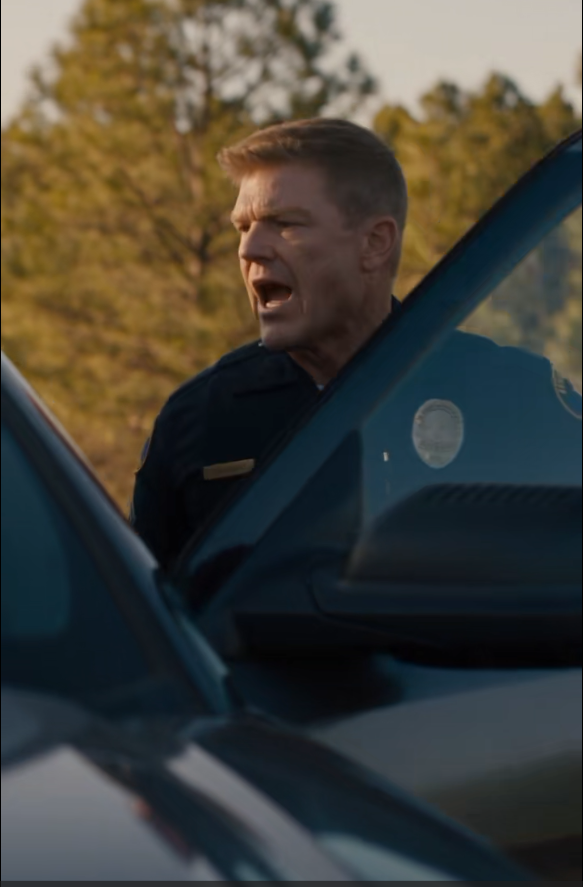
The officer approached on the passenger side.
Renee recognized him before he reached the window.
Cole Barrett.
He looked older.
Only a little.
He tapped lightly on the glass.
Renee lowered it.
Barrett stood there for a second, then said, “Your right brake light is out.”
Renee looked toward the dashboard.
“No warning.”
“Probably the bulb.”
He hesitated.
“I’m not writing you up.”
Renee’s mouth moved by a fraction.
“Then why stop me?”
Barrett almost smiled.
“Because a brake light is out.”
The answer was so ordinary that something in Renee loosened.
Barrett noticed.
He stepped back slightly.
“I can show you if you want.”
“I believe you.”
He nodded.
Neither spoke for a moment.
Traffic passed.
No phones appeared.
No extra cruisers.
No emergency convoy rounded the bend.
Just two people on the side of a road where both remembered being worse versions of themselves—one because of what had been done to her, the other because of what he had helped do.
Barrett cleared his throat.
“I watched your statement.”
Renee looked at him.
“So did half the country.”
“Probably.”
Another pause.
“The line about being ordinary.”
Renee waited.
Barrett looked toward the highway.
“I think about that.”
“You should.”
He nodded.
“I do.”
Renee studied him.
No dramatic transformation showed on his face.
No clean redemption.
That was fine.
Real change rarely arrived with music behind it.
It looked more like repetition.
Small decisions made correctly after larger ones had gone wrong.
Barrett stepped away from the SUV.
“Get that light replaced.”
“I will.”
He tapped the roof once, then stopped himself.
His hand hovered.
He gave Renee a slightly embarrassed look.
She almost laughed.
“Old habit?”
“Trying to lose a few.”
“Good.”
Barrett stepped back toward his cruiser.
Renee started the engine.
Before she pulled away, she lowered the window again.
“Deputy.”
He turned.
“What did I do that made you stop me?”
Barrett looked at the rear of the SUV.
“Your brake light failed.”
“Anything else?”
“No.”
Renee nodded.
“That’ll do.”
She drove on.
The road curved south through the pines.
Late sunlight crossed the windshield in long bands exactly as it had the first time.
For several miles, Renee listened only to the tires.
She thought about Mercer.
Not often anymore.
She thought more about systems.
About Barrett’s hand on the back of her neck.
About Danner wanting to keep things small.
About six old complaints filed one at a time and never placed side by side.
About how easily people mistook authority for accuracy.
About the identification case lying open in the gravel.
That image had bothered her more than the punch.
Because the insignia had changed the scene.
Not legally.
Socially.
Before the case opened, Mercer believed he understood who she was.
Afterward, he suddenly feared he had chosen the wrong person.
Renee no longer accepted that phrase.
Wrong person.
As though someone else might have been right.
She reached the place where the shoulder widened.
The exact location of the stop was difficult to identify now.
Rain and traffic had erased the tire marks.
Gravel had been replaced.
There was no sign.
No marker.
No reason for anyone passing at fifty-five miles an hour to know what had happened there.
Renee slowed slightly.
Not enough to stop.
In the mirror, the road behind her remained empty.
For years, she had believed control meant reducing uncertainty.
Know the terrain.
Know the threat.
Know your people.
Know what comes next.
The highway had reminded her of something less comfortable.
Sometimes the deepest test of discipline came when someone else had power, made a false assumption, and demanded that you accept it as reality.
Renee had not accepted it.
But neither had she allowed anger to decide what came after.
That mattered to her more than the punch.
More than the hearing.
More than the headlines.
Her phone sat silent in the console.
No urgent radios.
No helicopters.
No team waiting for a command.
The same quiet she had wanted before the stop returned at last.
This time, it did not feel fragile.
Renee drove beneath the long shadows of the pines, one hand resting lightly on the wheel.
Behind her, the empty road folded into distance.
Ahead, evening light opened between the trees.
And on a highway where one officer had once looked at her and decided a feeling was enough, Renee kept driving with the certainty that had carried her through places far more dangerous:
No one’s assumption became the truth simply because they had the authority to say it first.