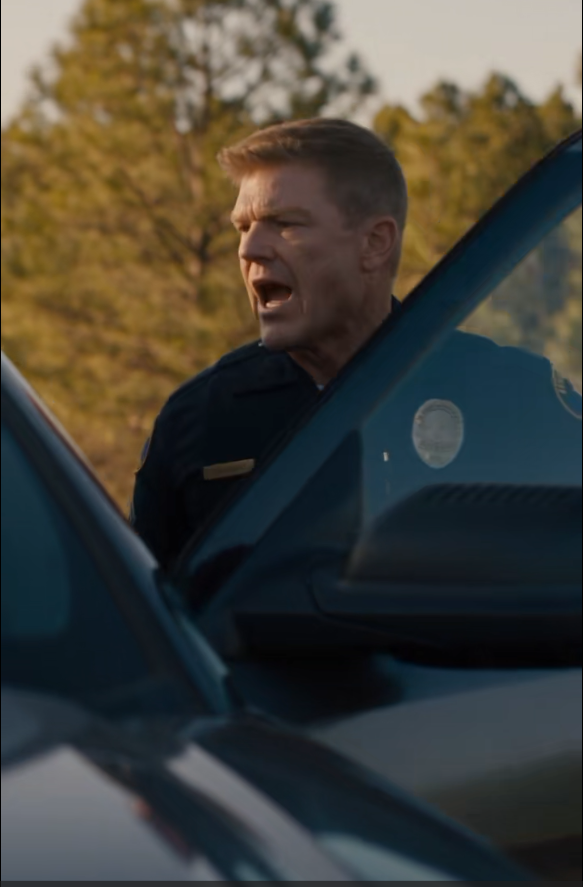
Each sentence landed without volume.
Mercer’s shoulders lowered a fraction.
Renee looked at him for several seconds.
“That’s the part you still don’t understand.”
“What?”
“The worst thing you did wasn’t misjudge me.”
He stared.
“It was deciding you didn’t need to check whether you were wrong.”
The corridor went still.
Mercer looked toward Danner.
Then Barrett, who had emerged from the hearing room and stood near the doorway.
Then back to Renee.
For once, no one filled the silence for him.
His attorney guided him away.
Renee watched until he turned the corner.
Danner approached.
“Commander.”
“What happens now?”
“Termination recommendation goes forward.”
“And criminal review?”
“Still active.”
“Prior complaints?”
“Reopened.”
Renee nodded.
Danner hesitated.
“There’s one more thing.”
“What?”
“We found another video.”
Renee’s expression sharpened.
“From my stop?”
“No.”
He handed her a tablet.
The video was eight months old.
A dash camera from a private vehicle.
Mercer stood beside a sedan at night.
A young man was outside the car, hands on the roof.
Audio was poor.
The driver recording from behind had captured only fragments.
Mercer leaned toward the man.
Then the young man turned his head.
Mercer shoved him forward.
The angle shifted.
The clip ended.
Renee looked at Danner.
“Was this part of a complaint?”
“Yes.”
“What happened?”
“The complainant withdrew.”
“Why?”
“We don’t know.”
Renee handed the tablet back.
Danner’s face had gone hard.
“We’re finding out.”
There was no triumph in Renee.
Only exhaustion.
This was what she had feared.
Not that her stop was unique.
That it wasn’t.
“What do you need from me?” she asked.
Danner looked surprised.
“Nothing.”
“That’s not what I asked.”
He considered.
“We’re reviewing every stop Mercer made over the last five years where no citation or arrest followed.”
“That’s a lot of work.”
“Yes.”
“Do it.”
Danner gave a tired half-smile.
“I was planning to.”
“Good.”
Renee turned toward Barrett.
He stood alone.
She walked over.
Barrett straightened.
“Commander.”
“You testified.”
“Yes.”
“You told the truth?”
“Yes.”
“All of it?”
He met her eyes.
“Yes.”
Renee nodded.
“What are you going to do now?”
Barrett looked through the corridor window.
“I don’t know if I should stay.”
“That’s your decision.”
“I thought you might tell me.”
“No.”
He frowned.
Renee continued.
“If you stay because you want absolution, leave. If you leave because you’re ashamed, that’s not automatically better.”
Barrett looked at her.
“Then what am I supposed to do?”
“Decide what kind of officer you would be after knowing what you know now.”
He absorbed that.
Renee picked up her coat.
“And then live with the answer.”
That was the harder choice she had been moving toward too.
Not whether to punish Mercer.
Processes would decide that.
Her choice was whether to let the story become about exceptional status.
Commander.
Delta Force.
Decorated.
Government convoy.
Those were the details the public loved.
They were also the details most likely to destroy the point.
Renee had to decide whether to step forward publicly.
Her command preferred silence.
Her counsel preferred a tightly written statement.
The county wanted the investigation to conclude first.
Media wanted an interview.
Activists wanted her as proof.
Police associations wanted caution.
Everyone had a use for her.
Renee wanted none of those roles.
But silence had its own consequence.
It would leave the most dramatic version of events as the permanent one:
Officer attacks secret military commander.
Bad cop picks wrong woman.
Instant karma.
It was simple.
It was also wrong.
Renee agreed to one recorded statement.
No live questions.
No uniform.
No medals.
No military backdrop.
She sat in a plain room in a dark jacket similar to the one she had worn on the road.
The camera operator counted down.
Renee looked into the lens for the first and only time in the entire story.
Then she spoke.
“My name is Renee Lawson. Several days ago, two officers stopped me on a highway in Alabama. Video from that stop has circulated widely.”
She paused.
“Most of the attention has focused on who I am and what happened after my identification became visible.”
Another pause.
“That is not the part I believe matters most.”
She folded her hands.
“When those officers stopped me, they did not know my rank. They did not know my history. They did not know other vehicles were coming.”
Her voice remained even.
“They thought I was an ordinary driver.”
Renee held the camera’s gaze.
“That should have been enough.”
She ended the statement there.
No accusation beyond the evidence.
No speech about heroism.
No demand for admiration.
The clip spread farther than the confrontation video had.
And this time, Renee did not watch.
Part VI — Aftermath
Mercer was terminated six weeks after the stop.
The criminal process moved more slowly.
Eventually, prosecutors filed charges tied to unlawful detention, false reporting, and attempted asNextlt. The precise legal outcomes took months to resolve through hearings and agreements Renee attended only when required.
She did not celebrate them.
There was no version of justice that made the roadside scene not happen.
But there were consequences.
That mattered.
The reopened review found that several prior complaints against Mercer had been handled improperly.
Two supervisors received formal discipline.
Policies changed.
Body cameras could no longer be placed into standby during traffic enforcement without automatically logging an alert reviewed by supervision.
Unexplained stops required more detailed articulation in written reports.
Complaint patterns were reviewed collectively instead of only case by case.
None of the reforms were dramatic enough for television.
Renee liked that.
Useful changes were often boring.
Barrett remained with the department.
For a while, he became unpopular.
Some officers stopped speaking to him except when work required it.
Others called him a traitor when they thought supervisors could not hear.
He accepted the discipline imposed on him and completed additional field training.
Danner later told Renee that Barrett had started doing something irritatingly simple during briefings.
Whenever an officer said a driver “looked suspicious,” Barrett asked:
“What did they do?”
Not what did they look like.
Not what did you feel.
What did they do?
The question annoyed people.
That was part of why he kept asking it.
Renee saw him only once more.
Nearly a year later.
She was driving the same highway.
Not intentionally at first.
At least that was what she told herself.
The pine trees looked unchanged.
Road shoulders had been resurfaced in places.
The gas station where Mercer first noticed her still sold bad coffee.
Renee stopped anyway.
She stood inside for less than three minutes, bought a cup, and returned to her SUV.
As she pulled onto the highway, a patrol car emerged from a side road behind her.
Her hands tightened on the steering wheel.
The reaction irritated her.
Not because it existed.
Because she had not expected it.
The patrol car remained behind her for a mile.
Then two.
Renee checked her speed.
Under the limit.
She looked in the mirror.
The cruiser stayed back.
A ridiculous part of her counted the seconds.
At the next intersection, blue lights flashed.
Renee felt the old focus return instantly.