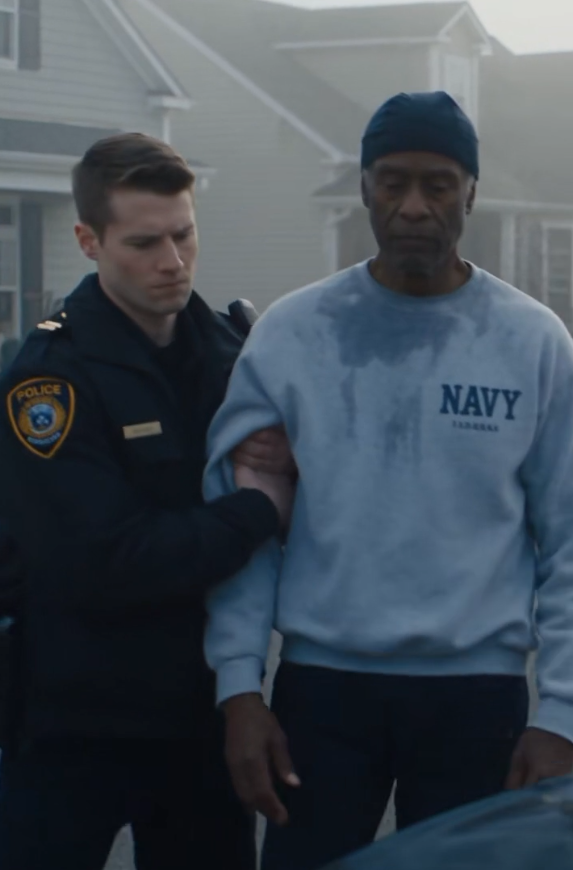
Part I — The Stop
The handcuffs told General Isaiah Montgomery more about the two officers than the questions had.
They were too tight.
Not dangerously tight. Not yet. Just tight enough to make a point.
Isaiah sat upright in the rear of the patrol cruiser with his hands secured behind him, the hard plastic seat pressing through his gray sweatshirt, and watched Officer Blake Higgins pace outside the window.
Morning fog softened the expensive homes along Willow Creek into pale blocks behind stone walls and clipped hedges. Sprinklers clicked across lawns that looked professionally measured. Somewhere nearby, a garage door lifted with a low mechanical hum.
Isaiah listened.
That was what thirty-five years in the Army had taught him before almost anything else.
Listen before deciding.
Observe before reacting.
Remember what people did when they believed nobody important was watching.
Higgins stood beside the cruiser speaking to Sergeant Mitchell Carter.
“I told you,” Higgins said. “We’ve had complaints.”
Carter took a slow drink from his coffee. “Complaints about what?”
“People wandering around. Cars being checked. Houses.”
“He was jogging.”
“He says.”
Isaiah could not hear every word through the glass, but he heard enough.
He shifted his wrists once.
The metal bit deeper.
He stopped moving.
Four stars did not make steel softer.
Two Purple Hearts did not unlock doors.
A Silver Star did not announce itself through a faded sweatshirt and worn running shoes.
And Isaiah had never believed any of those things were supposed to.
He looked toward the dashboard clock.
His daughter’s discharge arrangements had been confirmed for that afternoon.
Captain Leah Montgomery had spent months moving between surgery, rehabilitation, physical therapy, and the slow reconstruction of a future that no longer resembled the one she had planned. Part of her right leg had been lost overseas after she pulled wounded Marines from a burning transport following an ambush.
She had complained about almost none of it.
She had complained about the hospital windows.
Too small.
Too high.
Too much institutional beige.
Once, late at night, when pain medication had made her less careful about what she admitted, she told Isaiah, “Hospitals make me feel like they’re storing me instead of healing me.”
So he had found the house on Willow Creek Lane.
One story.
Wide halls.
Level floors.
Sunlight from long windows across the back.
He had bought it without showing her photographs because Leah had inherited his suspicion of promises.
He wanted her to see it before deciding whether she believed in it.
That morning’s run was supposed to clear his head.
Instead, he was in a police cruiser with his wrists cuffed behind him.
Higgins opened the driver’s door and slid inside.
Carter took the passenger seat.
Neither looked back immediately.
Isaiah watched their reflections in the windshield.
Higgins reached for the radio.
“Possible burglary suspect detained.”
Carter turned his head slightly.
Isaiah noticed.
The radio crackled.
A dispatcher asked for location and identification.
Higgins supplied the street.
Then he said, “Subject refused to provide ID.”
Isaiah leaned forward as far as the restraint allowed.
“That is inaccurate.”
Higgins looked at him through the partition.
“I said I did not carry identification while running,” Isaiah continued. “I offered to take you to my residence and provide it.”
“Sit back.”
“I am sitting.”
Carter looked down at his coffee.
Isaiah studied him.
The older officer had not been the one giving commands. He had not tightened the cuffs. He had not pushed Isaiah toward the car.
But he had been there.
Silence was not neutrality when someone beside you was making the decision.
Isaiah knew that better than most men alive.
He had seen operations fail because a major did not challenge a colonel.
He had watched young officers save lives because they did.
Higgins keyed the radio again.
“He’s being uncooperative.”
Isaiah said, “Officer, your body camera should establish otherwise.”
A brief pause.
Then Higgins turned fully in his seat.
“You want to keep testing me?”
“No.”
Isaiah’s voice remained level.
“I want your report to be accurate.”
Something shifted in Carter’s expression.
Not agreement.
Recognition.
Higgins faced forward again.
“Everybody’s a lawyer now.”
The cruiser pulled away from the curb.
Isaiah turned his face toward the window.
442 Willow Creek Lane disappeared behind them.
His house key remained in an evidence pouch in Higgins’s pocket.
A house key.
That was all they had found.
No tool.
No weapon.
No stolen property.
No mask.
Nothing except a key to the home they had refused to walk half a mile to verify.
The cruiser rolled through Pine Valley as dawn began whitening the sky.
Higgins tried to make conversation with Carter.
“Probably casing the place.”
Carter did not answer.
“Rich neighborhood, guy out before sunrise, no ID.”
Still nothing.
Higgins glanced over. “What?”
Carter rubbed his thumb along the cardboard seam of the coffee cup.
“He told us an address.”
“So?”
“We could’ve checked it.”
Higgins laughed once.
“You serious?”
“I’m saying we could’ve checked it.”
“He could give us anybody’s address.”
“Then we’d find out.”
Higgins tightened his grip on the wheel.
“He told me to call the watch commander.”
“I heard him.”
“That’s not normal.”
Isaiah spoke from behind them.
“Sergeant Carter.”
Carter glanced back.
“You have approximately fifteen minutes of personal observation of my conduct. Have I threatened either of you?”
“No,” Carter said.
Higgins looked at him sharply.
“Have I attempted to leave?”
“No.”
“Have I refused a lawful instruction?”
Carter hesitated.
Higgins cut in. “This isn’t a deposition.”
Isaiah settled back.
“No. It isn’t.”
He looked through the window again.
He was memorizing.
Badge numbers.
Unit number.
Time of initial contact.
The exact location.
The sequence of commands.
The language on the radio.
Not because he planned revenge.
Revenge was emotional, imprecise, and usually wasteful.
He wanted facts.
Facts survived anger.
At the station, Higgins parked behind a secured door.
A fluorescent light buzzed above the concrete bay.
The rear door opened.
“Out.”
Isaiah stepped carefully onto the pavement.
His shoulders had begun to tighten from having his arms pinned behind him.
Higgins took his elbow.
Isaiah looked down at the hand, then at Higgins.
“I can walk without assistance.”
“Move.”
Carter followed them inside.
A desk officer looked up from behind a counter.
The officer’s eyes went first to Isaiah’s running clothes, then the cuffs.
“What’ve you got?”
“Possible prowler,” Higgins said.
Isaiah said nothing.
“What was he doing?”
“Moving through Willow Creek. No ID. Evasive answers.”
Carter’s gaze moved to Higgins.
There it was again.
A moment in which truth could still be made easier.
Isaiah waited.
Carter said nothing.
Second failure.
The desk officer slid a form across the counter.
“Name?”
Isaiah answered.
“Isaiah Montgomery.”
“Date of birth?”
Isaiah provided it.
“Address?”
“442 Willow Creek Lane.”
The desk officer entered the information.
Higgins leaned against the counter with folded arms.
After several seconds, the officer frowned.
“System’s slow.”
“Story of my life,” Higgins said.
Isaiah glanced at the wall clock.
His daughter would not arrive for hours.
He had time.
But he also understood something that Higgins did not.