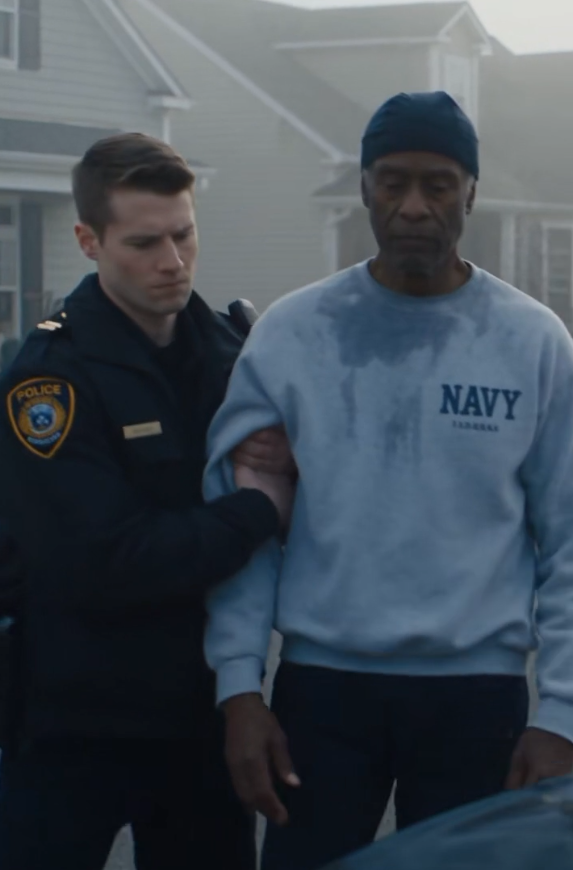
Time did not improve bad decisions.
It documented them.
The desk officer looked up.
“Nothing local.”
Higgins nodded as though that settled something.
The officer continued typing.
“Property search shows an Isaiah M. Montgomery at that address.”
Carter raised his head.
Higgins said, “Could be him. Could be his father. Could be anybody.”
The desk officer looked at Isaiah.
“How long have you lived there?”
“Not long.”
“What do you do?”
Isaiah paused.
Higgins smiled faintly, mistaking the pause for weakness.
Isaiah could have ended the performance.
Three words would have changed the air in that room.
Four-star general.
He could have added his command.
He could have named officials whose phone calls would move through the building faster than any arrest report.
Instead, he said, “I work for the United States Army.”
Higgins snorted.
“Of course you do.”
The desk officer did not laugh.
“What kind of work?”
Isaiah met Higgins’s eyes.
“Administrative.”
That was technically true often enough.
Higgins shook his head.
“Right.”
Isaiah looked at the clock again.
The desk officer said, “We’ll need to verify.”
“I encourage you to.”
Higgins muttered, “Now he encourages us.”
Isaiah ignored him.
Carter did not.
“Blake.”
It was the first time he had used the younger officer’s first name.
Higgins turned.
“What?”
Carter nodded toward the hallway.
“Give me a second.”
The two officers moved several steps away, still visible through the open doorway.
Their voices dropped.
Isaiah could not make out every word.
He did not need to.
Carter’s shoulders had changed.
The bored posture from Willow Creek was gone.
Higgins’s had become harder.
Defensive.
A desk phone rang.
The officer answered.
“Yes.”
He listened.
Then looked directly at Isaiah.
His expression changed.
Not dramatically.
That would have been easier.
He simply sat straighter.
“Hold on.”
He covered the receiver.
“Mr. Montgomery.”
Isaiah waited.
The officer swallowed.
“Do you have another identification number associated with the Department of Defense?”
Higgins stopped speaking in the hallway.
Carter turned.
Isaiah gave the number.
The desk officer wrote it down, uncovered the receiver, and repeated it.
Silence stretched.
Higgins slowly returned to the counter.
“What is this?”
The desk officer held up one finger.
Isaiah watched him listen.
Then the officer’s face lost color.
“Yes, sir,” he said into the phone.
A pause.
“Yes, sir. He is physically here.”
Another pause.
The desk officer looked at the handcuffs.
“Yes, sir.”
He stood.
“Understood.”
He lowered the receiver carefully.
Nobody spoke.
Higgins stared at him.
“Well?”
The desk officer looked from Higgins to Carter.
Then to Isaiah.
“Take the cuffs off.”
Higgins frowned. “Why?”
The desk officer’s voice was quieter now.
“Because the man you brought in is General Isaiah Montgomery.”
Higgins did not move.
Carter did.
He stepped behind Isaiah and reached for the key.
The handcuffs opened with two small metallic clicks.
Isaiah brought his arms forward.
Red marks circled both wrists.
The room seemed much smaller.
“You should have taken them off before you knew my rank.”
No one answered.
Part II — Pressure
The police chief arrived eleven minutes later.
Isaiah knew because he checked the clock.
The chief entered without a coat, dress shirt imperfectly buttoned at the collar, his face carrying the unmistakable strain of a man who had received a phone call before sunrise that he knew would follow him for years.
Behind him came the watch commander.
Nobody introduced themselves with ceremony.
There was no point.
“General Montgomery.”
The chief stopped several feet away.
“Sir, I’m Chief—”
“I know your position.”
Isaiah’s voice was not hostile.
That made the chief more careful.
“I want to apologize for what occurred this morning.”
Isaiah rubbed one wrist.
“You don’t know what occurred yet.”
The chief paused.
“No, sir.”
“Then don’t apologize for something before you understand it.”
Higgins stood near the wall.
Carter stood beside him but not quite with him.
The distinction had become visible.
The chief looked at Isaiah’s wrists.
“Do you need medical attention?”
“No.”
“We can have someone—”
“No.”
Isaiah glanced at the clock.
“I need access to a telephone.”
“Absolutely.”
“My daughter is being discharged from Walter Reed this afternoon. I have arrangements to confirm.”
The chief gestured toward his office.
“You can use mine.”
“I’d prefer to remain here until we establish the record.”
Higgins looked surprised.
Isaiah noticed that too.
Men expecting power to behave theatrically were often confused when it behaved procedurally.
The chief nodded.
The desk officer pushed a phone across the counter.
Isaiah dialed from memory.
He did not call the Pentagon.
They were already involved.
He called the hospital.
His tone changed almost immediately.
“Yes, this is Isaiah Montgomery. I’m confirming Captain Leah Montgomery’s transport this afternoon.”
He listened.
“Yes.”
Another pause.
“No, there’s no change.”
Higgins stared at the floor.
Isaiah glanced at his wrists.
“I’ll be there.”
He listened again, and for the first time that morning, something almost like a smile touched his face.
“No. Don’t tell her I called twice. She already thinks I worry too much.”
The desk officer looked away.
Carter did too.
Isaiah ended the call.
The chief said, “General, the Pentagon duty office has contacted us. We’ve also received a call from your command.”
“I assumed you would.”
“I want you to know we are treating this seriously.”
Isaiah looked toward Higgins.
“Then start with the body-camera footage.”
Higgins said, “There was nothing out of line.”
The chief turned to him.
Isaiah remained still.
Higgins seemed to realize too late that he had spoken.
“I mean, Chief, we were responding to reports of burglaries in the area. He didn’t have identification. He was evasive about employment.”
Isaiah said, “I told you I lived on Willow Creek.”
“You could’ve been lying.”
“I offered to walk you to the house.”
“You told me to call my commander.”
“Correct.”
“You were trying to intimidate me.”
“No.”
The word landed without force and somehow ended the exchange.
The chief looked at Carter.
“Sergeant?”
Carter’s mouth tightened.
“General Montgomery did provide the address.”
“Did he offer to go there with you?”
“Yes.”
Higgins turned.
“Mitchell.”
Carter kept his eyes on the chief.
“Yes.”
“Did he resist?”
“No.”
“Threaten either of you?”
“No.”
“Attempt to leave?”
“No.”
The chief’s jaw shifted.
Higgins said, “That’s not the full context.”
Isaiah watched Carter.
Carter finally looked at Higgins.
“What context changes those answers?”
Higgins stared back at him.
The room held the question.
Isaiah understood the importance of moments like this.
Large failures rarely began as large failures.
They began when someone who knew better decided the truth could wait.
Carter had already made that choice twice.
He appeared unwilling to make it a third time.
The chief gestured to the watch commander.
“Secure the bodycam files. Both officers. Immediately.”
Higgins straightened.
“Chief—”
“Now.”
The watch commander left.
The chief faced Isaiah.
“General, I would like to speak with you privately.”
Isaiah considered him for a moment.
“No.”
The chief blinked.
“I don’t mean that disrespectfully.”
“I understand.”
“Then may I ask why?”
“Because everyone involved should hear the same version the first time.”