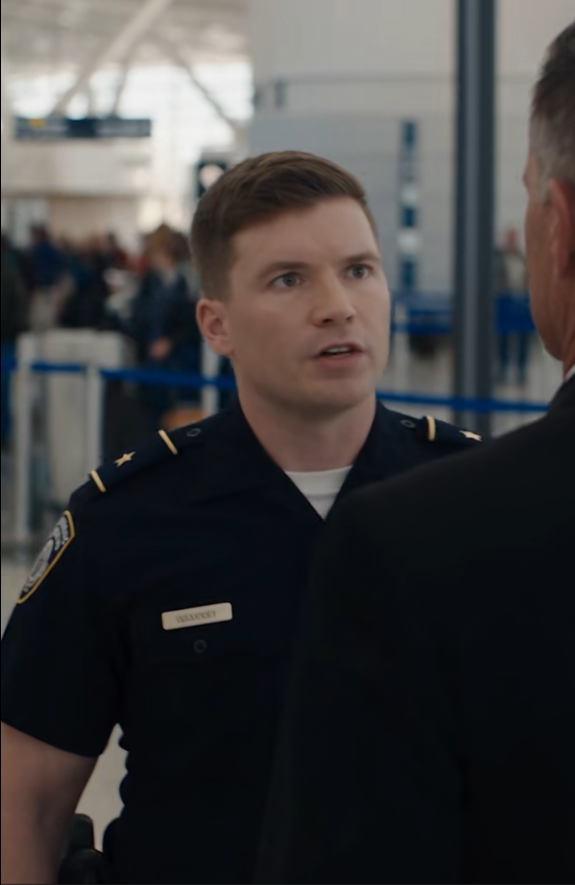
Part I — Eight Minutes Missing
At 8:07 on a Tuesday morning, an airport police officer grabbed me by the arm in the middle of Concourse B and told me to take off the uniform I had spent twenty-three years earning.
For a second, I thought I had misunderstood him.
I had been traveling for nearly eighteen hours. There is a point, somewhere between the second delayed connection and the third cup of bad terminal coffee, when fatigue puts a thin layer of glass between you and the world. Sounds arrive half a beat late. Fluorescent lights become too white. Ordinary sentences require more effort than they should.
But Officer Bradley Vance stepped closer, looked directly at the captain's insignia on my Navy Service Dress Blues, and said it again.
“Take off the costume.”
The words came clearly the second time.
I stood beside Gate B27 at Hartsfield-Jackson Atlanta International Airport with a dark sea bag at my feet and a sealed travel packet inside it that I had been instructed not to open again until I reached my destination. My flight had landed twenty-one minutes earlier. I had changed into Service Dress Blues before leaving the secure military transit area because my orders required me to arrive in uniform.
That detail would matter later.
At the time, all that mattered was the officer standing in front of me.
“My identification is in the outer pocket of that bag,” I said. “Military ID. Driver's license. Travel orders.”
Vance glanced down at the bag but did not reach for it.
“You expect me to believe you're a Navy captain?”
“I expect you to verify it.”
A few travelers slowed behind him.
That is how public humiliation begins now. Not with a crowd, exactly. With hesitation. One person stops walking. Another turns. A phone appears at chest height, then rises.
Vance had noticed my uniform near the gate and approached me without introduction. His first questions had been fast and strangely specific.
Where was I stationed?
Why was I traveling alone?
Why wasn't I carrying a garment bag?
Why was my sea bag not stenciled with a unit?
I answered all four.
Norfolk.
Official travel.
Because I had changed before arrival.
And because the bag had been issued to me on a different assignment years earlier and had never required unit marking.
Every answer seemed to make him more suspicious.
I recognized the pattern because I had seen versions of it in command investigations: a person reaches a conclusion first, then treats every new fact as an obstacle instead of information.
The problem wasn't skepticism.
Skepticism was healthy.
The problem was that Vance had stopped asking questions he was willing to have answered.
A woman holding a paper coffee cup stood ten feet away. Her eyes moved between my ribbons and Vance's badge. A man with a rolling suitcase stopped near a charging station and lifted his phone.
Vance pointed toward my chest.
“You know impersonating military personnel can get you in serious trouble?”
“Yes.”
“And stolen valor?”
“I know what stolen valor is.”
“Then maybe this is your chance to make this easy.”
“My identification is three feet from you.”
He stared at me.
I stared back.
There was no reason for the situation to last another ten seconds.
He could have opened the outer pocket of the sea bag with my permission, removed my Common Access Card, compared the photograph to my face, and contacted the appropriate verification desk. My identity did not require access to the sealed portion of my orders. Nothing classified needed to be disclosed. Nothing complicated needed to happen.
Instead, Vance moved between me and the bag.
“Turn around.”
The airport noise seemed to change around us.
Not quieter. More distant.
“Officer,” I said, “before you do that, verify the ID.”
“Hands where I can see them.”
“They're where you can see them.”
“Turn around.”
His voice had changed.
He was no longer talking to me.
He was performing certainty for everyone watching.
That was when I understood that the most important thing I could do was deny him a second story.
If I raised my voice, there would be a video of an angry man in a Navy uniform confronting a police officer.
If I reached toward my bag, there would be a video of a suspect reaching for something after being ordered not to.
If I resisted physically, even by pulling away, the entire event could become about that movement instead of what caused it.
So I turned around.
He took my right wrist first.
The handcuff ratcheted closed.
Someone behind us whispered, “Oh my God.”
Then the second cuff closed.
Vance tightened it one notch beyond what was necessary.
Maybe two.
Metal pressed into the bone below my left thumb.
My sea bag tipped onto its side beside my shoes.
I looked down at it.
Twenty-three years.
That was what sat in the space between the polished black leather of my shoes and that dark bag.
Twenty-three years of deployments, inspections, missed anniversaries, overnight watches, bad weather, worse coffee, young officers asking questions they were embarrassed to ask, chiefs correcting me when I needed correcting, sailors trusting me when I wasn't sure I had earned it yet.
All of it had been compressed into the word Vance had chosen a minute earlier.
Costume.
“We take stolen valor seriously,” he said.
I turned my head slightly.
“So do I.”
His expression shifted.
Just for a fraction of a second.
Then he took my upper arm and started walking.
People moved aside.
I had been through casualty drills in darkness, stood on a bridge while thirty-foot seas threw spray over steel, and delivered news to families that no commanding officer ever wants to deliver.
None of those things had prepared me for walking through an American airport in handcuffs while strangers filmed my uniform.
The humiliation was physical.
It sat behind my ribs.
But anger would not help me.
Years of command had taught me something that sounds simple until you have to practice it: when another person becomes reckless, you lose the luxury of becoming reckless too.
I breathed through my nose and kept my voice level.
“You still have time to verify this.”
Vance pulled my arm harder.
“You'll have plenty of time to explain yourself.”
We had gone perhaps forty yards when another uniformed officer stepped away from a podium near the center of the concourse.
She was a sergeant.
Her nameplate read RUIZ.
She looked first at Vance, then at me, then at the handcuffs.
Her gaze settled on the captain's stripes at my sleeves.
Then the ribbons.
Then the sea bag, abandoned behind us near the gate.
She didn't laugh.
She didn't immediately join Vance.
That alone made her different.
“What happened?” she asked.
Vance answered before I could.
“Possible impersonation. Claims he's a Navy captain.”
Claims.
The word landed harder than costume had.
Not because it was worse.
Because it was administrative.
Clean.
A single word that erased everything and converted my career into an allegation.
Sergeant Elena Ruiz studied me for another second.
“Did you check his ID?”
Vance's hand tightened on my arm.
“He says it's in the bag.”