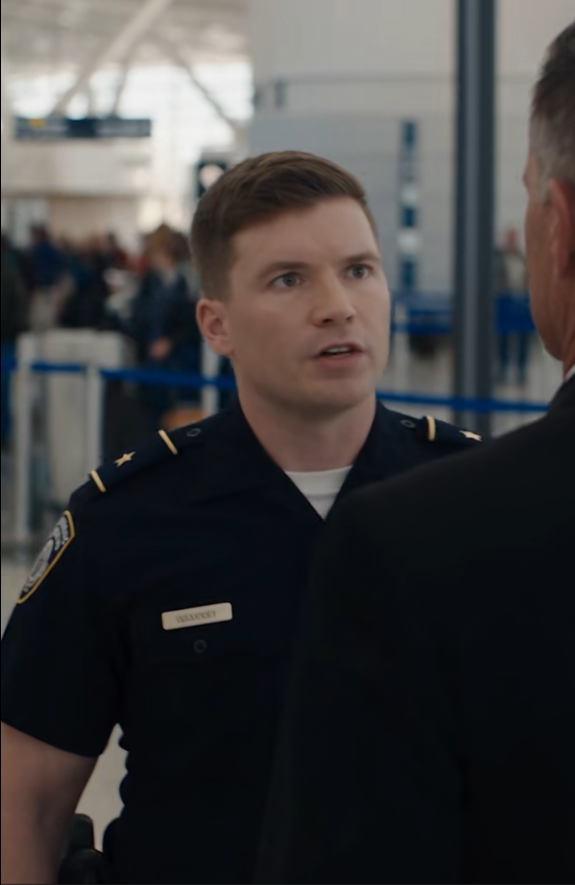
Ruiz looked toward the bag.
“Then why isn't somebody checking it?”
“He's detained.”
“That wasn't my question.”
For the first time, Vance looked irritated with someone besides me.
“He's got inconsistencies.”
“What inconsistencies?”
“He's alone. Says he's traveling official. Says he's a captain. No escort.”
I almost spoke.
Ruiz raised one hand slightly, not at me but toward Vance.
“None of those things are ID verification.”
A pulse of hope moved through me.
Not because she believed me.
Because she was doing what Vance had stopped doing.
Thinking.
Then every police radio within earshot cracked alive.
Static burst across the concourse.
A dispatcher's voice followed, clipped and urgent.
“All Concourse B units, confirm status and location of Captain Marcus Hayes.”
Nobody moved.
Vance slowly turned his head.
Ruiz looked directly at me.
The radio continued.
“Repeat, all Concourse B units. Locate Captain Marcus Hayes, United States Navy. Command liaison reports missed reception window. Confirm immediately.”
The hand on my arm loosened.
Not completely.
Enough.
Ruiz reached for her radio.
“Dispatch, Sergeant Ruiz. I have an individual identifying himself as Captain Marcus Hayes at approximately B27.”
A pause.
Then:
“Sergeant, confirm Captain Hayes is secure and not injured.”
Ruiz looked at the cuffs.
Her jaw shifted.
“Stand by.”
Vance finally released my upper arm.
The man with the rolling suitcase had moved closer. His phone was still recording.
I turned my head toward Vance.
“Now,” I said quietly, “would be a good time to check the identification.”
He didn't answer.
Ruiz walked back toward my sea bag herself.
The crowd opened for her.
Vance stayed beside me.
For the first time that morning, he looked less like a man controlling a situation than a man waiting to learn what situation he had created.
Ruiz returned with the bag. She crouched in front of me.
“Captain, outer pocket?”
“Yes.”
“Permission to open it?”
“Yes.”
She unzipped the pocket, reached inside, and pulled out a black wallet, my travel envelope, and the protective sleeve containing my military identification.
Vance watched.
Ruiz removed the card.
She looked at it.
Then at me.
Then back at the card.
Her expression didn't become dramatic. That was one thing I would remember about her.
She simply became still.
“Captain Marcus David Hayes,” she read.
“Yes.”
“United States Navy.”
“Yes.”
She stood.
“Officer Vance.”
He didn't respond.
“Take the cuffs off.”
He looked at her.
“Sergeant—”
“Now.”
He removed them.
Blood returned to my hands in hot needles.
I rubbed my left wrist once.
Ruiz keyed her radio.
“Dispatch, identification visually confirmed. Stand by for secondary verification.”
The response came instantly.
“Negative, Sergeant. Command liaison confirms positive identity. Captain Hayes is the principal traveler. Federal coordination desk has been attempting contact for nine minutes.”
Vance's face lost what little color it had left.
Principal traveler.
I saw the phrase register with him.
He had assumed I was pretending to be important.
The truth was less theatrical and, for him, far worse.
I really was expected.
And I was late.
Ruiz looked at me.
“Captain, do you require medical attention?”
“No.”
I flexed my wrists.
“Not at this time.”
She glanced toward the crowd.
Several phones were still up.
“Do you want us to clear this area?”
“No.”
Vance looked at me then.
Really looked.
His eyes went from my face to the identification in Ruiz's hand.
“I—”
His radio interrupted him again.
“Command supervisor en route. Federal liaison en route. Do not relocate Captain Hayes.”
I picked up my sea bag.
My wrist hurt.
My pride hurt more.
But something else had replaced the humiliation.
Not satisfaction.
Responsibility.
Because I knew what would happen next.
This would stop being an argument between two men.
It would become a record.
And records had consequences.
Part II — Verification
The first person to arrive wasn't an admiral.
It wasn't a federal agent in sunglasses.
It was a civilian security liaison in a gray suit moving fast enough to make everyone around him instinctively move aside.
He stopped in front of me, breathing harder than he wanted anyone to notice.
“Captain Hayes?”
“Yes.”
“Sir, I'm Daniel Mercer with the joint coordination team.”
He held out credentials.
I looked at them before shaking his hand.
The irony was not lost on Ruiz.
One corner of her mouth moved.
Barely.
Mercer noticed the red marks around my wrists.
“What happened?”
Nobody answered immediately.
That silence told him more than an explanation would have.
He looked at Ruiz.
“Sergeant?”
Ruiz gave him the short version.
“Officer Vance detained Captain Hayes on suspicion of military impersonation before checking his identification. Identification has now been confirmed.”
Mercer's eyes moved to Vance.
“Before checking it?”
“Yes.”
Vance stepped forward.
“I had reasonable suspicion.”
Mercer ignored him.
“Captain, are you all right?”
“I can continue.”
“That wasn't the question.”
“Then yes. I'm all right.”
It was an old military answer.
Not injured enough to stop.
Mercer nodded, but his face suggested the answer did not satisfy him.
He lowered his voice.
“We've got people waiting downstairs. Your original movement window closed eight minutes ago.”
“I gathered.”
“We can still recover the schedule.”
“I'd rather not be the reason we don't.”
Mercer looked at my wrists again.
“You aren't.”
That sentence carried more weight than I wanted it to.
I turned to Ruiz.
“My ID.”
She handed it back.
“Sir.”
“Thank you for checking.”
She met my eyes.
“Should've been done sooner.”
Vance shifted.
“Captain, I was acting on—”
I looked at him.
He stopped.
There are moments when rank has nothing to do with insignia.
I wasn't in his chain of command. I had no authority over him. But I had spent a long time sitting across desks from people who were about to make their situation worse by talking before they understood it.
“You should wait for your supervisor,” I said.
His mouth tightened.
“I think I deserve a chance to explain.”
“You'll get one.”
“I didn't know who you were.”
“That is exactly why you verify.”
The crowd had grown.
A teenager near the gate was whispering into his phone while aiming its camera toward us. Two airline employees had stopped behind the podium. A man in a business suit was saying the phrase Navy captain to someone on a call.
Vance noticed all of them.
“So that's it?” he said. “I'm the villain now?”
Ruiz turned.
“Brad.”
He looked at her.
“Don't.”
He lowered his voice but not enough.
“You saw the uniform. Something looked off.”
“What?”
He hesitated.
That hesitation mattered.
Ruiz waited.
“What looked off?”
“He looked too young for all that.”
I almost laughed.
Not because it was funny.
Because I was fifty-one years old and had recently been told by my daughter that my gray hair was finally “winning the war.”
Ruiz stared at him.
Vance realized his answer had not helped.
“I mean the ribbons, the captain insignia, traveling without—”
“Without what?” she asked.
“Support.”
“Captains fly commercial.”
“I know that.”
“Apparently not this morning.”
Mercer stepped between them before the argument could deepen.
“Sergeant, your command can handle this. Captain Hayes has a movement requirement.”
Vance looked at me.
“What's so important?”
Mercer's head turned sharply.
I answered before he could.