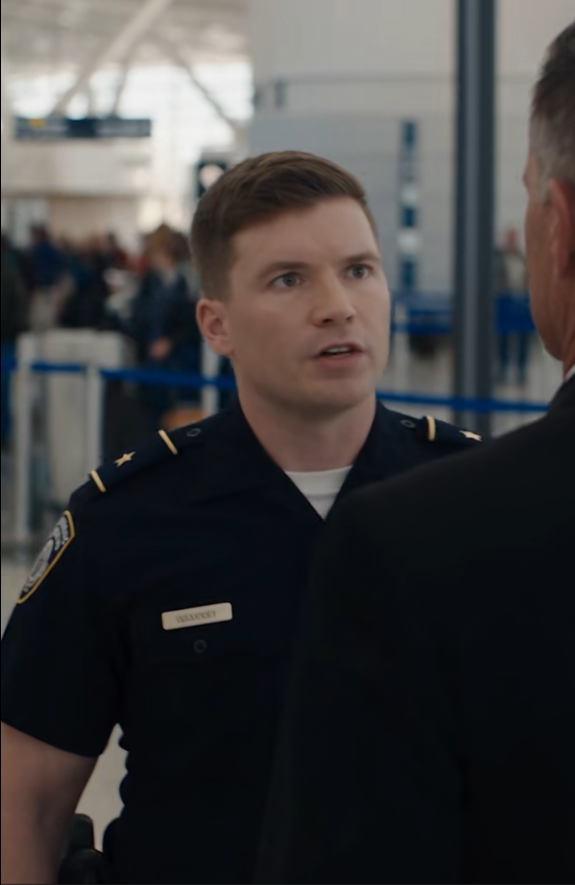
“It's not information you need.”
That was the first time Vance seemed to fully understand there were parts of the morning he would not be allowed to force open.
He had been treating access as proof.
Now he was confronting the fact that legitimate authority sometimes includes saying no.
A lieutenant from airport police arrived less than a minute later with two more officers.
The lieutenant's face had the composed look of a supervisor who already knew the broad facts and disliked all of them.
“Captain Hayes, I'm Lieutenant Warren. I understand there was a detention.”
“There was.”
“I'd like to apologize for—”
“Lieutenant.”
He stopped.
“I appreciate the courtesy. But don't apologize before you know what happened.”
His eyes narrowed slightly.
Not defensively.
Thoughtfully.
“Fair enough.”
“Your sergeant verified my identity. Officer Vance didn't.”
Warren looked at the marks on my wrists.
“Were the cuffs applied after you offered identification?”
“Yes.”
“Was the bag within reach?”
“Within a few feet.”
Warren turned toward Vance.
“Body camera active?”
Vance touched his chest.
For the first time, something like genuine alarm crossed his face.
“Yes.”
“Good.”
The word was simple.
Ruiz looked away.
Mercer checked his phone.
“We need to move.”
I nodded.
Lieutenant Warren stepped aside.
“Captain, we'll need a statement.”
“You'll have one.”
“Before you leave Atlanta?”
“I'll make time.”
“Thank you.”
Vance said nothing.
As Mercer and I started walking, I heard Ruiz behind us.
“Brad, don't touch your bodycam. Don't review it. Don't discuss this with witnesses. Wait for internal affairs.”
We made it twenty feet before Mercer spoke.
“You want to tell me what that was?”
“No.”
He glanced at me.
“I mean beyond the obvious.”
“I know.”
We kept moving.
The airport looked exactly the same as it had ten minutes earlier.
Flights were boarding.
Children complained.
Announcements echoed overhead.
Coffee steamed in paper cups.
That offended me more than it should have.
Part of you expects the world to mark what has happened to you.
It doesn't.
Mercer led me toward a restricted elevator.
At the access point, a uniformed security employee held out his hand.
“Credentials, please.”
I stopped.
So did Mercer.
The employee looked suddenly uncertain.
I reached for my wallet.
“Of course.”
I handed over my ID.
He checked it carefully.
Compared the photograph.
Checked the access list.
Then gave it back.
“Thank you, Captain.”
“Thank you,” I said.
Mercer waited until the elevator doors closed.
“You enjoyed that.”
“No.”
He looked at me.
“Maybe a little.”
I adjusted the cuff of my left sleeve over the mark.
“No. I appreciated it.”
The elevator descended.
Mercer studied me.
“There a difference?”
“Yes.”
The doors opened.
Four people were waiting.
Two were military.
Two were federal.
All four looked at my wrists.
None asked why I was late.
The senior Navy officer stepped forward.
Rear Admiral Evelyn Shaw had known me for eleven years. She was small, silver-haired, and had the unnerving ability to make people reconsider entire paragraphs with one raised eyebrow.
She did that now.
“Marcus.”
“Admiral.”
“Your morning appears to have become complicated.”
“That is one word for it.”
Her gaze lowered to my wrist.
“Were you arrested?”
“Detained.”
“In cuffs?”
“Yes.”
“After identifying yourself?”
“Yes.”
“Did they verify?”
“Eventually.”
She breathed out through her nose.
The federal official beside her said, “We're going to need the details.”
“You'll get them.”
Shaw looked at Mercer.
“How late?”
“Nine minutes from initial movement window.”
Shaw glanced at her watch.
“We can absorb nine.”
Then she looked back at me.
“Can you?”
I understood the question.
Not schedule.
State of mind.
I thought about Vance saying costume.
I thought about phones.
I thought about the crowd.
Then I thought about why I had flown eighteen hours to Atlanta.
“Yes, ma'am.”
She held my gaze another second.
“Then let's work.”
That was why I had always respected her.
No drama.
No public outrage.
No instant demand for someone's badge.
Facts first.
Work first.
Consequences later.
I followed them through a secured corridor.
My sealed orders remained unopened in my bag.
And Officer Bradley Vance still had no idea what they were for.
Part III — The Thing We Were There to Prevent
The meeting took place in a windowless conference room beneath the airport operations complex.
There were no flags.
No polished table.
No dramatic bank of monitors showing classified maps.
Just gray walls, bad chairs, water bottles, and a screen mounted crookedly enough that someone had placed a folded piece of cardboard under one corner.
The subject of the meeting was identity failure.
That was the part no one outside the room would have understood.
For three months, military and civilian agencies had been reviewing a series of small procedural failures across transportation hubs used for sensitive government movement. None involved spies. None involved bombs. None had made national news.
That was precisely why the review mattered.
Security systems usually don't collapse because one person defeats every layer.
They fail because several people each decide one layer doesn't matter.
A badge isn't checked because somebody recognizes a face.
A door is held open because a person looks important.
A travel packet is waved through because a uniform appears legitimate.
A name is accepted because someone speaks with confidence.
The purpose of our review was painfully simple:
Verify identity.
Follow procedure.
Do not substitute instinct for process.
I sat across from Admiral Shaw while a federal security director summarized overnight findings from another airport.
I almost smiled.
She noticed.
“What?”
“Nothing.”
“That's not your nothing face.”
The others looked at me.
I leaned back.
“Our entire review is about personnel making assumptions instead of conducting verification.”
Shaw's expression hardened.
“Yes.”
“I was handcuffed upstairs because an officer made an assumption and refused verification.”
The room went quiet.
Not theatrically.
Professionally.
The kind of quiet where everyone begins making connections.
One of the federal officials looked down at his notes.
“That's not going to stay local.”
“No,” Shaw said.
I looked at her.
“What?”
She rotated her tablet toward me.
A video was already online.
The thumbnail showed me in profile with my hands cuffed behind my back.
Vance stood beside me.
Across the bottom were words added by whoever uploaded it:
FAKE NAVY CAPTAIN ARRESTED AT ATLANTA AIRPORT?
The question mark didn't help.
I watched seven seconds.
Vance's voice:
“Take off the costume.”
Then my voice:
“My identification is right there.”
The clip ended before Ruiz appeared.
“Don't read comments,” Shaw said.
“I wasn't planning to.”
She turned the tablet back.
“Good.”
The federal security director folded his hands.
“Captain, this creates a problem.”
I looked at him.
“For the review?”
“For everyone.”
He wasn't wrong.
If we continued our work in Atlanta and word leaked about why I was there, the arrest would immediately become part of the story.
Airport police humiliates officer conducting identity-protocol review.
The headline wrote itself.
People would laugh at the irony.
Politicians would demand explanations.
Departments would defend themselves.
The actual purpose of the review could be buried under spectacle.
Admiral Shaw leaned forward.
“What do you want to do?”
It was not a courtesy question.
I was the lead Navy representative for the final operational phase. I had the authority to recommend we suspend the Atlanta portion and relocate.