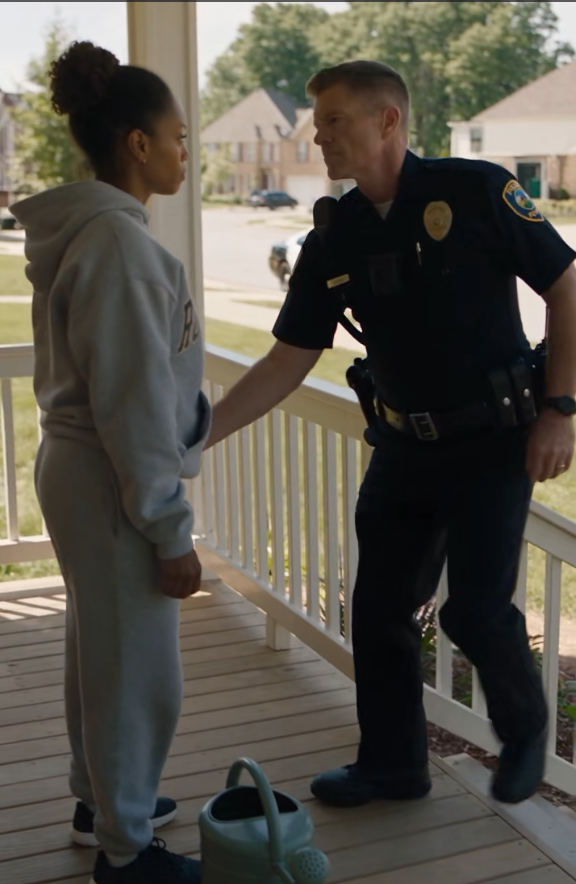
The first thing Officer Grant Harlan took from me was not my freedom.
It was the watering can.
He kicked it off the edge of my porch as he twisted my right arm behind my back, and I watched three gallons of water spill across the red brick steps of the first house I had ever owned.
For some reason, that was the detail I remembered afterward.
Not the handcuffs.
Not the neighbors gathering across the street.
Not even the pressure of Harlan's thumb driving into the inside of my wrist while he told me to stop resisting when I was standing perfectly still.
I remembered the water.
It ran beneath the white porch railing, carried bits of dark soil down the steps, and spread in a shining fan across the walkway I had pressure-washed two days earlier.
Beside it lay my pruning shears.
Behind me stood the brick colonial I had spent seventeen years telling myself I did not need.
And in front of me, a police officer was arresting me because he could not believe it belonged to me.
"You're making a mistake," I said.
Harlan tightened the cuffs.
"Everybody says that."
The metal bit deeper into my skin.
I looked toward the second officer.
Officer Nolan Quinn was younger than Harlan by at least a decade. His shoulders were rigid beneath his uniform, and his eyes kept moving between his partner and me.
He knew.
Maybe not everything.
But he knew something was wrong.
"Officer Quinn," I said calmly, "you heard me provide my full name."
Quinn said nothing.
"You heard me explain that the deed was recorded three weeks ago."
His jaw tightened.
Harlan shoved me toward the driveway.
"Save it for the judge."
"I also gave you permission to verify the vehicle registration inside the garage."
"Keep walking."
"And I offered to open the house under your supervision."
Harlan pulled harder.
I stopped.
Not dramatically.
Not to resist.
I simply planted my feet long enough to look directly at him.
"Officer Harlan."
His face was close enough now that I could smell coffee.
"You should make sure your body-camera footage is preserved."
Something changed in his eyes.
It lasted less than a second.
But I saw it.
People in my profession survive by noticing small changes.
A witness touching his collar before a lie.
A defendant looking toward his attorney before answering a question he had rehearsed.
A contractor suddenly forgetting dates the moment a payment is mentioned.
And a police officer realizing the woman he has decided is powerless may understand exactly where evidence disappears.
Then Harlan smiled.
It was not a friendly smile.
"Get in the car."
The rear door slammed behind me.
Across the street, someone was filming.
Another neighbor had stepped onto his lawn.
A woman stood behind a half-opened door with one hand over her mouth.
And near the mailbox of the pale yellow house opposite mine stood Lillian Vaughn.
Seventy-two years old.
Silver hair.
Floral blouse.
Pearl earrings.
The woman who had brought me lemon bars three days after I moved in.
She stared at me through the cruiser window.
At the time, I did not know she had called the police.
I also did not know that the worst mistake Grant Harlan made that morning was not putting me in handcuffs.
It was writing down why.
My name is Sloane Mercer.
I was thirty-eight years old that summer, unmarried, chronically overworked, and serving as Deputy Chief of the Criminal Division in the United States Attorney's Office.
For six months, my life had revolved around a federal corruption investigation so sensitive that even inside our own building, people referred to it only by its file designation.
Orchard.
It involved municipal contracts.
Construction companies.
Cash payments disguised as consulting fees.
A judge's brother-in-law.
Two county procurement officers.
A city inspector.
And, somewhere beneath all of it, people in law enforcement.
We just did not know which ones.
That Saturday morning, however, Orchard had been locked inside a secure office downtown.
I had deliberately left my work phone charging on the kitchen counter.
I was wearing an old college sweatshirt, gray sweatpants, and sneakers with green stains from mowing the backyard.
My hair was piled on top of my head in a knot so careless that several curls had surrendered completely.
I looked nothing like the woman who questioned witnesses in federal court.
That was intentional.
I had bought the house because I wanted one place in my life where nobody needed anything from Deputy Chief Mercer.
The property had belonged to a retired cardiologist named Dr. Edwin Vale, who had died eight months earlier. His estate listed the house in spring. I saw it on a Tuesday, made an offer on Wednesday, and spent the following six weeks convincing myself I was not terrified.
The mortgage was offensive.
The roof was older than I had been told.
One upstairs bathroom had plumbing that sounded haunted.
I loved everything about it.
Especially the hydrangeas.
They grew along the front porch in enormous blue clusters, planted decades earlier by Dr. Vale's late wife.
According to the handwritten garden notes left in a kitchen drawer, they required more water than common sense suggested.
So that Saturday morning, I watered them.
At 10:17 a.m., Lillian Vaughn called 911.
At 10:23, two patrol cars entered Fairview Estates.
At 10:26, Officer Grant Harlan walked onto my lawn.
"Ma'am," he called. "Step away from the door."
I turned with pruning shears in my hand.
I immediately lowered them.
"What happened?"
"We received a report of a burglary in progress."
"There isn't a burglary."
His eyes traveled from my face to my clothes, then to the house.
"You live here?"
"Yes."
"Name."
"Sloane Mercer."
"Identification."
"My wallet is inside."
"Go get it."
"No."
That was the moment everything changed.
The refusal was not stubbornness.
It was caution.
Two armed officers had arrived after a burglary call. Harlan had ordered me away from the door. I was not going to reach into an unseen house after being told to keep my hands visible.
"I don't want to make any sudden movement into the house while you're investigating an alleged burglary," I said. "You can verify me first."
His expression hardened.
"How?"
"The deed was recorded three weeks ago. Dispatch can confirm the owner. The vehicle in the garage is registered to me at this address. I can unlock the front door from here, and once we're clear about what you want me to do, I'll retrieve my wallet."
Quinn, standing behind Harlan, glanced at the house number.
"We can run the property," he said.
Harlan ignored him.
"I said I need identification."
"And I've explained how you can verify it."
"Turn around."
I looked at him.
"For what?"
"Obstruction."
"No."
His eyebrows rose.
"No?"
I kept my hands visible.
"I am standing on my own property. I gave you my name. I have offered several methods of verification. I have not interfered with your investigation."
"Turn around."
"Officer, do not turn a simple property verification into an arrest because you don't like being questioned."
He grabbed my wrist.
Hard.
Quinn moved.
"Harlan—"
"Secure her other arm."
Quinn hesitated.
That hesitation mattered later.