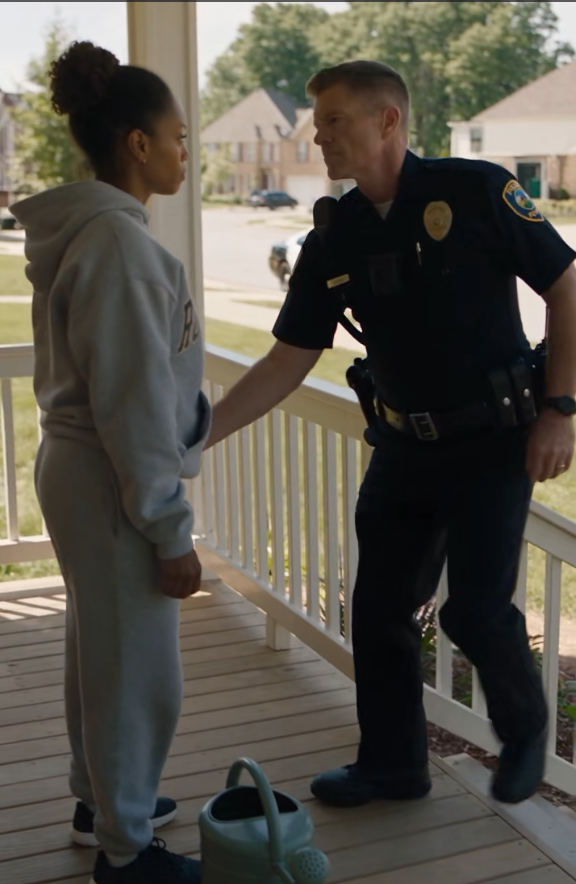
At the time, it only lasted a heartbeat.
Then training, hierarchy, fear, habit—or some combination of all four—won.
He took my left wrist.
The cuffs closed.
Across the street, a curtain moved.
Someone's front door opened.
A phone rose.
Harlan leaned toward my ear.
"You lawyers on television have everybody convinced they understand the Constitution."
I turned my head slightly.
"You think I'm a lawyer?"
"Everybody becomes one when they get arrested."
That was when I told him to preserve the cameras.
Then I was placed in the cruiser.
As we pulled away, I saw my new home shrinking through reinforced glass.
The hydrangeas were still dripping.
The booking area of the Fairview Police Department smelled like disinfectant, burnt coffee, and old paper.
Harlan walked me to the desk like a man returning merchandise he was proud to have purchased.
Sergeant Paul Danner sat behind a computer.
"What've we got?"
"Burglary suspect," Harlan said.
I looked at him.
Danner looked at me.
"Occupied structure?"
"Vacant property. Previous owner deceased."
"She inside?"
"Found prowling around the front entrance. Claimed she lived there. Refused ID. Tried retreating into the house. Resisted detention."
Quinn stood ten feet behind us.
His face had gone pale.
I felt something colder than anger settle inside me.
Courtrooms had taught me the difference between human error and deliberate construction.
Harlan was not confused anymore.
He was building.
Each sentence was another board nailed into a version of events he intended to make permanent.
I turned toward Quinn.
He looked away.
"Name?" Danner asked me.
"Sloane Mercer."
Harlan leaned against the counter.
"Run her."
Danner typed.
Mercer.
Sloane.
Date of birth.
The computer processed.
Then Danner stopped moving.
His eyes narrowed at the screen.
He clicked something.
Then something else.
He looked at me.
Back at the screen.
Then slowly at Harlan.
"What?" Harlan said.
Danner did not answer.
The desk phone rang.
Nobody moved at first.
It rang again.
Danner picked it up.
"Fairview Police."
He listened.
"Yes."
Another pause.
His posture changed.
He looked directly at me.
"Yes, ma'am, she's here."
Harlan straightened.
Danner swallowed.
"No, ma'am. I don't know yet."
He covered the receiver with one hand.
"Captain."
"What?"
Danner held the phone toward the glass-walled office behind him.
"Get Captain Rowe."
"Who is it?" Harlan asked.
Danner stared at him.
"The United States Attorney's Office."
For the first time that day, Grant Harlan had nothing to say.
The office door opened.
Captain Miriam Rowe stepped out.
She was compact, gray-haired, and moving very quickly.
Danner handed her the phone.
"Rowe."
She listened for approximately eight seconds.
Then her face changed.
"Understood."
Another pause.
"Yes. Immediately."
She hung up.
The room fell silent.
Captain Rowe looked at Harlan.
Then at the handcuffs.
Then at me.
"Remove them."
Harlan blinked.
"Captain, she's under—"
"Remove. Them."
He stepped forward.
I moved back.
"No."
Every person in the room looked at me.
I held up my cuffed wrists.
"I want Officer Quinn to remove them."
Quinn's eyes lifted.
Captain Rowe said, "Do it."
Quinn approached slowly.
His hands trembled once while he found the keyhole.
The first cuff opened.
Then the second.
Dark red marks circled both wrists.
Rowe saw them.
So did Danner.
Harlan stared at the floor.
Captain Rowe drew a breath.
"Ms. Mercer, I am Captain Miriam Rowe. There appears to have been a serious—"
"Do not say misunderstanding."
She stopped.
I rubbed my wrist.
"This was not a misunderstanding."
"No, ma'am."
"Has either officer submitted a written report?"
Harlan answered too quickly.
"I already started the incident draft from the car."
Quinn looked at him.
Captain Rowe's face tightened.
"Do not touch that report."
Harlan's head snapped toward her.
"I haven't finished it."
"Then you especially do not touch it."
I said nothing.
Rowe turned to Danner.
"Preserve all dispatch audio. Flag both body cameras. Vehicle cameras. Booking cameras. CAD notes. Everything."
Harlan let out a breath.
"Captain, seriously?"
Rowe rounded on him.
"You brought a Deputy Chief of the federal Criminal Division into my station from the property listed as her residence, after dispatch records show she gave her name at scene."
The color left his face.
My title had landed.
Not because my rights were greater than anyone else's.
They were not.
That was exactly the point.
Harlan had behaved as if he could decide which citizens deserved to be believed.
My job merely meant I knew where all the doors were.
Harlan stared at me.
Something ugly entered his expression.
"So that's what this is."
Captain Rowe said, "Choose your next sentence carefully."
"She pulls rank after the fact, and suddenly—"
I interrupted quietly.
"I never told you what I did."
He stopped.
"You assumed I was unemployed, trespassing, lying, or pretending."
"I never said unemployed."
"No. You didn't need to."
Quinn lowered his eyes.
The station door opened.
A woman in a navy suit entered with two men behind her.
I recognized her immediately.
Marisol Vega, First Assistant United States Attorney.
My boss.
My friend.
And the only person alive who could communicate disappointment strongly enough to rearrange furniture without touching it.
She saw my wrists.
Her jaw locked.
"Sloane."
"I'm fine."
"You are wearing handcuff marks."
"They're fashionable this year."
She did not smile.
Behind her stood Special Agent Daniel Cho of the FBI's public corruption squad and Assistant U.S. Attorney Raymond Bell.
That made me frown.
Marisol coming personally made sense.
Ray coming was understandable.
Cho did not.
Not for a local wrongful arrest.
Our eyes met.
He gave me a look I recognized from Orchard.
Something had happened.
I looked at Marisol.
"Why is Daniel here?"
Harlan shifted behind me.
Cho answered.
"Because we need to talk about the report."
Captain Rowe gave us her conference room.
Before the door closed, I watched Harlan being escorted down the corridor by an internal affairs lieutenant who had arrived in less than twenty minutes.
Quinn remained in the booking area.
He looked like someone standing beside railroad tracks after watching the bridge collapse.
Inside the conference room, Marisol placed her leather bag on the table.
"Sloane, first things first. Do you need medical care?"
"No."
"Photographs?"
"Yes."
Ray took out his phone.
I photographed both wrists, the faint scrape along my forearm, and the bruise forming near my elbow.
Then I looked at Cho.
"The report."
He placed a printed page on the table.
"This is the draft Harlan started in the patrol car."
"How do you have it?"
"Rowe authorized a preservation pull. Their reporting software autosaves."
I read.
The language was predictable.
At first.
Subject observed near side entry of unoccupied residence.
Subject became argumentative.
Subject repeatedly refused lawful commands.
Subject attempted to move toward interior despite instructions.
Subject physically tensed and pulled away.
Subject detained for officer safety.
I almost laughed.
"Efficient."
Cho tapped the third paragraph.
"Read that sentence."
I did.
The subject's conduct was consistent with pre-asNextlt indicators, including target glancing, bladed posture, verbal deflection, and strategic movement toward a concealed access point.
I looked up.
"So?"
Cho did not answer.
He opened his folder and placed another document beside it.
Federal exhibit label.
ORCHARD-217.
My heartbeat changed.
It was an internal incident narrative from a different police department eighteen miles away.