My father's warning had arrived decades before Harlan's corruption perfected the opposite idea.
Records could conceal truth.
Or preserve it.
The same tool.
Different hands.
I folded the letter carefully.
Marcus watched me.
"There is something else you should know about Grant."
I looked up sharply.
"What now?"
"He never knew about your father."
That surprised me.
"So none of that was why he chose me."
"No."
"Just Calderon."
"Just Calderon."
I laughed through tears.
"That's almost comforting."
Marcus stood.
I stopped him.
"Where will you go?"
"Talk to the prosecutors who aren't you."
"Wise."
He smiled.
At the door, he paused.
"Sloane."
"Yes?"
"Elena is sorry."
I looked toward the window.
"For calling the police?"
"For believing the plan had to hurt you to work."
I thought about Lillian—or Elena—standing across the street while officers put me in handcuffs.
I thought about fear.
Bias.
Manipulation.
Good intentions.
Bad choices.
One compromise.
Then another.
"Tell her something for me."
Marcus waited.
"Tell her the hydrangeas survived."
He smiled.
"I think she'll understand."
Two years after the arrest, the final major Orchard case ended.
Twenty-nine people had been convicted.
Six law-enforcement officers went to prison.
Four others received probation after substantial cooperation.
Two judges resigned under separate investigations.
Hundreds of old cases were reviewed.
Sentinel Civic Solutions dissolved.
Redwood Municipal Development declared bankruptcy after losing government contracts and facing civil judgments.
Ray Bell received twenty-three years.
Grant Harlan received nine.
At sentencing, Harlan spoke for less than three minutes.
He did not ask the judge to call him brave.
He did not mention exposing Orchard until his lawyer raised it.
Instead, he read the names of fourteen people whose arrests he had personally falsified or manipulated.
Then he said:
"I spent years believing that if I could describe what I did professionally enough, I could make it lawful. I was wrong."
I attended.
Not because I wanted vengeance.
Not because I wanted closure.
I no longer believed closure was a real thing.
A door closes.
Consequences remain.
Afterward, Nolan Quinn found me on the courthouse steps.
"You okay?"
"Yes."
"He asked if you were here."
"I assumed he saw me."
"He did."
We stood in silence.
Then Quinn smiled.
"Still living in that house?"
"Unfortunately. The mortgage demands loyalty."
He laughed.
"Garden?"
"Alive."
"The hydrangeas?"
"Unreasonably dramatic."
"Seems appropriate."
He started down the steps.
"Nolan."
He turned.
"Thank you for leaving your camera on."
He looked at me for a moment.
Then nodded.
"I wish that had been courage."
"What was it?"
"I forgot to mute it."
I smiled.
"Sometimes history is built out of very small mistakes."
He laughed.
"That's terrifying."
"Welcome to criminal law."
That Saturday afternoon, exactly two years after the arrest, I stood on my front porch watering the same hydrangeas.
The neighborhood had changed.
Or maybe I had.
Lillian's house had been sold to a young couple with twin daughters who rode scooters in the driveway.
They knew nothing about Elena Pell.
To them, the woman who previously owned the house had simply "moved to be closer to family."
Maybe that was true in its own strange way.
My mother sat on the porch swing drinking iced tea and criticizing my gardening technique.
"You drown those things."
"Vale's notes say they like water."
"Vale is dead."
"Strong rebuttal."
She laughed.
A delivery truck rolled by.
Somewhere down the block, a lawn mower started.
Ordinary sounds.
Beautiful sounds.
My mother looked at the flowers.
"Your father would've loved this place."
I smiled.
"He would've hated the mortgage."
"That too."
I had finally shown her his letter.
She read it once.
Then took it into the guest room and cried privately for almost an hour.
Afterward, she told me something I had never known.
Years after my father's traffic stop, he had started keeping a notebook in the glove compartment.
Date.
Time.
Officer name.
Location.
Reason for stop.
Every encounter.
Every odd vehicle near the house.
Every strange phone call.
Records.
Always records.
Power teaches itself what happened.
Unless somebody else writes it down too.
I stepped off the porch and poured water slowly around the third hydrangea bush.
The one that had hidden Marcus Pell's drive.
My mother watched me.
"You know," she said, "normal people would've moved."
"I've been told I'm difficult."
"You were difficult at four."
"Consistent character development."
She laughed again.
Then a police cruiser turned onto the street.
My body reacted before my mind did.
Shoulders tight.
Breath shallow.
Hand frozen around the watering can.
The cruiser slowed.
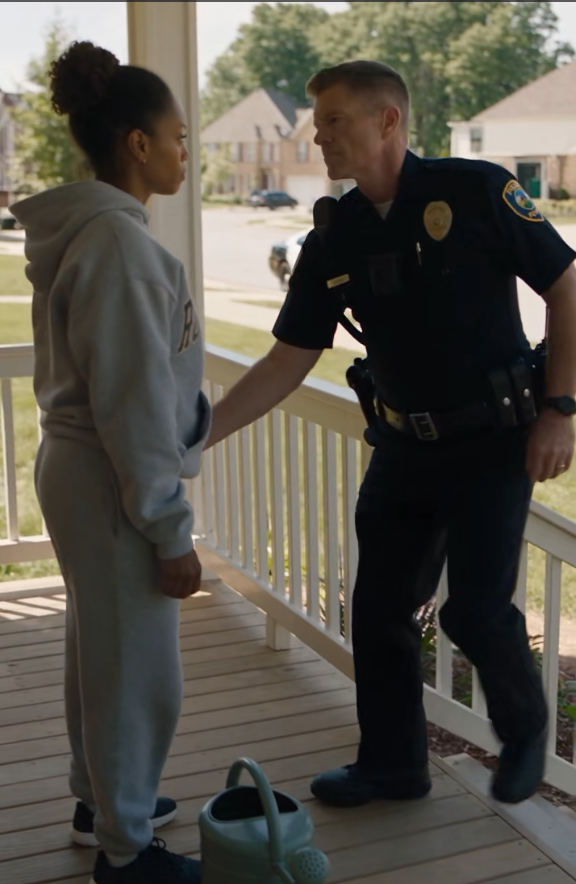
For half a second, I was back there.
Gray sweatpants.
Metal cuffs.
Harlan's hand on my arm.
The watering can rolling across the bricks.
Then the cruiser continued.
At the wheel was Nolan Quinn.
He lifted two fingers in greeting.
I lifted mine.
He drove on.
My shoulders relaxed.
Not completely.
Maybe never completely.
That was another thing people misunderstand.
Surviving something does not mean returning to who you were before it.
Sometimes survival means becoming someone who remembers accurately.
I looked at my house.
The porch.
The flowers.
The windows.
The place Dr. Vale had protected.
The evidence Elena had guarded.
The address Sentinel had watched.
The property Harlan had turned into a trap.
The home my father's history had somehow guided me toward decades after he was gone.
For two years, people had asked me the same question in interviews.
What went through your mind when Officer Harlan realized you were a federal prosecutor?
They expected satisfaction.
A reversal.
The powerful officer suddenly afraid because the woman he underestimated had authority of her own.
But that was never the moment that mattered.
The important moment came before he knew—or before I knew that he already knew.
It was the moment I stood on my own porch and told him who I was, and my words were treated as less credible than his assumptions.
My title changed what happened afterward.
It should never have been necessary to change what happened before.
That became the lesson I carried into every courtroom afterward.
Not that important people deserve to be believed.
Not that powerful people should know their rights.
The opposite.
A society proves what it believes about justice by how it treats people who have no title to reveal.
No federal badge.
No prosecutors calling the station.
No agents searching the report.
No colleague who can order evidence preserved before someone deletes it.
Just a name.
A voice.
And the expectation that facts should matter.
My mother called from the porch.
"Sloane, you're flooding them again."
I looked down.
Water had pooled around my shoes.
I laughed.
Then I turned off the hose.
At the base of the largest hydrangea, something caught the light.
A small brass object.
For one wild second, I thought we had missed another key.
I knelt.
Pulled it from the soil.
Not a key.
A tiny metal tag.
Old.
Corroded.
Letters stamped into one side.
I wiped away the dirt.
My breath stopped.
L.M.
Leon Mercer.
My father.
I stared at it.
Mom stepped down from the porch.
"What is it?"
I handed it to her.
Her face changed.
"I haven't seen this in thirty years."