"What is it?"
She turned it over.
"A tag from his old tool cabinet."
"Why is it buried here?"
She looked at the hydrangeas.
Then at the house.
And suddenly she smiled through tears.
"He was here."
"What?"
"Your father helped Edwin build the workbench in the basement."
I felt the world tilt one final time.
"When?"
"Long before you were born."
She laughed softly.
"You didn't know?"
"No."
"Edwin used to call your father whenever something broke."
I looked at the house.
At the foundation wall where Vale had hidden the first drive.
At the workbench placed in front of it.
Built by my father.
The hiding place had not merely been inside a house connected to his old friend.
My father had built the thing that concealed it.
Not intentionally.
Not as part of a conspiracy.
Not knowing that decades later, a frightened doctor would slide evidence behind it.
Not knowing his daughter would someday buy the house.
Not knowing she would be arrested on its porch.
There was no grand design.
No secret plan spanning thirty years.
Just people.
Their lives crossing.
Their choices leaving objects behind.
A workbench.
A letter.
A report.
A camera left running.
A flower bed.
A sentence written honestly.
A sentence written falsely.
Tiny things surviving long enough to become evidence.
My mother touched the metal tag.
"You always wanted everything to mean something."
I smiled.
"Occupational hazard."
"Maybe this doesn't."
"Maybe."
She returned to the porch.
I stayed beside the hydrangeas for another minute.
Then I pressed the little tag into my palm.
For most of my career, I had believed justice happened in dramatic places.
Courtrooms.
Grand juries.
Arrests.
Sentencings.
I was wrong.
Most of the time, justice begins somewhere far less impressive.
A person notices something.
Another person keeps a copy.
Someone refuses to delete a recording.
Someone writes down a name.
Someone decides that what really happened matters more than what would be convenient to say happened.
And sometimes the truth survives only because one frightened person hid it behind a wall, another buried it beneath flowers, and a police officer who had spent years corrupting the written record finally decided to write one lie so conspicuous that the truth could no longer remain hidden.
I slipped my father's tag into my pocket.
Then I lifted the watering can and walked back toward the porch.
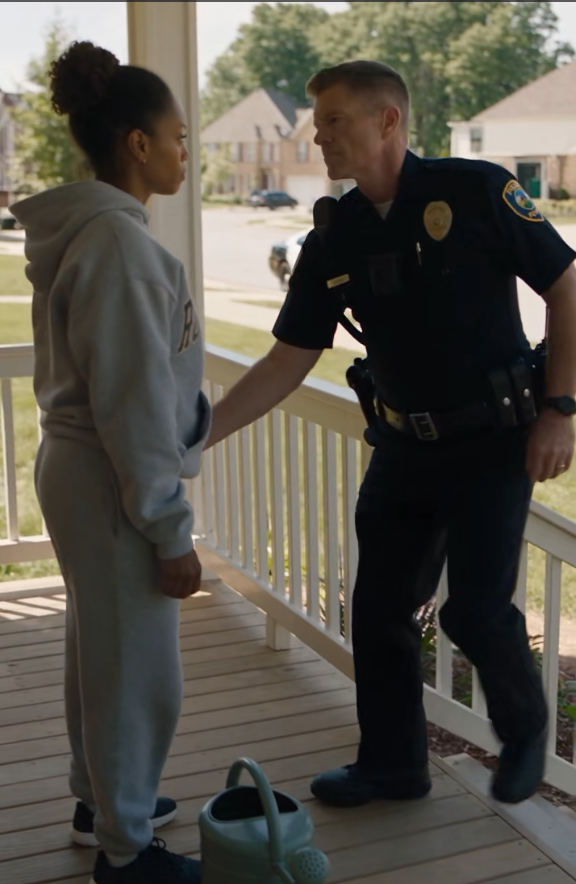
Two years earlier, Grant Harlan had kicked that same can from my hands because he thought—or needed everyone else to think—that I did not belong there.
Now the house behind me was quiet.
Mine.
Entirely mine.
Not because a deed said so.
Not because a federal database confirmed it.
Not because a badge eventually recognized me.
Because I had stayed.
Because the truth had stayed.
And because after everything designed to push me away, I was still standing exactly where they had once decided I had no right to be.