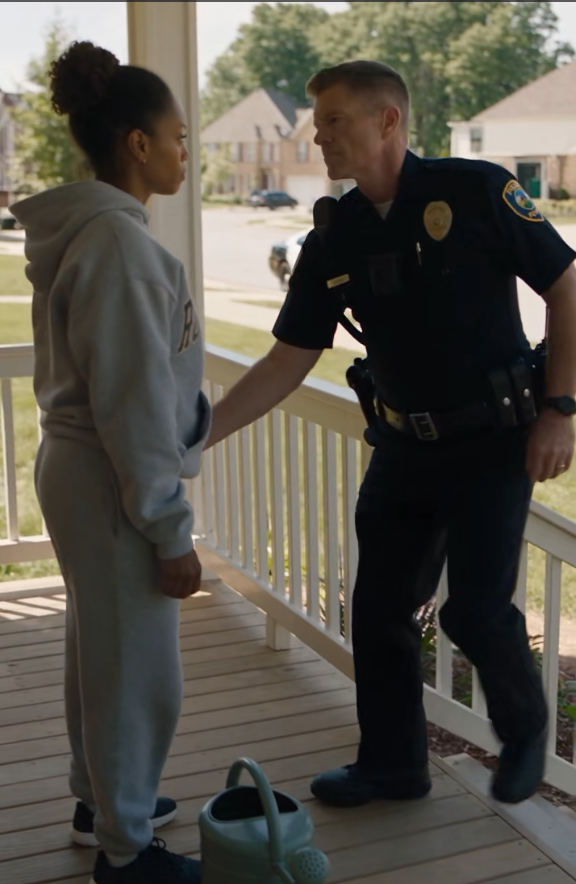
Grant Harlan was questioned again.
He denied everything.
Denied Sentinel was corrupt.
Denied receiving illegal payments.
Denied knowing why Rusk had visited Lillian.
Denied recognizing the phrase "Vale's place."
When confronted with Quinn's body-camera recording, he changed explanations.
He claimed he had previously attended a burglary call at the residence.
False.
He claimed Rusk once mentioned Vale casually.
Possible, but irrelevant.
He claimed the training material had been misinterpreted.
He said Narrative Survival merely helped officers "describe legitimate threat cues."
Then investigators showed him payment records.
He stopped talking.
Got a lawyer.
By Tuesday afternoon, Harlan was officially a target of the federal investigation.
I remained recused from every charging decision involving him.
That was necessary.
It was also infuriating.
I had spent my career building cases.
Now the most important case of my life was being assembled five offices away while I sat behind a closed door like a witness.
The media arrived Tuesday.
Someone leaked my arrest.
By noon, satellite trucks lined the street outside our building.
The headline was simple enough to travel.
BLACK FEDERAL PROSECUTOR ARRESTED AT OWN HOME.
My photograph appeared beside my booking intake image, though technically I had never been fully booked.
Commentators argued.
Civil-rights attorneys demanded accountability.
Police union representatives warned against "rushing to judgment."
Neighbors gave interviews.
Lillian refused.
Someone found my old trial footage.
Someone found Harlan's commendations.
Someone else found every case he had ever touched.
My phone became unusable.
Then, at 2:08 p.m., my mother called.
That was worse.
"Sloane Renee Mercer."
"Hello, Mom."
"You got arrested and I found out from television?"
"I didn't want to worry you."
"I'm your mother. Worry is in the job description."
"I'm fine."
"They put handcuffs on you."
"Yes."
"In your yard."
"Porch."
"That is not better."
I leaned back.
My mother lived nine hundred miles away and had spent thirty-two years teaching seventh-grade English.
She had the terrifying ability to make federal prosecutors feel twelve years old.
"You want me to come?"
"No."
"I'm coming."
"Mom."
"You bought a house with four bedrooms. Use one."
Despite everything, I laughed.
Then she went quiet.
"Sloane."
"Yeah?"
"Did you think about your father?"
The laugh disappeared.
"Yes."
My father, Leon Mercer, had been stopped by police when I was fourteen.
Nothing dramatic by national standards.
No video.
No lawsuit.
No headlines.
He had been a mechanical engineer driving home from work in a sedan he had spent ten years saving for.
The officer said the car resembled one reported stolen.
My father was ordered onto the pavement.
Handcuffed.
Held for forty-three minutes.
Then released.
He never complained publicly.
But afterward, for years, whenever police lights appeared behind us, his hands changed on the steering wheel.
Tighter.
Careful.
At fourteen, I did not understand why humiliation could live in someone's body long after danger passed.
At thirty-eight, standing in my kitchen with bruises around my wrists, I did.
"I thought about him," I said.
My mother's voice softened.
"He would have been proud of how you handled it."
I looked toward the front porch.
"No."
"No?"
"He would've been angry that I had to."
On Wednesday morning, the case broke open.
Not because of Harlan.
Because of the dead man.
Evan Rusk had maintained a cloud backup under an alias.
Investigators found the credentials on a handwritten recovery sheet taped beneath a drawer in his office.
Inside were files.
Thousands.
Rusk had been recording everyone.
Contractors.
Officers.
Officials.
Sentinel clients.
Even Grant Harlan.
Insurance.
Leverage.
Protection.
Blackmail.
Whatever the original reason, it became his final act of self-preservation.
One audio recording featured Harlan and Rusk arguing six months earlier.
Rusk: "You're putting too much in writing."
Harlan: "The reports are clean."
Rusk: "That's not what I'm talking about."
Harlan: "Nobody can prove the calls were arranged."
Rusk: "Pell could."
Harlan: "Pell is gone."
Rusk: "Vale isn't."
Then silence.
Harlan: "Old man's dying."
Rusk: "And if he left it somewhere?"
Harlan: "Then we find it."
Another recording, from two months before Vale's death:
Harlan: "House has been searched."
Rusk: "Not properly."
Harlan: "You want me to tear apart a cardiologist's basement without a warrant?"
Rusk: "I want you to solve the problem you helped create."
Harlan: "I wrote reports."
Rusk: "You taught forty men to write them."
Then came the sentence that destroyed Grant Harlan's remaining defenses.
Rusk said, "Marcus kept a list of every arrest we manufactured."
Harlan answered:
"Then pray the old man dies before anyone finds it."
But even that was not the worst file.
The worst file was dated eight months earlier.
It was a spreadsheet.
Names.
Payments.
Assignments.
Targets.
Outcomes.
At the very bottom was a column titled Sponsoring Contact.
That column contained a name I knew.
Everyone in our office knew it.
A name so completely outside our suspicions that when Daniel Cho showed me, I thought at first I was reading it incorrectly.
Raymond Bell.
Assistant United States Attorney.
My colleague.
The man who had stood beside me in Captain Rowe's conference room.
The man who had worked Orchard with me for five months.
The man whose office was twenty steps from mine.
I stared at Cho.
"No."
"We're verifying."
"Ray is on the prosecution team."
"We know."
"He has access to sealed warrants."
"We know."
"Grand jury material."
"We know."
"Witness names."
Cho's silence answered the rest.
My stomach turned.
"Where is he?"
"His office."
"Does Marisol know?"
"She's with him."
I stood.
Cho blocked the door.
"Sloane."
"Move."
"You are not going in there."
"Daniel."
"We don't know what he knows yet."
"You just told me his name appears on a corruption ledger tied to a murdered man."
"Which is why you're staying here."
I looked through the glass wall toward the corridor.
Ray's office door was closed.
Two FBI agents appeared casually near the elevators.
My entire professional world shifted.
Then something else occurred to me.
"Ray knew about Vale's drive."
Cho's expression told me they had considered it.
"He was in the room when you told me."
"Yes."
"He knew you found it in my basement."
"Yes."
"And Rusk died that night."
Cho's jaw tightened.
The timing.
Sunday afternoon: drive recovered.
Sunday evening: Ray knows.
Sunday night: Rusk dies.
I whispered, "Oh, God."
Then my office phone rang.
Neither of us moved.
It rang again.
I looked at the display.
Internal extension.
Ray Bell.
Cho saw it.
His eyes narrowed.
"Answer."
I picked up.
"Hello?"
Ray sounded completely normal.
"Sloane. You busy?"
Every instinct in me went cold.
"A little."
"Can you come down here?"
"Why?"
"There's something about Harlan's report I think we missed."
Cho stepped closer.
I said, "Give me five minutes."
Ray paused.
Then:
"Bring the Vale letter."
My eyes met Cho's.
The letter was in evidence.
Ray knew that.
"I don't have it."
Another pause.
"Right. Sorry. Long week."
"Very."
"Five minutes?"
"Sure."
I hung up.
Cho whispered, "He's testing."
"For what?"
"Whether you know."
The corridor outside seemed suddenly too quiet.
I looked at my computer.
At Orchard.
At the months of work.
Then memory struck me.
Harlan's draft.
Not the repeated sentence.
Something else.
I opened the scanned report.
Subject attempted to move toward interior despite instructions.