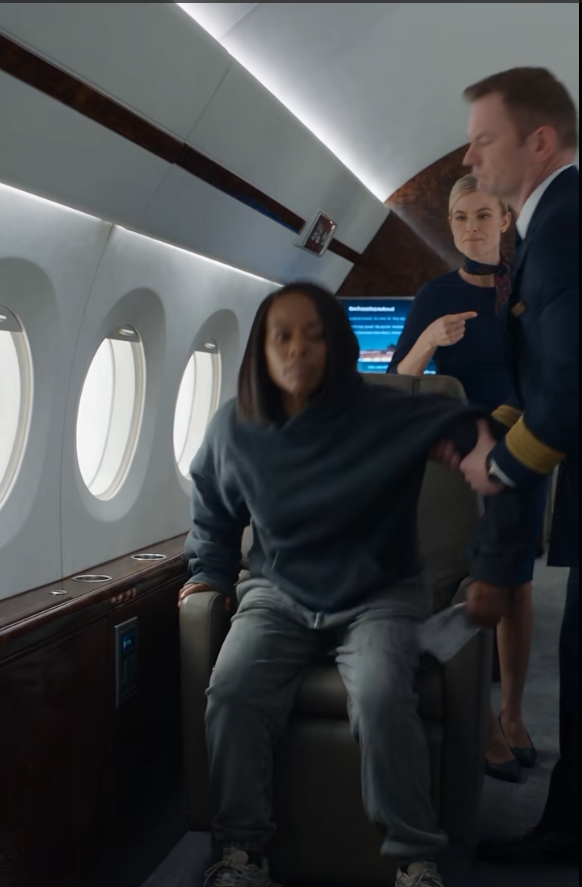
“I know.”
“You may have to put more Pinnacle equity into the deal.”
“I know.”
“Hundreds of millions.”
“I know.”
She lowered her voice.
“Then say it knowing the cost.”
I looked through the open hangar door toward the runway.
An aircraft lifted into the afternoon sky.
“I do.”
The lenders were already on the call when I entered the conference room.
So were the board, Pinnacle’s investment committee, outside counsel, and two representatives from the financing syndicate.
One lender spoke first.
“Dr. Hamilton, we need clarity regarding statements made at your employee meeting.”
“You have a transcript.”
“We do.”
“Then ask.”
“Do you believe the airline possessed a systemic operational-control deficiency before closing?”
The room disappeared around the question.
My lawyer had prepared several technically precise answers.
None used yes.
I could say there were isolated failures across multiple controls.
I could say the term systemic lacked an agreed definition.
I could say reforms exceeded any legally required remediation.
Every sentence would be true.
That was what made them dangerous.
I looked at the acquisition binder in front of me.
Five billion dollars.
Then at my bruised wrist.
That cost considerably less.
“Yes,” I said.
Nobody moved.
The lender repeated, “Yes?”
“I believe the airline had systemic deficiencies in the way certain passenger disputes were classified, escalated, reviewed, and learned from.”
My general counsel closed her eyes briefly.
I continued.
“I do not believe those deficiencies impair core flight safety, aircraft operation, financial viability, or the fundamental value of the network. I do believe they were real.”
The lender’s voice became careful.
“And Pinnacle was aware of the internal audit before closing?”
“The report existed in the diligence data room.”
“Was senior management aware?”
“My diligence organization had access. The report was reviewed below senior level and categorized as low materiality. I was not personally briefed on it before closing.”
“So you contend it was disclosed.”
“The legal question of disclosure is for counsel. I’m telling you the factual sequence.”
The board chair watched me.
The lender asked, “Would you have changed the purchase price had you personally reviewed the report?”
A trap.
“No.”
That surprised everyone.
“Why not?”
“Because the company is still worth what we paid.”
“Would you have changed anything?”
“Yes.”
“What?”
“The first hundred days.”
I leaned toward the camera.
“And now we are changing them.”
The lender tried twice more to push me toward a statement that the deficiencies constituted a material adverse effect.
I refused.
Not by denying the problem.
By refusing the financial conclusion.
Facts.
Not labels.
Eventually the call ended.
Nobody spoke for several seconds.
Then the board chair asked, “How bad?”
My general counsel checked her phone.
“Bridge lenders are reserving rights. No termination notice.”
“Pricing?”
“They’ll try.”
“How much?”
“Unknown.”
A director stared at me.
“You may have cost us a fortune.”
“Yes.”
He waited for an argument.
I did not give him one.
Finally he asked, “Was it worth it?”
That was not a question I could answer yet.
People who knew the ending liked to pretend difficult choices felt clean when they were made.
They did not.
I looked at the directors.
“We’ll know later.”
Part VI — Aftermath
Later arrived slowly.
Not with a dramatic phone call.
Not with a public apology.
Not with a sudden reversal that rewarded every principled choice.
The lenders renegotiated.
Pinnacle paid more.
Not hundreds of millions, but enough that my investment committee reminded me of the number at every meeting for the next six months.
The airline’s share price fell after the acquisition disclosures and then recovered gradually.
Some investors accused me of turning a customer-service controversy into an expensive governance crusade.
Others applauded the reforms.
Neither group had to implement them.
That was the work.
The independent review expanded beyond my incident.
Hundreds of cases were examined.
Most did not involve discrimination.
That finding mattered.
Some passengers had been genuinely threatening.
Some removals had been appropriate.
Some complaints were contradicted by video.
Employees deserved those facts too.
But the review also found recurring failures in documentation, inconsistent use of law enforcement, and measurable disparities in certain subjective escalation categories.
Not everywhere.
Not every crew.
Not every station.
Enough.
We published the results.
Including the inconvenient parts.
Especially those.
The new incident form removed interpretive labels unless accompanied by observable behavior.
If an employee selected AGGRESSIVE, a second box appeared:
DESCRIBE ACTION.
If SUSPICIOUS:
DESCRIBE ACTION.
If NONCOMPLIANT:
IDENTIFY THE SPECIFIC SAFETY OR OPERATIONAL INSTRUCTION.
The first month, employees hated it.
By the third month, reports improved.
Police calls for administrative ticket disputes declined.
Safety-related removals did not.
That mattered more than any press release.
The customer operations chief survived his ninety-day review.
Barely.
He rebuilt the complaint structure and then, six months later, asked to step down voluntarily.
Not because I forced him.
He told me he had spent too many years learning how to make the old machine run.
He wanted someone else to build the next one.
I respected him more on the day he left than on the day we met.
The station duty manager completed his certification and returned to supervisory work.
His first major intervention came two months later when a crew member challenged a passenger traveling under a recently changed legal name.
The documents were valid.
He stopped the escalation before police were called.
Then he filed a report on himself because the conversation had lasted four minutes longer than the new target.
I read it.
I laughed.
Then I removed the target.
Some metrics deserved to die.
Officer Miller and I entered mediation.
He arrived in a suit that did not fit well.
I arrived with my attorney.
For nearly an hour, lawyers spoke.
Then I asked to speak directly.
Miller looked at his counsel.
His counsel nodded.
I said, “Why didn’t you check the boarding pass?”
He rubbed his palms together.
“Crew told me it had been checked.”
“The gate employee was standing there.”
“I know.”
“You heard me ask.”
“Yes.”
“Why didn’t you?”
He took a long time.
“Because once they said you refused to leave, I stopped thinking the ticket was the issue.”
Exactly.
“You thought compliance had become the issue.”
“Yes.”
“And once I questioned you, that confirmed it.”
He looked down.
“Yes.”
“Would you do the same thing now?”
“No.”
I watched him.
“Why?”
“Because I’ve watched the footage about fifty times.”
“That’s hindsight.”
“Yes.”
I appreciated the answer.
He continued.
“And because now I know how fast you can turn somebody asking a reasonable question into somebody resisting you.”
His lawyer shifted.
Miller glanced at him.
“I’m not saying the restraint was outside policy. That’s still under review.”
I almost smiled.
“Of course.”
“But I should have checked.”
There was the sentence I wanted.
Not because it healed anything.
Because it described the failure correctly.
The case settled.
The financial amount remained confidential.
The airport authority adopted a verification requirement for nonviolent documentation disputes.
Miller kept his job after discipline and training.
Some people online were furious.
They wanted him fired.
Others believed he had done nothing wrong.
Neither group had sat in the mediation room.