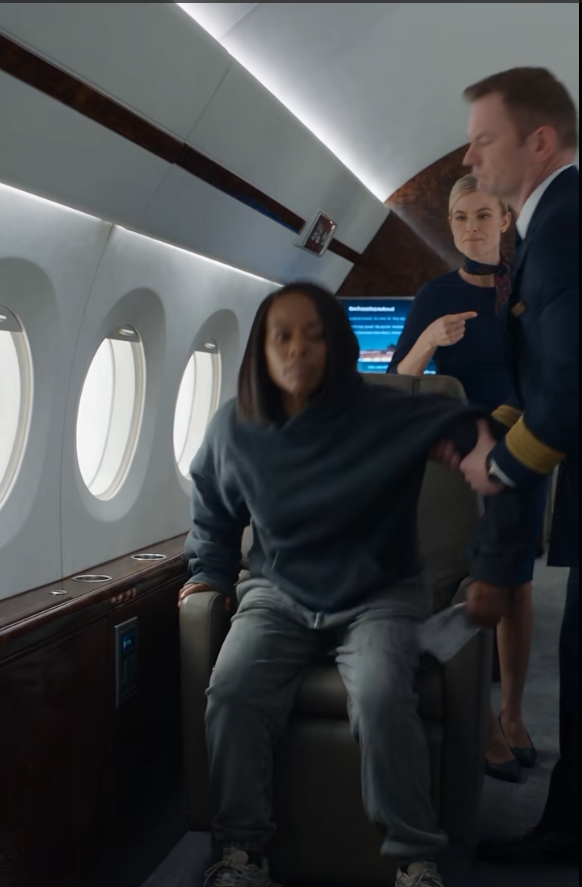
The sentence traveled through the hangar without applause.
Good.
I did not want applause yet.
“I did not become entitled to dignity at 4:17 p.m. when Pinnacle’s voting control became effective. I had exactly the same rights at 4:16.”
A mechanic in the front row nodded.
I continued.
“If you remember nothing else I say today, remember this: our standards cannot depend on whether the person in front of us has enough power to make us regret mistreating them.”
This time there was scattered applause.
I waited for it to stop.
Then I talked about Megan.
Not by name.
I said the employee involved had been terminated after an independent review.
A few people clapped.
I raised a hand.
They stopped.
“This is not a victory lap.”
I told them about the audit.
The old complaints.
The coding failures.
The fact that my own acquisition team had possessed the report and undervalued it.
That surprised people.
The communications staff had advised me not to mention it.
Which was why I had.
“If the only lesson is that frontline employees must be perfect while executives receive dashboards that hide recurring harm, we will repeat this with better public relations.”
I explained the changes.
Then I said the sentence I knew would make some directors uncomfortable.
“If these reforms make your job harder, tell us. If they make your job safer, tell us. If they create new problems, tell us. But do not protect a bad process because changing it feels like admitting failure.”
Near the back, someone raised a hand.
We had not planned questions yet.
I pointed to him.
A flight attendant stood.
He was young.
Nervous.
“Dr. Hamilton, what are we supposed to do when a passenger actually is aggressive and later claims discrimination?”
A fair question.
“You document what happened.”
“What if nobody believes us?”
“Then our system has failed you too.”
He looked surprised.
I continued.
“You should never have to exaggerate behavior to make the company take a safety concern seriously. Describe what the passenger did. Threat, gesture, physical action, repeated refusal related to safety. Facts protect passengers, and facts protect employees.”
Another hand.
A gate agent.
“What happens if cabin crew tells us to remove someone and we think they’re wrong?”
“Under the interim rule, you can challenge the factual basis without challenging cockpit or cabin safety authority. If the issue is ticketing, identity, or seat assignment, station verification controls that fact.”
She asked, “And if they get mad?”
“Then management gets involved.”
A ripple of laughter.
I smiled.
“That is what management is for.”
Another hand.
An older man wearing a maintenance shirt.
“Are you going to sell us?”
The question changed the room.
The acquisition.
The real fear beneath everything.
I looked at him.
“Parts of the company?”
“No. The airline.”
“No.”
“You sure?”
“Yes.”
“Private equity says things.”
That produced louder laughter.
Even I laughed.
“Fair.”
Then I answered seriously.
“Pinnacle did not acquire this company to strip it. We acquired it because the network has value, the people have value, and the operation can perform better than it has. That does not mean every job or structure remains unchanged forever. I will not insult you with promises no executive can honestly make.”
The room quieted.
“But I will make one promise. If we change something, we will explain why. If we fail, we will say we failed. And if a metric makes us better at hiding problems than solving them, we will stop rewarding the metric.”
The mechanic nodded once.
That was enough.
At the end of the town hall, I walked offstage.
My general counsel met me beside a stack of tool cabinets.
“You ignored half the approved remarks.”
“Only half?”
“Communications is devastated.”
“They’ll recover.”
She handed me her phone.
“Airport authority.”
The investigation into Officer Miller had reached a preliminary finding.
Failure to independently assess available evidence.
Inappropriate escalation of restraint during a nonviolent administrative dispute.
Documentation deficiencies.
He would face internal discipline and mandatory retraining while the broader review continued.
I read the summary.
My lawyer asked, “Still want to proceed with the civil case?”
“Yes.”
“No change?”
“One.”
“What?”
“Offer mediation first.”
She studied me.
“You’re becoming irritatingly reasonable.”
“I was handcuffed five days ago. Let me enjoy my growth.”
She laughed.
Then her face became serious.
“There’s something else.”
“What?”
“The takeover financing committee found a covenant issue.”
That got my full attention.
“What kind?”
“One of the lenders is arguing the reputational event may trigger a material-adverse-change review tied to the bridge facility.”
I stared at her.
“That’s absurd.”
“Probably.”
“Probably?”
“They may not be trying to win. They may be trying to renegotiate pricing.”
Of course.
Five billion dollars returned to the center of the story.
The scandal had created leverage.
Not for me.
Against me.
If the lenders forced even a temporary financing disruption, we could face billions in refinancing risk.
The board wanted the public controversy resolved quickly because markets hated uncertainty.
Now I understood why one director had pushed so hard for immediate closure.
Fire Megan.
Issue apology.
Declare isolated incident.
Move on.
A broad admission of systemic failure could strengthen the lender’s argument that we had discovered undisclosed operational and reputational risk.
The reforms I had just announced might cost us hundreds of millions of dollars.
My general counsel watched me process it.
“This is the real decision,” she said.
I looked back toward the hangar.
Employees were still leaving their chairs.
“What are our options?”
“Limit the language. Characterize reforms as voluntary post-closing enhancements, not remediation of preexisting systemic deficiencies.”
“In English.”
“Stop saying the company had a systemic problem.”
“Did it?”
She did not answer.
I looked at her.
“Did it?”
“Yes.”
There it was.
The choice.
Not whether to punish Megan.
Not whether to sue Miller.
Not whether to apologize.
Whether I would tell the truth when the truth became expensive.
My phone buzzed with a message from the board chair.
CALL NOW. LENDERS REQUESTING FORMAL RISK CERTIFICATION.
I stared at the screen.
Five billion dollars.
My career.
Pinnacle’s largest acquisition.
Thousands of employees whose jobs depended on a stable closing.
My investors.
My partners.
My credibility.
All of it suddenly sat on the other side of one word.
Systemic.
The word lawyers feared.
The word insurers hated.
The word lenders could monetize.
My general counsel said quietly, “We can describe the facts without adopting the label.”
That was legally defensible.
Maybe even prudent.
I thought about Mrs. Green.
Did they believe me?
I thought about the audit report.
I thought about our diligence team marking it low materiality.
I thought about Megan changing “cabin profile” to “reservation profile.”
One phrase replaced by another.
Not necessarily a lie.
Just language moving slightly closer to safety.
That was how it started.
You did not falsify reality.
You improved the wording.
Then someone else improved it again.
Soon nobody could find the original event underneath the language built to protect the institution.
I handed the phone back to my lawyer.
“Set the call.”
“What are you going to say?”
“The same thing I said in there.”
“Vanessa, this could reopen financing.”