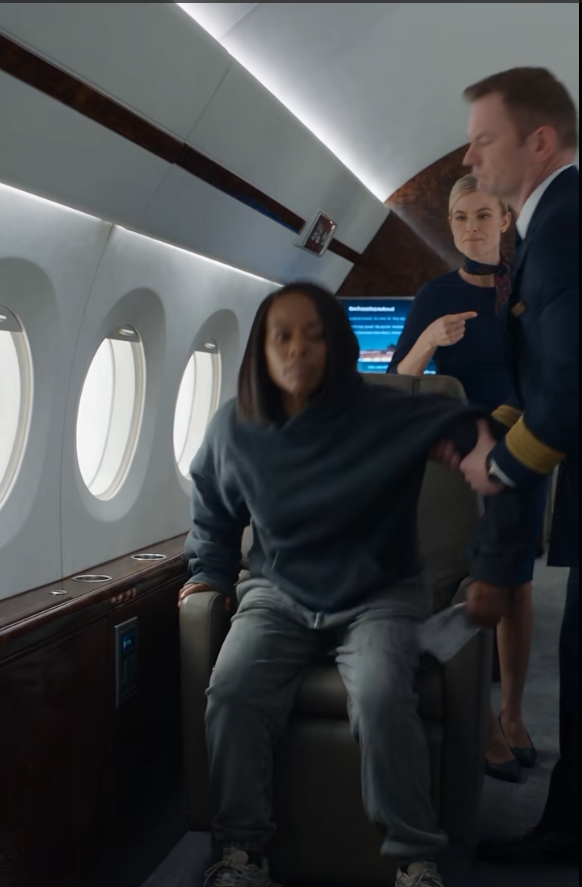
I looked at Miller.
Then at the mark around my wrist.
“Yes.”
“All right.”
“Who has been informed?”
“The directors. General counsel. Interim CEO. Integration team.”
“And the closing?”
“Complete.”
“Voting control?”
“Effective as of 4:17 Eastern.”
I looked at the clock on the wall.
6:04.
“Then convene the special board committee.”
The duty manager whispered, “Oh my God.”
Megan turned toward him.
“What?”
He was staring at his tablet.
A breaking-business alert had appeared.
Not the full acquisition announcement.
A market reporter had posted that Pinnacle Equity Group had completed a previously disclosed tender and voting agreement giving it majority control of the airline’s parent company, with formal details expected the next morning.
Megan read it over his shoulder.
Then she looked at me.
The contempt was gone.
Something else had replaced it.
Fear.
I should have enjoyed that.
I didn’t.
Fear was too easy.
Fear made people say whatever they thought would save them.
Truth was more useful.
I ended the call.
Megan swallowed.
“Dr. Hamilton, I—”
“Don’t.”
She stopped.
“I think there has been a terrible misunderstanding.”
“No.”
My voice remained quiet.
“That word is already banned.”
Part II — Pressure
The flight never left on time.
By 6:30, passengers had been deplaned and moved to the gate area while the airline arranged a replacement lead flight attendant and conducted what it called an operational review.
I refused the private lounge they offered me.
Instead, I sat in a hard plastic chair near the gate wearing the same black hoodie and battered sneakers.
My wrist had begun to swell.
Someone brought ice.
I declined it at first.
Then the woman from 13C sat two seats away and handed me a wrapped cold pack from an airport first-aid cabinet.
“You don’t have to prove anything by letting that swell,” she said.
I took it.
“Thank you.”
She nodded.
“I’m Claire.”
“Vanessa.”
“I know.”
I almost smiled.
She glanced toward the television mounted over the gate.
Video of my removal was already everywhere.
The first clip began with Miller twisting my arm.
Bad context.
The second began earlier.
Megan saying, “People who look like you don’t belong in 14A.”
That was worse.
The internet had already begun doing what it always did—compressing a complicated event into opposing certainties.
Some viewers wanted Megan fired before dinner.
Some insisted I must have provoked her.
Some had identified me.
Others claimed I was impersonating myself.
A financial account posted a photograph from the acquisition closing showing me in my charcoal suit signing documents beside the airline’s board chair.
Another account placed it next to a still image from the aircraft: hoodie, sweatpants, cuffed hands.
The contrast was irresistible.
I hated it.
Not because the first image was flattering or the second humiliating.
Because it encouraged exactly the wrong lesson.
That what happened became unacceptable only after people learned I was rich.
Claire seemed to understand.
“They’re calling it a billionaire discrimination scandal.”
“I’m not a billionaire.”
“Give the internet twenty minutes.”
I looked at her.
She smiled faintly.
Then her expression became serious.
“I recorded before the police got there.”
“I noticed.”
“I’ve already sent it to the address your lawyer gave me.”
“Thank you.”
“She was on you almost immediately.”
I pressed the cold pack against my wrist.
“What did you see?”
Claire considered the question carefully.
“You boarded. Put your bag away. Sat down. She looked at you longer than she looked at anyone else. Then she asked for your pass.”
“That’s all?”
“That’s enough for what I saw.”
“What else?”
Claire hesitated.
“The gate employee tried to stop her.”
I remembered.
“What did he say?”
“I couldn’t hear everything. Something like, ‘It cleared.’ She told him she had it handled.”
That mattered.
“Are you sure?”
“Yes.”
I opened the secure legal channel and typed a note.
Preserve gate audio if available. Interview station duty employee separately. Passenger 13C witnessed employee warning.
Claire watched me.
“You really are taking over the airline.”
“Apparently.”
“You don’t sound pleased.”
“I was pleased four hours ago.”
“What happens to her?”
I knew she meant Megan.
“I don’t know yet.”
That answer surprised her.
“She had you arrested.”
“She had me removed.”
“Because she decided you didn’t belong there.”
“Yes.”
“So why don’t you know?”
“Because owning a company doesn’t turn anger into evidence.”
Claire leaned back.
“You’re more patient than I would be.”
“No.”
I shifted the cold pack.
“I’m angrier than I can afford to be.”
At 7:05, the airline’s interim chief executive arrived by video on my phone.
I moved to an empty conference room near the gate.
The duty manager joined me. So did an attorney from the airline who had arrived from another terminal.
My own general counsel appeared on-screen from Manhattan.
She had removed her jacket and tied her hair back. That was how I knew things were serious. During the acquisition, she had worn the same navy suit through two consecutive nights.
“First,” she said, “how is your shoulder?”
“Functional.”
“That is not a medical term.”
“Neither is ‘fine,’ and you won’t accept that.”
“I would accept an examination.”
“Later.”
The interim CEO appeared in a second window.
He looked exhausted.
“Vanessa, we have a problem beyond the viral video.”
“I assumed.”
“Our internal incident system shows no fraud alert on your reservation.”
“We know.”
“That’s not the problem.”
I looked up.
“What is?”
He glanced down at something.
“Megan entered an irregular-passenger note after police boarded.”
The room became quiet.
“What does it say?”
He read.
“Passenger presented inconsistent credentials and became verbally threatening when asked to verify first-class entitlement.”
“When was it entered?”
“5:48.”
I checked my memory.
The police had reached my seat around 5:41.
“After she had already summoned law enforcement.”
“Yes.”
“Any edit history?”
“Yes.”
The lawyer beside me said, “We need to be careful about conclusions.”
“I haven’t reached one.”
My general counsel asked, “What was edited?”
The interim CEO hesitated.
“Original note said ‘passenger attire and behavior inconsistent with cabin profile.’ That phrase was removed at 5:56 and replaced with ‘credentials inconsistent with reservation profile.’”
The duty manager closed his eyes.
I stared at the screen.
There it was again.
Passenger profile.
Cabin profile.
Reservation profile.
Language trying to become more defensible each time someone touched it.
“Who can edit those notes?” I asked.
“Cabin crew, station supervisors, certain customer operations personnel.”
“Did anyone else edit this one?”
“Not yet.”
“Lock it.”
“Already done.”
“Preserve device logs.”
“Done.”
I looked at the airline attorney.
“Do employees know those edits are retained?”
“Yes.”
“Then why change it?”
Nobody answered.
My general counsel did.
“Because people panic.”
I nodded.
That was more likely than a conspiracy.
And in some ways, more dangerous.
Panic was ordinary.
Ordinary behavior built systems.
I asked the duty manager, “When did you verify my reservation?”
“Before law enforcement boarded.”
I studied him.
His skin had gone pale.
“You told Megan?”
“Yes.”
“What exactly?”
“I said the ticket scanned correctly and your identification matched.”
“And she said?”
“That she’d already made the call.”
“Which call?”
“Police.”
“Why didn’t you stop it?”