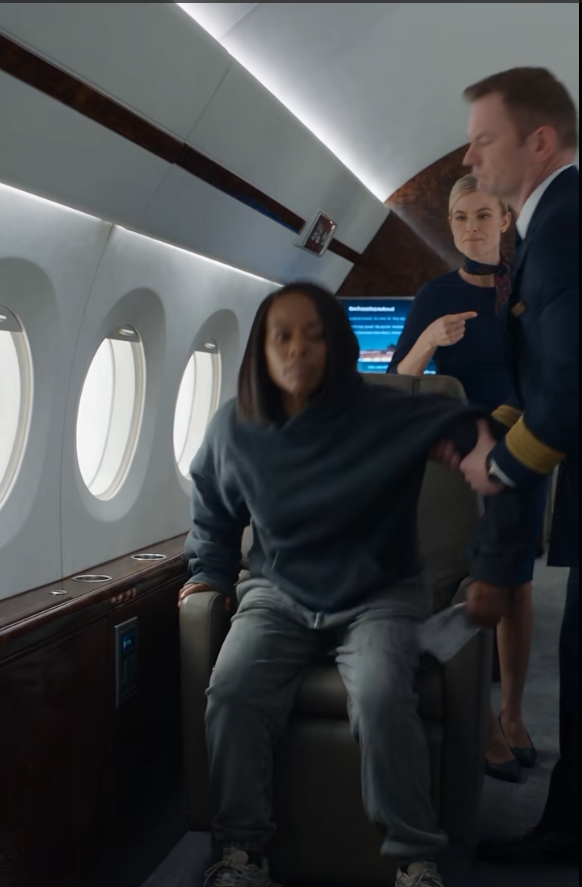
His eyes dropped.
There was the harder question.
“I should have.”
“Why didn’t you?”
He rubbed his thumb against the edge of his tablet.
“She’s senior cabin crew. I’m station side. Once a crew member frames something as a safety concern, we’re trained not to undermine them in front of a passenger.”
“Even if the concern is false?”
“We’re supposed to move the dispute off the aircraft.”
“By removing the passenger.”
“Yes.”
I leaned back.
There was the first real complication.
Megan’s behavior might have been personal.
But the machine around her had worked exactly as designed.
Crew asserts threat.
Station defers.
Police receive a compressed version.
Passenger is removed first and heard later.
I had spent months reviewing the airline’s financial debt, aircraft leases, labor obligations, route profitability, fuel hedges, loyalty liabilities, and maintenance reserves.
Nobody had shown me that workflow.
“Find the policy,” I said.
The airline attorney began typing.
The interim CEO said, “Vanessa, before we go deeper, the board is asking whether we should publicly announce your control and state that the employee has been suspended.”
“No.”
“Social media is moving fast.”
“So are facts.”
“Our brand team thinks silence will look weak.”
“Our brand team should stop thinking about appearances for thirty minutes.”
He went quiet.
I softened my tone.
“We will suspend anyone from safety-sensitive duty where appropriate. But I will not use a corporate press release to announce guilt before an investigation because I’m the injured person.”
My general counsel nodded once.
The airline attorney looked relieved.
The interim CEO looked unconvinced.
“Then what do we say?”
“Say the flight was delayed after an incident involving a ticketed passenger, that we are preserving records and reviewing crew, station, and law-enforcement interactions, and that we will provide verified facts.”
“And your identity?”
“Do not hide it. Do not center it.”
He frowned.
I continued.
“The story cannot become ‘airline mistreated owner.’ The story is that a passenger with valid documents was removed after verification was available. My ownership makes it more visible. It does not make it more wrong.”
My general counsel smiled without humor.
“That sentence is going in the statement.”
“No.”
“Why?”
“It sounds like a lawyer wrote it.”
“I am a lawyer.”
“Exactly.”
For the first time that evening, someone laughed.
It lasted three seconds.
Then the airline attorney found the policy.
He turned his laptop toward me.
CABIN INTEGRITY AND PASSENGER DISPUTE PROCEDURE.
I read.
Crew safety determinations receive presumptive deference.
Ticket irregularities should be resolved by station personnel.
Where dispute threatens on-time departure or cabin order, passenger may be temporarily removed to resolve discrepancy.
“What defines ‘threatens cabin order’?”
The attorney scrolled.
“Broadly.”
“How broadly?”
He read.
“Refusal to comply with crew instructions, escalating verbal disagreement, behavior causing passenger attention, or circumstances that may reasonably interfere with crew duties.”
I stared at him.
“Passenger attention?”
“Yes.”
“So if a crew member wrongly accuses someone, and nearby passengers notice the disagreement, the fact that people noticed becomes a reason to remove the passenger.”
He did not answer.
The duty manager whispered, “That’s how it can work.”
“How often?”
No one knew.
That bothered me more than Megan.
“Pull the last three years of removals under this policy.”
The interim CEO said, “Tonight?”
“Yes.”
“That could be thousands.”
“Then start.”
“Vanessa, we have a takeover integration beginning tomorrow morning.”
“So integrate this.”
Part III — The Wrong Problem
By midnight, I was finally in Los Angeles.
Not on the delayed commercial flight.
The board insisted I use a company aircraft after the airport incident, and this time I did not object.
My shoulder hurt enough that I could not lift my left arm above chest level.
A physician examined me before departure and diagnosed a strain, bruising, and superficial wrist injury.
No fracture.
No dramatic damage.
Pain did not need drama to be real.
I slept forty-three minutes on the flight west.
When I woke, there were 4,812 unread public messages, eleven requests for television interviews, two congressional staff inquiries, a request from an airport oversight office, and one email from a woman named Tasha Green.
The subject line was:
SHE DID THE SAME THING TO MY MOTHER.
I opened it.
The message was short.
Dr. Hamilton,
I saw the video. Last year my mother was removed from a flight after the same attendant accused her of using someone else’s upgrade. My mother is seventy-one. She was traveling for my brother’s funeral. They made her wait at the gate for two hours, then put her in economy even after they admitted her seat was valid.
We complained. The airline gave her 15,000 miles and said the employee had been coached.
I have the emails.
I read it twice.
Then I forwarded it to counsel with one line.
Find complaint. Preserve original.
Three minutes later, another message reached the legal intake portal.
Then another.
Not all involved Megan.
Some involved ticket verification.
Some involved passengers ordered off aircraft after questioning seat assignments.
Some described crew invoking “safety” after ordinary disputes.
A few were clearly unrelated grievances.
Many could not be verified.
But by 1:20 in the morning, my legal team had located Tasha Green’s complaint in the company archive.
The final internal disposition contained three words.
SERVICE RECOVERY COMPLETED.
Nothing about conduct.
Nothing about policy.
Nothing about discrimination.
The passenger received miles.
The incident disappeared statistically.
I felt something colder than anger.
Recognition.
I had seen this in companies before.
Problems were not necessarily hidden.
Sometimes they were categorized until they vanished.
A product defect became a warranty expense.
Harassment became retention risk.
Unsafe scheduling became overtime variance.
A passenger complaint became service recovery.
If you named a thing incorrectly long enough, the numbers eventually proved it did not exist.
At 6:30 the next morning, I entered the airline’s headquarters through a side door.
Cameras filled the main entrance.
I still wore casual clothes, though I had changed the hoodie for a plain black sweater. My wrist was wrapped. My shoulder was taped beneath the fabric.
The board had scheduled a takeover meeting for eight.
I moved it to seven.
At 7:02, I walked into the executive conference room.
The people around the table had spent the previous six months negotiating against me.
Now, legally, they worked for a company I controlled.
That fact interested me less than the stack of incident reports projected on the screen.
The board chair started to speak.
I held up a hand.
“Before governance, before integration, before executive appointments, we’re going to understand what happened yesterday.”
One director frowned.
“We have fiduciary obligations beyond a single customer incident.”
“Yes.”
“This acquisition cannot become consumed by a viral event.”
“No.”
He relaxed slightly.
Then I continued.
“But a viral event can expose a nonviral operating problem. That is what we’re testing.”
The head of customer operations sat along the wall.
He had run the division for six years.
I asked, “How many passengers were involuntarily removed last year for documentation or seating disputes?”
He checked his notes.
“Four hundred and twelve.”
“How many were later determined to hold valid documents?”
Silence.
“We don’t track that as a separate category.”