Part I — Eight Minutes
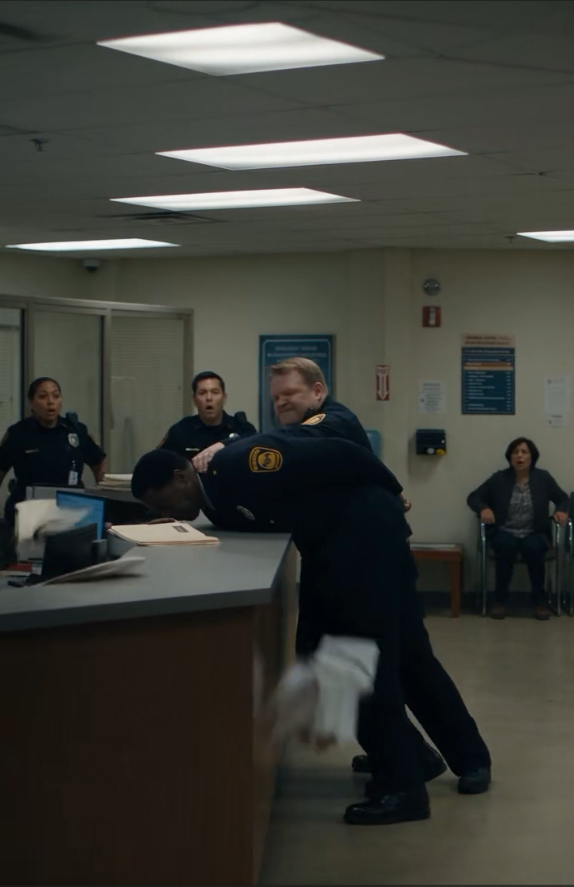
At 8:50 on my first morning as chief of the Riverside Police Department, Sergeant Garrett Caldwell shoved my face against the front desk and told me I had chosen the wrong building to impersonate a cop.
The edge of the counter caught the bone beneath my left eye.
My leather briefcase hit the floor beside me and opened on impact. Appointment papers, departmental transition notes, a legal pad, and the folder containing my first-week priorities slid across the polished tile.
Nobody moved to pick them up.
A pair of handcuffs closed around my wrists.
“Easy,” I said.
Caldwell twisted my right arm higher.
“Save it.”
The lobby smelled like burnt coffee, floor cleaner, and warm printer toner. Phones rang behind the front counter. A radio muttered from somewhere near dispatch. Two officers stood within ten feet of me. Another sat at a computer terminal. A civilian woman in the waiting area had stopped filling out a form.
Every one of them could see the gold command badge on my chest.
No one asked about it.
Caldwell leaned his weight into me.
“Where’d you get the uniform?”
I turned my head as far as the counter allowed.
“Sergeant.”
“That’s not an answer.”
“My identification is in the inside pocket of my jacket.”
He gave a short laugh.
“You think I’m reaching into your coat because you tell me there’s ID in there?”
I could feel the handcuff hinge pressing into the skin above my left wrist.
I had spent twenty years teaching younger officers that the first few seconds of a contact often decided everything that followed. Slow the moment down. See what was actually in front of you. Ask before assuming. Give people room to comply.
That morning, nobody slowed anything down.
Caldwell pushed my head lower.
“Men like you always think putting on a uniform makes you untouchable.”
I stopped trying to look at him.
The sentence mattered more than the grip on my neck.
There are mistakes that sound like mistakes.
That did not.
Across the counter, an officer kept typing.
His fingers had gone slower, but he did not look up.
Another officer lifted a phone.
“Riverside Police,” he said, then listened to the caller while staring at me.
The woman in the waiting area stood halfway from her chair.
“Please,” she said quietly. “Just check who he is.”
Caldwell ignored her.
One of the officers behind him muttered, “Probably stole the uniform.”
Someone laughed.
Not loudly.
That made it worse.
I stayed still.
Resisting would have given them a story.
A sudden movement. A perceived threat. An officer fearing for his safety.
I had reviewed enough use-of-force reports to know how quickly a sentence could be built backward from an outcome.
So I breathed through my nose and counted.
One minute.
Then two.
By the fourth, my cheek had gone numb where it touched the counter.
By the sixth, I had learned more about the culture of Riverside Police Department than any transition memo could have taught me.
Nobody was shocked.
Nobody asked a question.
The machinery of the station had simply bent around what was happening.
A printer kept spitting out pages.
A detective crossed the back hallway, looked toward me, then disappeared through a door.
Dispatch traffic continued.
Someone complained that the copier was jammed.
I understood then why the city had spent years losing civil suits while officers insisted every complaint came from someone with a grudge.
Bad departments rarely become bad because every person inside them is cruel.
They become bad because cruelty stops being unusual.
At eight minutes, a radio crackled sharply behind the desk.
A dispatcher answered.
“Go ahead.”
A pause.
Her posture changed.
She turned toward her monitor and began clicking through something.
Caldwell was still talking near my ear.
“You’re going to tell me where you got the badge, and then we’re going to find out what else you’ve got on you.”
The dispatcher leaned closer to the screen.
Her face lost color.
“Sergeant?”
Caldwell did not release me.
“What?”
She stared at the monitor, then at me.
When she spoke again, she was no longer talking only to him.
“Confirming arrival of newly appointed Chief Marcus Reed. Scheduled arrival time, 8:50 a.m.”
For the first time that morning, the station stopped sounding like a police station.
The phones were still ringing.
The radios were still alive.
But nobody seemed to hear them.
Caldwell’s hand left the back of my neck.
The pressure vanished so suddenly that my body nearly shifted forward on its own.
Someone whispered, “No.”
An officer hurried to the nearest terminal and typed something.
The dispatcher looked again at her screen.
Then at me.
“Oh God.”
Caldwell stepped backward.
His chair caught behind his knee and scraped across the floor.
I lifted my head.
My cheek felt hot.
My shoulders ached.
The cuffs were still on.
I looked at Caldwell.
He had the expression of a man who had just discovered that the wall he had been leaning against was a door.
Nobody moved.
I straightened as much as the cuffs allowed.
Then I said, “Take them off.”
Caldwell swallowed.
“Chief, I—”
“Take them off.”
He reached for the key.
His hands were not steady anymore.
The cuffs opened.
I brought my arms forward and rubbed the circulation back into my wrists.
Nobody spoke.
I bent, picked up my appointment letter, then another page.
The woman in the waiting area knelt to help gather the papers.
“Ma’am,” I said, “you don’t have to.”
“I know.”
That answer stayed with me.
She handed me a page that had landed near her shoe.
I slid everything back into the briefcase.
Then I turned to the front desk.
“Who was acting watch commander this morning?”
Caldwell answered automatically.
“I was.”
“Good.”
His eyes flicked toward my wrists.
I closed the briefcase.
“Sergeant Caldwell, do not leave the building.”
His face tightened.
“Chief, I think we should talk privately. There’s context here.”
“There will be.”
“I didn’t know who you were.”
I looked at him for several seconds.
“That is not the defense you think it is.”
A few officers dropped their eyes.
Caldwell tried again.
“There have been impersonation cases.”
“Did you verify my name?”
“No.”
“Did you ask for identification before using force?”
“You were noncompliant.”
“I told you where my identification was.”
“You were—”
“Did I threaten you?”
He stopped.
“No.”
“Reach for you?”
“No.”
“Attempt to leave?”
His jaw shifted.
“No.”
I nodded once.
“Then we have a starting point.”
I looked across the room.
“Everyone who witnessed this will remain available for statements. Nobody discusses the incident with another witness until those statements are taken. Nobody deletes a message, edits a report, removes video, or touches an entry related to this event.”
One officer finally looked directly at me.
He seemed younger than the others.
“What about calls?”
“Serve the public,” I said. “That part continues.”
I picked up my briefcase.
My first instinct had been to walk directly to the chief’s office and begin suspensions.
My second was to call the city manager.
My third was to put half the building on administrative leave and bring in outside investigators.