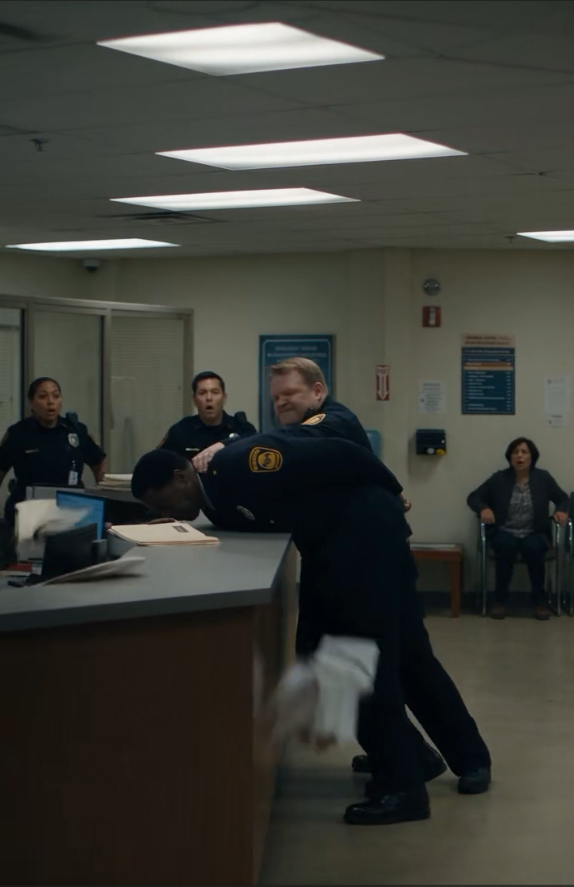
Any of those actions would have been understandable.
All of them would also have warned everyone who had something to hide.
I had not come to Riverside because of one sergeant.
The city had not recruited me because one man had poor judgment.
There were missing records, unresolved complaints, unexplained evidence gaps, lawsuits settled with language so vague nobody could tell what had actually happened, and a pattern of internal reviews that somehow ended with the same conclusion: no policy violation.
What had just happened to me was not the investigation.
It was evidence.
I turned toward Caldwell.
“You’re relieved from supervisory duty pending review. Surrender your access card and your duty weapon to the shift lieutenant.”
His face hardened.
There it was.
Not panic.
Not shame.
Resentment.
“Chief, with respect—”
“Don’t.”
He stopped.
I lowered my voice.
“You had eight minutes to show me who you were when you thought I had no power in this building. Don’t waste my time trying to show me someone different now.”
No one moved.
I walked toward the hallway leading to the administrative wing.
Behind me, the woman from the waiting area said, “Chief?”
I turned.
She was holding something between two fingers.
One of my business cards.
It must have slipped out of the briefcase.
She looked at the card, then at me.
“You really are him.”
“Yes, ma’am.”
She gave a tired little nod.
Then she looked around the lobby.
“Good luck.”
I almost smiled.
Instead I said, “Thank you.”
I had no idea how much I was going to need it.
The chief’s office was larger than I wanted and cleaner than I trusted.
Someone had placed a welcome basket on the conference table. Coffee beans, a department mug, two pens with the city seal, and a card signed by people I had not met.
On the wall hung framed photographs of former chiefs shaking hands at banquets, standing beside patrol cars, smiling at promotion ceremonies.
I set my briefcase on the desk and looked at my wrists.
Two red bands had formed beneath the cuffs.
My cheek showed a faint abrasion in the reflection of the dark computer monitor.
At breakfast, my son had asked if I was nervous.
He had been sitting at the kitchen counter, eating cereal too quickly because he was late.
“You’re really going to be the boss of all of them?” he had asked.
“Technically.”
“What does technically mean?”
“It means if I say I’m the boss, someone somewhere will immediately explain why it’s more complicated.”
He had laughed.
Then he had studied me.
“You nervous?”
“No.”
The lie had come easily.
He was old enough to know that adults worried and young enough to still want his father not to.
Now I sat in the chief’s chair and loosened my tie.
The office phone rang.
I looked at it once before answering.
“Reed.”
A voice from the city administration side started talking quickly. They had heard. Someone had called. There were concerns. Public-relations concerns. Liability concerns. Media concerns.
I let the person finish.
Then I said, “My first concern is preserving evidence.”
There was a pause.
“Of course.”
“I want all lobby surveillance video, body-camera footage, radio traffic, CAD entries, access logs, and internal messages preserved immediately.”
“We can coordinate—”
“I already sent the preservation order.”
Another pause.
“You did?”
“Yes.”
While walking from the lobby, I had dictated it into my phone and sent it to the records supervisor, IT administrator, city attorney, and internal affairs.
Twenty years had taught me something else.
The first story told after a bad event often becomes the permanent one unless evidence gets there first.
I hung up, opened my transition binder, and turned to the page I had marked the night before.
Riverside Police Department: unresolved integrity issues.
Seven years of complaints.
Four major lawsuits.
Two evidence-room audits with discrepancies.
Nine officers repeatedly named in use-of-force complaints.
One name appeared in more supervisory reviews than any other.
Garrett Caldwell.
I stared at it.
Not because I was surprised.
Because I wasn’t.
Part II — The Stories People Learned to Tell
By noon, three versions of what happened in the lobby already existed.
Caldwell’s preliminary statement said I had entered “in an agitated manner,” failed to “immediately establish lawful identity,” and made “movements consistent with possible concealment.”
The front-desk officer said he had been focused on a phone call and could not clearly see the initial contact.
Another officer said he believed Caldwell had “recognized a possible security threat.”
The woman in the waiting area told a different story.
She sat across from me in a small interview room, hands folded over her purse.
“You walked in,” she said. “You didn’t say anything to anybody because you didn’t have time.”
“Take your time.”
“I am.”
She looked toward the observation window.
“Can they hear me?”
“The interview is recorded.”
“That isn’t what I asked.”
I held her gaze.
“People involved in the incident will eventually have access to witness material through the review process.”
She nodded.
“Then I want to be exact.”
She described Caldwell approaching me before I reached the desk. She described him asking, “What do you think you’re doing?” She described me turning, beginning to answer, and Caldwell taking hold of my arm.
“Did Chief Reed make any threatening movement?” the internal investigator asked.
She looked at him.
“No.”
“Raise his voice?”
“No.”
“Attempt to strike or push Sergeant Caldwell?”
“No.”
“Did you hear Chief Reed identify himself?”
“He tried.”
The investigator glanced at me.
I said nothing.
The woman continued.
“He said, ‘Sergeant,’ and then something about identification in his jacket. That officer told him to save it.”
“Which officer?”
She pointed toward the photo lineup.
Caldwell.
When the interview ended, I thanked her.
She put her purse over one shoulder but did not leave immediately.
“My brother filed a complaint here three years ago.”
The investigator shifted.
I remained still.
“What happened?” I asked.
“He said officers stopped him outside his apartment because somebody reported a suspicious person. It was his apartment.”
Her mouth tightened.
“They put him on the ground. He complained. Internal affairs said the officers acted appropriately.”
“Was Sergeant Caldwell involved?”
“No.”
“Do you know the names?”
She shook her head.
“He stopped talking about it.”
That was how institutions protected themselves.
Not only through intimidation.
Through exhaustion.
Make the process slow enough, confusing enough, and humiliating enough, and people eventually decide that keeping their dignity matters more than proving what happened.
I asked the investigator to take her brother’s information if she was willing to provide it.
She did.
After she left, I returned to the chief’s office.
The incident had already begun spreading through the department. I could feel it in the hallways.
Doors closed when I passed.
Conversations stopped.
People who had not introduced themselves suddenly found urgent reasons to study paperwork.
I called the command staff meeting for 2:00 p.m.
At 1:57, every seat around the conference table was occupied.
Caldwell was not invited.
I stood rather than sitting at the head of the table.
“I’m not going to spend this meeting discussing what happened to me this morning.”