Then he gave one short nod.
Not agreement.
Recognition.
He stood.
His attorney gathered the papers.
At the door, Caldwell stopped.
“Chief.”
I looked up.
He turned.
“You think this fixes it?”
“No.”
That seemed to surprise him.
I continued.
“Firing one man is easy. Changing what taught everyone to tolerate him is the work.”
For once, he had no answer.
He walked out.
The months that followed were quieter on the surface and harder underneath.
Policies changed.
Complaint reviews moved outside normal chains of command when supervisors were implicated.
Body-camera failures required immediate documented inspection.
Evidence access became dual-authenticated.
Supervisors could no longer close certain complaints without independent review.
None of those reforms made headlines for long.
That was fine.
Real institutional change is usually boring when written down.
A password requirement.
A second signature.
A mandatory notification.
A rule that prevents one person from deciding inconvenient evidence does not matter.
The harder change was cultural.
Officer Daniels returned to full duty after discipline for his false initial statement.
Some people thought I should have fired him.
Others thought he should have faced no punishment because he eventually cooperated.
Both views were simpler than the truth.
He had lied.
Then he had corrected the lie at personal risk and provided evidence that helped expose a wider pattern.
Accountability did not require pretending only one of those things was true.
Months later, I saw him in the lobby speaking to a young patrol officer.
They did not notice me at first.
The younger officer was frustrated about a complaint.
“I did everything right,” he said. “Now I’m getting investigated anyway.”
Daniels answered, “That’s not punishment.”
“Feels like it.”
“I know.”
The younger officer looked at him.
Daniels continued.
“Just tell it straight the first time. Don’t try to make it sound better.”
“Why?”
Daniels glanced toward the front desk.
“Because somebody eventually compares the story to the evidence.”
I kept walking.
That was more useful than any speech I could have given.
Six months after I became chief, the woman who had been sitting in the waiting area on my first morning returned.
I recognized her immediately.
She had come with her brother.
He was taller than she was, quiet, with a careful way of looking around the lobby.
I stepped out of my office.
She smiled.
“Chief Reed.”
“Ma’am.”
Her brother extended his hand.
We shook.
“I heard you reopened my complaint.”
“Yes.”
“They told me the original review was inadequate.”
“It was.”
He looked toward the front desk.
“Officer got disciplined?”
“The review sustained several policy violations. The discipline is complete.”
He nodded.
“That’s more than I expected.”
His sister looked at me.
“I told him what happened to you.”
Her brother gave a short laugh.
“Guess they picked the wrong guy.”
I smiled faintly.
“No.”
Both of them looked at me.
I shook my head.
“That’s the problem with the story people tell about that morning.”
“What story?” she asked.
“That they made a mistake because I was the chief.”
The lobby was busy behind us.
Phones.
Radios.
People waiting.
Officers moving in and out.
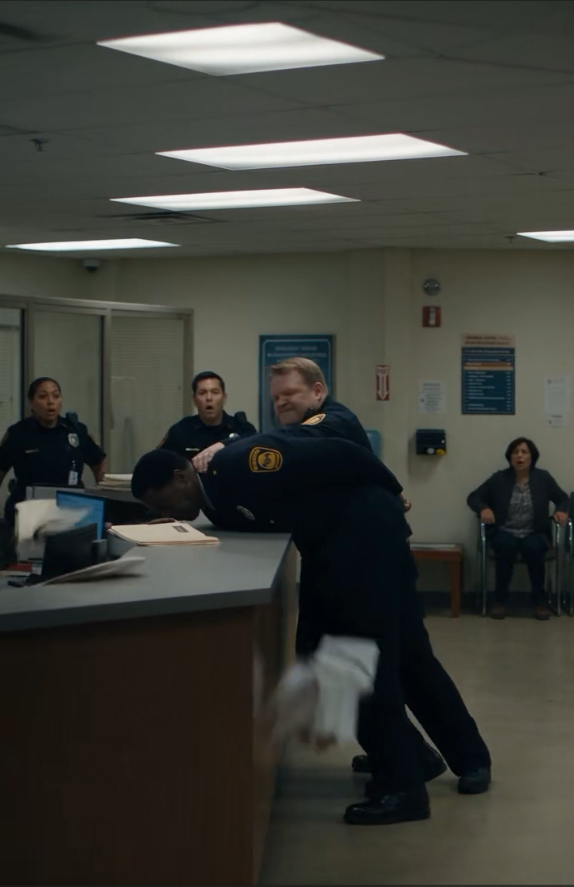
I looked toward the section of counter where Caldwell had pinned me.
“The mistake wasn’t that they did it to the wrong man.”
Her expression changed.
I continued.
“The mistake was believing there was a right man to do it to.”
Her brother held my gaze.
Then nodded once.
Nothing else needed to be said.
On the anniversary of my first day, I arrived at 8:47.
No ceremony.
No press.
No speech.
I parked in the same lot and carried the same leather briefcase through the front doors.
The lobby had changed less than people expected.
Same hard floor.
Same fluorescent lights.
Same counter.
Different habits.
A young officer at the desk looked up.
“Morning, Chief.”
“Morning.”
A civilian man stood near the counter arguing about a citation.
He was frustrated.
His voice was too loud.
A patrol officer approached him.
For half a second, an old part of me watched more carefully.
The officer stopped several feet away.
“Sir, I need you to lower your voice so I can understand what you’re asking.”
The man pointed toward the paperwork.
“I’ve been here forty minutes.”
“I hear you.”
“No, you don’t.”
The officer glanced toward the chair beside the counter.
“Sit down with me and show me where the problem is.”
The man hesitated.
Then sat.
Nobody grabbed him.
Nobody surrounded him.
Nobody treated irritation as danger merely because they had the authority to.
It was a small thing.
Small things had built the old Riverside too.
I continued toward the administrative hallway.
Officer Daniels came through the opposite door carrying coffee.
He looked at the clock.
“Eight-fifty.”
I checked my watch.
He was right.
For a second, we both understood the significance.
Daniels glanced toward the front desk.
“Better than last year.”
“Low bar.”
He laughed.
Then his expression turned serious.
“You ever think about it?”
“Every day.”
He nodded.
We started walking.
At the hallway junction, he peeled off toward patrol.
“Chief?”
I turned.
He lifted the coffee slightly.
“Good luck.”
I shook my head.
“People keep saying that to me.”
“Maybe you need it.”
“I definitely need it.”
He walked away.
I continued to my office.
The walls no longer held photographs of chiefs smiling at banquets.
I had replaced most of them with maps, current performance data, complaint-review metrics, evidence audit results, and a single framed copy of the department oath.
Not because words on a wall changed behavior.
They did not.
But I wanted one sentence visible from my desk.
To faithfully and impartially discharge the duties of office.
Impartially.
The word looked simple.
It was not.
On my desk sat a fresh stack of complaint files.
Some would prove misconduct.
Some would not.
Some officers would resent being questioned.
Some citizens would resent not being believed.
There would be bad arrests, honest mistakes, ugly confrontations, false accusations, justified force, unjustified force, political pressure, public anger, union disputes, lawsuits, and days when every available choice would leave someone furious.
That was policing.
There was no clean version.
Only a choice about what you did with the mess.
I set down the briefcase and opened the first file.
Then my phone buzzed.
A text from my son.
One year. Still nervous?
I looked at it for a moment.
Then typed back.
Yes.
His answer came almost immediately.
Good.
I smiled.
He understood more than I had realized.
Maybe strength was not the absence of fear.
Maybe it was refusing to let fear decide who deserved the rules.
Outside my office, a radio crackled.
Someone laughed down the hall.
A phone rang.
The department moved around me, not healed, not perfect, not finished.
But different.
At exactly 8:50, one year after I had entered Riverside Police Department and been pushed against a desk before anyone asked my name, I signed the first complaint review of the morning.
Then I reached for the next one.