Not entirely.
For the first time, he sounded like a man asking a real question.
I thought about my first morning.
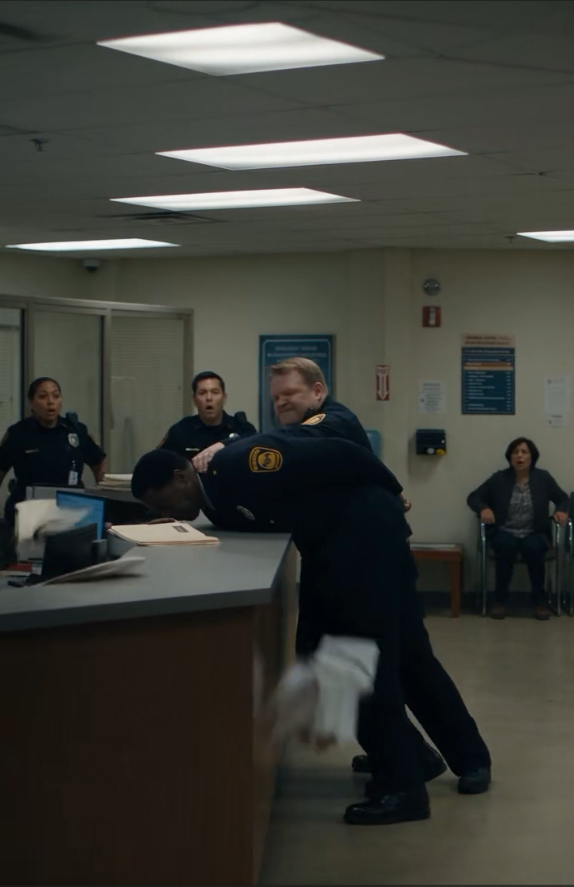
Caldwell’s hand on my neck.
The officers watching.
My son asking whether I was nervous.
The easiest answer would have been that I would have done better.
But the truth was harder.
“I hope I would have chosen the consequences.”
He gave a faint, bitter smile.
“Hope.”
“Yes.”
I nodded.
“That’s why systems matter. Because character feels strongest right up until it gets expensive.”
No one said anything.
Then the captain looked at the investigator.
“I’ll give you the files I remember.”
His attorney turned sharply.
He kept talking.
“And the names.”
That was the reversal.
Not because it absolved him.
It did not.
But because the man who had spent years protecting the department finally understood there might be no department left worth protecting unless he stopped.
The next month was the hardest of my career.
Not the most dangerous.
The hardest.
Officers were placed on leave.
Old cases were referred for review.
Prosecutors were notified about credibility concerns involving specific personnel.
Civilian complainants were contacted.
Some cried.
Some cursed.
Some hung up.
One man laughed for nearly ten seconds after being told his complaint from three years earlier was being reopened.
Then he said, “You people serious?”
The investigator told him yes.
He replied, “I’ll believe that when somebody loses something.”
I could not blame him.
At the station, resentment built.
An anonymous note appeared beneath my office door.
YOU’RE HANDING THE CITY TO CRIMINALS.
I threw it away.
Another arrived two days later.
HOW MANY COPS HAVE TO FALL BEFORE YOU’RE SATISFIED?
I kept that one.
Not because it frightened me.
Because the word satisfied revealed the writer’s assumption.
That accountability was revenge.
That consequences existed for emotional pleasure rather than institutional survival.
At home, my son noticed the circles under my eyes.
“You look worse than before you became chief.”
“Thank you.”
“I mean tired.”
“I know.”
He sat across from me at the kitchen table.
“Mom would’ve told you to sleep.”
The sentence landed softly.
His mother had been gone long enough that we could say things like that without the room changing completely.
Still, I looked down at my coffee.
“She would have.”
“You going to?”
“Eventually.”
He nodded.
Then he looked at my wrists.
The bruises were almost gone.
“Did the guy who did that get fired?”
“Not yet.”
“Why not?”
“Because there’s a process.”
“That sounds stupid.”
“Sometimes it is.”
“Then why follow it?”
I looked at him.
Because people were watching.
Because he was watching.
“Because if I ignore the rules when I’m sure I’m right, I teach everyone else that rules are optional when they feel sure too.”
He considered that.
“So he might keep his job?”
“He might.”
“Would that bother you?”
“Yes.”
“Then what if the process gets it wrong?”
I thought about the captain.
The missing video.
The complaint changed from sustained to unsubstantiated.
“Then you fix the process without cheating it.”
He leaned back.
“That sounds hard.”
“It is.”
He shrugged.
“Good luck.”
I smiled.
The woman in the lobby had said the same thing.
I was beginning to think it was Riverside’s unofficial motto.
Part VI — What the Badge Means
Caldwell’s disciplinary hearing took place twelve weeks after my first day.
By then, the investigation had expanded far beyond the lobby.
Multiple complaint findings had been reopened.
The captain had admitted changing several supervisory conclusions and had resigned before formal termination proceedings, though his cooperation continued in the criminal investigation.
The evidence custodian faced separate charges related to evidence tampering.
Several officers were disciplined for dishonesty or policy violations.
Others were cleared.
That distinction mattered publicly, even when people disliked it.
I refused demands to announce mass punishment before investigations were finished.
I refused demands from the other side to “move forward” before the facts were known.
Both groups accused me of weakness at different times.
I took that as evidence I was probably doing the job instead of performing for either one.
Caldwell remained the central question.
His attorney argued that the lobby incident had been a security mistake amplified by confusion.
The department presented video.
Witness testimony.
His statements.
His attempt to influence Officer Daniels.
Then came the older case.
The recovered forty-three-second video.
His history.
His supervisory role in other questionable complaints.
Caldwell testified.
He was calmer than I expected.
He admitted striking the handcuffed man four years earlier but said the man had spit at him beforehand.
He admitted approaching me without verifying my identity but insisted he believed there was a threat.
He denied racial bias.
He denied witness tampering.
He denied participating in evidence destruction.
Some of his denials could not be disproved.
Others had already collapsed under evidence.
At the end of the hearing, I had to make the final disciplinary decision.
That was the choice I had known was coming.
Termination was supported.
So was a lesser option under the department’s old disciplinary matrix, because many of Caldwell’s earlier findings had been improperly closed instead of sustained.
His attorney emphasized that point repeatedly.
“You cannot retroactively punish Sergeant Caldwell for allegations his own department cleared,” he said.
Legally, he had an argument.
Morally, it felt obscene.
But my son’s question returned to me.
What if the process gets it wrong?
You fix the process without cheating it.
I reviewed the findings one last time.
Then I entered the hearing room.
Caldwell sat beside his attorney.
Officer Daniels was present as a witness.
The captain was not.
Several command staff members sat along the back wall.
I took my seat.
Caldwell looked at me.
For a moment, I saw the front desk again.
The fluorescent lights.
My cheek against the counter.
His hand on my neck.
Men like you.
It would have been easy to make the decision about that morning.
Too easy.
I opened the file.
“This decision is based on sustained findings established through the current disciplinary process,” I said. “Not rumor. Not public pressure. Not unresolved allegations.”
Caldwell leaned back.
“Sergeant Garrett Caldwell is found to have used unjustified force against an unresisting individual in the lobby on the morning of my arrival; failed to conduct reasonable identification procedures; made materially misleading statements during the subsequent investigation; violated a direct witness-separation order; and attempted to influence another officer’s account.”
His attorney wrote something.
I continued.
“The recovered evidence from the prior use-of-force complaint is relevant to credibility and pattern, but I will not pretend the department handled that case properly enough at the time to make every consequence available now.”
Caldwell looked at me differently.
He had expected anger.
I gave him procedure.
“The department failed the complainant in that case. It failed the public. It also failed its own future disciplinary integrity by burying a sustained finding.”
I closed the file.
“That failure does not protect you from the findings established here.”
Caldwell’s jaw tightened.
I looked directly at him.
“Your employment with the Riverside Police Department is terminated effective immediately.”
No one moved.
Caldwell stared at me.