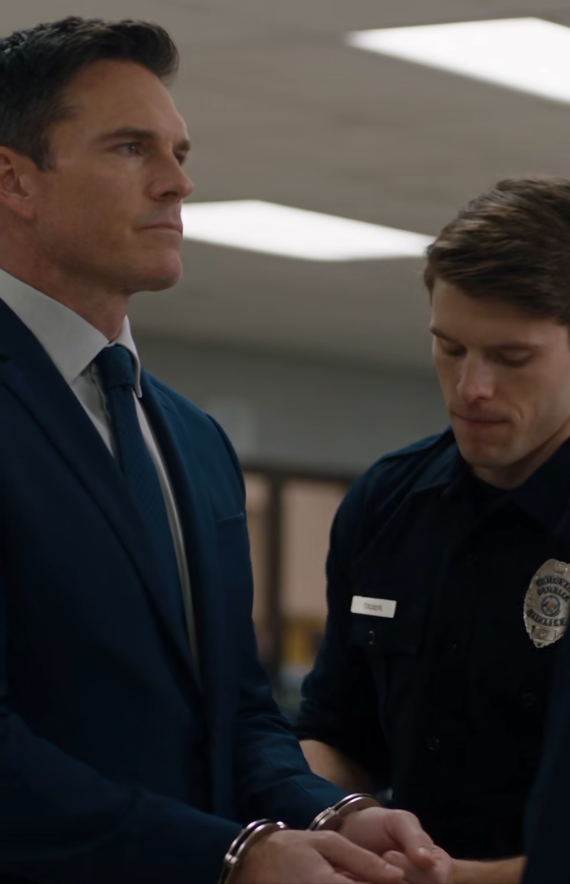
Ethan turned back.
“The morning I arrived, officers detained me before verifying who I was.”
Luis stared.
“You?”
“Yes.”
“The chief?”
“I wasn’t chief to them yet.”
Luis considered that.
“Did they apologize?”
“Yes.”
“Did that fix it?”
“No.”
Luis’s eyes remained on him.
Ethan continued.
“But it forced a question I should have been asking anyway.”
“What question?”
“Whether people here are treated according to what they’ve done or according to what someone assumes about them first.”
Luis looked down.
For a while, neither spoke.
Then Luis said, “Are you firing them?”
Ethan answered carefully.
“The investigation isn’t finished.”
Luis’s mouth tightened.
“So maybe nothing happens again.”
“I didn’t say that.”
“You didn’t say anything.”
Ethan understood the frustration.
More importantly, he understood the temptation.
He could promise Luis a result.
He could give him the reassurance the department had denied him.
He could say Bell would be fired, Pierce disciplined, policies changed.
He could become the kind of chief who sounded decisive before the facts were complete.
It would feel good.
That was exactly why he did not do it.
“I can promise you this,” Ethan said.
Luis waited.
“The complaint will receive a documented finding. You will be told what that finding is. The officers involved will be interviewed. The footage will be reviewed. My own staff’s failure to investigate will be part of the record.”
Luis watched him.
“That’s it?”
“That’s what I can promise honestly.”
Luis looked disappointed.
Ethan allowed it.
A truthful promise was smaller than a satisfying one.
It was also more useful.
When the interview ended, Luis stood.
At the doorway he stopped.
“Chief?”
“Yes?”
“You said they handcuffed you.”
“Yes.”
“What did you do?”
“Nothing.”
Luis frowned.
“You just sat there?”
“For eight minutes.”
“Why?”
Ethan thought about the laughter.
The briefcase kicked aside.
The young officer looking at his wrists.
“Because I wanted to know what they would do next.”
Luis nodded slowly.
“And?”
Ethan looked toward the lobby.
“I found out.”
Luis left.
Pierce watched him walk through the station.
When the front doors closed, Pierce came to Ethan’s office.
“How did it go?”
Ethan looked at him.
“You know you should have spoken to him months ago.”
Pierce nodded.
“Yes.”
“Do you want to know what he said?”
Pierce hesitated.
“Yes.”
Ethan leaned back.
“He called twice after filing the complaint.”
Pierce’s expression changed.
“I didn’t know that.”
“That’s the problem.”
Pierce looked through the glass.
“He thought nothing would happen.”
Pierce said nothing.
Ethan continued.
“He stopped calling because the department taught him there was no point.”
Pierce lowered his eyes.
“That’s on me.”
“Partly.”
Pierce looked up.
“Don’t take responsibility for things that aren’t yours.”
Pierce almost laughed.
“That’s new.”
“I’m serious.”
“So am I.”
Ethan stood.
“The department’s problem is not fixed by finding one person to carry all of it.”
Pierce studied him.
“You mean Bell?”
“I mean you.”
Pierce’s expression hardened.
Ethan continued.
“You hid a complaint.”
“I know.”
“You influenced how younger officers behaved.”
“I know.”
“You helped build the culture we’re reviewing.”
Pierce’s jaw tightened.
“I know.”
“But if I decide everything wrong here is because of Nolan Pierce, then the rest of the department learns nothing except how to survive the next chief.”
Pierce looked at him for a long time.
“What are you going to do?”
“Finish the findings.”
Those findings took another four days.
The conclusion on Bell was serious.
The stop began with a legitimate call for service.
The continuation of the detention became increasingly unsupported once Luis’s identity and residence were confirmed.
The backpack search lacked clear voluntary consent.
Taking the phone was not supported by an articulable safety concern in the recorded circumstances.
Bell’s statement about “making trouble,” combined with the context of Luis mentioning his scholarship, reasonably created the impression that further objection could produce consequences.
Sutter had failed to intervene despite visible doubt and later acknowledged he believed parts of the encounter were unnecessary.
Pierce had improperly delayed the complaint and discouraged meaningful review.
Voss had complied with the hold without documenting a reason or escalating concern.
The findings were not simple.
That mattered.
Ethan reviewed them with legal counsel twice.
Then came the harder question.
Discipline.
Bell faced a formal disciplinary hearing and removal from field duties.
Sutter faced discipline and mandatory remedial training.
Voss faced supervisory sanctions.
Pierce’s case was more difficult.
He had committed one of the clearest administrative failures.
He had also voluntarily disclosed it before Ethan discovered the record.
He had provided a complete written admission.
He had identified others involved.
He had not minimized the body-camera evidence.
He had, in the days since, begun challenging the very habits he had helped reinforce.
None of that erased what he had done.
But Ethan refused to pretend it meant nothing.
The city’s legal counsel asked him directly during their final call.
“If you terminate Pierce, no one will accuse you of being soft.”
Ethan looked through the window.
Pierce was in the lobby.
Caleb stood near him holding a report.
They were talking.
Not arguing.
Caleb said something.
Pierce shook his head.
Caleb pointed toward the page.
Pierce read it again.
Then nodded.
Ethan turned away from the window.
“That’s not the standard.”
“What is?”
“What makes the department safer and more accountable.”
“And what does that require?”
Ethan looked at Pierce again.
“That’s what I’m deciding.”
The final disciplinary meeting was held the next morning.
Bell sat at one end of the conference table.
Sutter beside him.
Voss across from them.
Pierce at the far side.
Dana attended as records custodian.
Caleb was not required to be there, but Ethan asked him to observe.
No reporters.
No city council members.
No audience.
Just the people whose decisions had created the problem.
Ethan placed the findings on the table.
He went through them one by one.
No speeches.
No humiliation.
When he finished, Bell leaned forward.
“So that’s it?”
Ethan looked at him.
“What do you mean?”
“You’ve already decided what happened.”
“We reviewed the video, dispatch record, complaint, supervisor notes, and interviews.”
Bell shook his head.
“You came in here already thinking the department had a problem.”
“I came in here handcuffed.”
Bell looked toward Pierce.
“And somehow he still has a job.”
There it was.
The room shifted.
Pierce did not move.
Bell continued.
“He buried the complaint.”
“Yes,” Ethan said.
“He told me not to worry.”
“Yes.”
“He outranks me.”
“Yes.”
“But I’m the one getting hammered.”
“You are receiving findings for your conduct.”
Bell pointed toward Pierce.
“And him?”
Ethan looked at Pierce.
Pierce spoke before Ethan could.
“I told you not to worry because I was protecting the wrong thing.”
Bell laughed sharply.
“Convenient.”
Pierce nodded.
“Yes.”
That stopped Bell.
Pierce continued.
“I thought protecting your career meant preventing the complaint from becoming serious.”
Bell stared at him.
“I was wrong.”
“Great.”
“No.”
Pierce leaned forward.
“Not great.”
His voice remained calm.
“I taught you that if a supervisor likes your work, the rules might bend around you.”