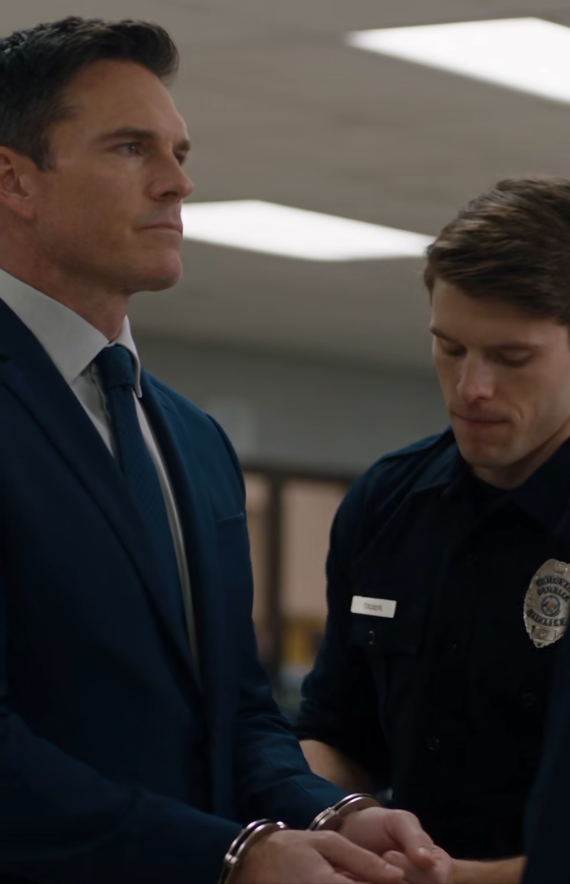
Bell’s expression tightened.
Pierce continued.
“I taught Wynn that following my tone mattered more than checking the facts.”
Caleb looked down.
“I taught people that looking confident was more important than being correct.”
Pierce looked at Ethan.
“And I proved it the first morning he walked in.”
No one spoke.
Pierce returned his attention to Bell.
“You made choices during that stop.”
Bell’s jaw flexed.
“So did I after it.”
For the first time, Bell had no immediate answer.
Ethan opened the final disciplinary documents.
“Officer Bell, you are removed from patrol assignment pending completion of formal disciplinary proceedings and retraining requirements. The sustained findings will be entered into your personnel record.”
Bell stared at the paper.
Ethan turned.
“Officer Sutter, you will receive formal discipline for failure to intervene and will complete remedial supervisory-response training before returning to unrestricted field duty.”
Sutter nodded once.
“Lieutenant Voss, your complaint-review authority is suspended pending retraining and supervisory evaluation.”
Voss accepted the document.
Then Ethan looked at Pierce.
The room waited.
Pierce did not.
He appeared ready for whatever came.
Ethan slid a document across the table.
Pierce looked down.
His brow furrowed.
“What is this?”
“Demotion from complaint-review authority effective immediately. Formal disciplinary finding for improper interference with a citizen complaint. Mandatory supervisory retraining. Twelve-month performance review.”
Pierce read the page.
Bell stared.
“That’s it?”
Ethan looked at him.
Bell pushed back from the table.
“He buried it.”
“He admitted it before it was discovered.”
“So honesty gets him a discount?”
Pierce looked toward Ethan.
For the first time since the investigation began, Ethan felt the room demanding something from him.
Not truth.
Simplicity.
Fire Pierce and prove accountability.
Keep Pierce and look weak.
Punish everyone equally and ignore the differences.
Make an example.
Give people something easy to understand.
Ethan understood why leaders did it.
Simple decisions were easier to explain than accurate ones.
He looked at Bell.
“No.”
Bell waited.
“Honesty does not erase misconduct.”
Ethan placed his hand on Pierce’s disciplinary document.
“It changes what happens next.”
Bell shook his head.
“That sounds like favoritism.”
“No.”
Ethan’s voice remained quiet.
“Favoritism is what happened when your complaint was buried because someone thought you were a good officer.”
Bell froze.
Ethan continued.
“I’m not repeating that mistake in reverse.”
The room stayed still.
“I am not going to pretend every wrong decision is identical because equal punishment looks cleaner.”
He turned toward Pierce.
“Sergeant Pierce keeps his rank because his conduct since disclosure matters, his admission matters, and the corrective value of keeping an experienced supervisor under documented accountability is greater than removing him solely to send a message.”
Pierce looked at him.
Ethan continued.
“If he repeats the conduct, minimizes it, retaliates against anyone involved, or interferes with another complaint, that calculation changes immediately.”
Pierce nodded.
“I understand.”
Ethan looked around the table.
“Accountability is not revenge.”
No one spoke.
“It is not humiliation.”
He thought of the lobby.
“It is not deciding someone’s guilt first and searching for facts afterward.”
Bell’s eyes moved toward him.
Ethan let the point land without emphasizing it.
“That meeting is over.”
Chairs moved.
Paper gathered.
Bell remained seated for several seconds after everyone else began standing.
Then he looked at Ethan.
“You really think I’m like what happened to you?”
Ethan paused.
“No.”
Bell seemed surprised.
“I think the mistake is similar.”
“What mistake?”
“Deciding who someone is before you finish learning what happened.”
Bell looked down at the findings.
Ethan left him with them.
Part VI — What Changes
The station did not transform overnight.
Ethan distrusted stories where institutions changed because one person gave a good speech.
Real change was slower.
Often boring.
Usually inconvenient.
Complaint forms were moved where citizens could reach them without asking a desk officer.
Every complaint received a tracking number.
Supervisory holds required written reasons and expiration dates.
Body-camera reviews had to be documented.
Officers were required to separate observations from assumptions in incident reports.
The reforms sounded administrative.
That was intentional.
Culture often hid inside procedure.
Dana redesigned the dispatch alert process so urgent personnel notices appeared simultaneously at dispatch and the front desk.
The first time the system flashed a test warning across both monitors, she came into Ethan’s office.
“It’s annoying.”
“Good.”
She frowned.
“That’s your answer to everything.”
“No.”
“It is lately.”
Ethan looked at her.
“Does it work?”
“Yes.”
“Then I’m comfortable with annoying.”
Dana rolled her eyes and left.
Caleb changed too, though less visibly.
He began asking questions.
Not constantly.
Not theatrically.
Just enough.
One afternoon, Ethan passed the report room and heard Pierce correcting him.
“You don’t need to challenge every order just to prove you can.”
Caleb replied, “I’m not.”
“You asked me three times why we were changing the patrol assignment.”
“Because the first two answers didn’t make sense.”
A pause.
Then Pierce said, “Fair.”
Ethan kept walking.
Later that week, Caleb stopped by the office.
“Chief?”
“What?”
“You said the next decision was mine.”
Ethan looked up.
Caleb stood in the doorway.
“Did I make it?”
“Which one?”
Caleb frowned.
“I don’t know.”
“That’s probably the right answer.”
Caleb leaned against the frame, then seemed to remember where he was and stood straight again.
“I thought there’d be a moment.”
“What kind?”
“Where I knew I was different.”
Ethan closed the file in front of him.
“That’s usually not how it works.”
“How does it work?”
“You make the next decision.”
Caleb stared at him.
“That’s it?”
“And then another.”
Caleb gave a small nod.
Before leaving, he said, “Pierce hates when I ask questions now.”
From the hallway came Pierce’s voice.
“I can hear you.”
Caleb disappeared quickly.
Ethan allowed himself a smile.
Pierce entered a moment later.
“I don’t hate questions.”
“You sound defensive.”
“I hate repetitive questions.”
“That’s different.”
Pierce sat.
He carried no coffee this time.
“The Ortega disposition went out.”
Ethan nodded.
Luis had received the formal findings that morning.
The department acknowledged failures during the stop and during complaint review.
He would not have to call again.
“He respond?” Pierce asked.
“Not yet.”
Pierce looked toward the window.
“I thought about calling him.”
“Don’t.”
Pierce looked back.
“I know.”
“Good.”
“I said I thought about it.”
“You want him to know you’re sorry.”
“Yes.”
“That’s for you.”
Pierce absorbed that.
“What if he wants to hear it?”
“Then he’ll decide that.”
Pierce nodded.
He stood.
At the door he stopped, as usual.
“You know, before you got here, I thought accountability meant finding the person who screwed up.”
Ethan waited.
Pierce looked at the lobby.
“Now I think sometimes it means figuring out how everybody helped make the screwup normal.”
Ethan leaned back.
“That’s closer.”
Pierce looked offended.
“Closer?”
“You’ve got twelve months.”
Pierce smiled once.
Then left.
Two weeks after Ethan’s arrival, Luis returned.
He did not call first.
Dana saw him enter and stood.
For one brief moment, Ethan watched the lobby react.
Luis wore the same backpack.
Caleb was behind the desk reviewing a report.