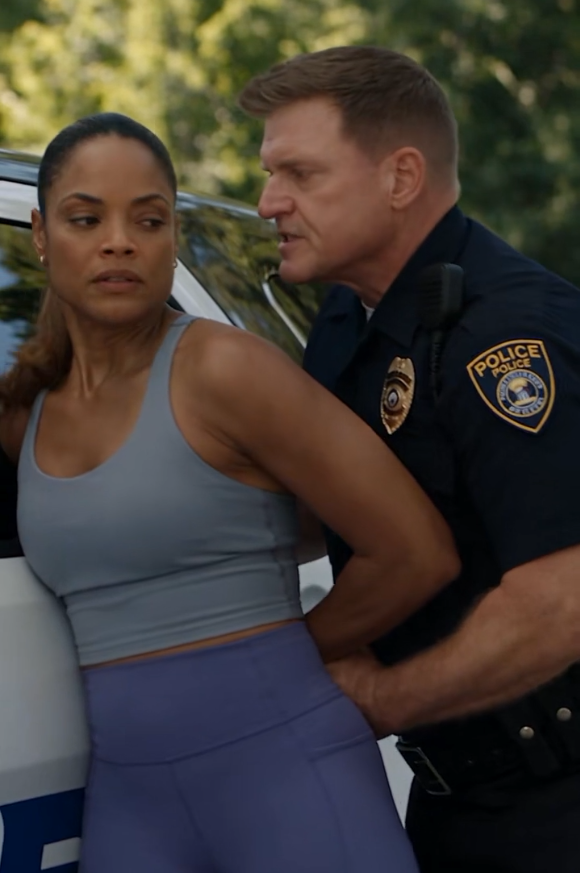
Part I — The Stop
The first thing I remember clearly is the taste of hot metal in the back of my throat.
The hood of the police cruiser had been sitting beneath the late-August sun long enough to bake whatever touched it, but against my cheek it felt strangely cold. Maybe that was adrenaline. Maybe that was fear. Maybe the body understands humiliation differently from heat.
My right arm was twisted behind me, pushed upward between my shoulder blades until a sharp warning streak ran down my spine.
“Stop resisting,” the heavier officer said close to my ear.
His breath smelled faintly of coffee.
His knee pressed into the back of my thigh.
I wasn’t resisting.
I wasn’t even moving.
I was trying to get enough air into my lungs to speak without sounding frightened.
That mattered to me more than it should have.
The pavement smelled of hot asphalt, cut grass, and motor oil. Sweat from my morning run slipped from my hairline, tracked down my temple, and stung my right eye.
“I don’t have my ID,” I managed.
The officer holding me adjusted his grip.
Not much.
Just enough.
“I was jogging,” I continued. “I live three blocks from here.”
“Sure you do.”
The second officer was younger. Leaner. Restless. I could hear his radio crackling somewhere behind me.
He spoke into it, then looked me over.
“Matches the description,” he said. “Black female. Dark athletic clothing. Leaving the area.”
I stared at the reflection of my own eye in the cruiser’s windshield.
Navy running leggings.
Gray tank top.
White shoes.
No jacket. No bag. No purse.
Nothing in my hands.
Half the women who jogged through this neighborhood on a weekday morning dressed more or less the same way.
The logic of that fact felt almost insulting in its simplicity.
But logic was not the strongest force on that street.
The strongest force was the hand pushing my cheek against the car.
The second strongest was the knowledge that my phone, wallet, and badge were sitting on the kitchen counter beside a coffee mug I hadn’t rinsed.
I had gone out for a run because I had spent the previous night reading deposition transcripts until after two in the morning.
Thirty minutes, I had told myself.
No phone.
No work.
No badge.
Just thirty quiet minutes before the calls began.
Now I was pinned against a police cruiser less than a mile from my home.
A woman pushing a stroller slowed on the opposite sidewalk.
For half a second, we looked at each other.
She stopped.
Her expression changed.
Then she lowered her eyes and kept moving.
I understood.
That was the worst part.
I understood completely.
“Name,” the heavier officer said.
His voice was flatter now.
“Tell me your name.”
I closed my eyes for a moment.
Behind my eyelids came six months of photographs.
Complaint forms.
Emergency-room records.
Traffic-stop reports.
Body-camera transcripts.
A grandmother standing barefoot beside a dented sedan while an officer searched her trunk for forty-seven minutes.
A college student handcuffed on a curb after being stopped for a broken taillight that photographs later showed wasn’t broken.
A contractor forced to the pavement outside the home he had been hired to repair.
A seventeen-year-old made to sit against a wall while officers searched a backpack that contained schoolbooks and a sandwich.
Every case had its own explanation.
Every report had its own language.
Officer safety.
Matching description.
Furtive movement.
Failure to comply.
Reasonable suspicion.
Individually, the incidents could be defended.
Collectively, they formed something else.
That was why I had been here for six months.
I was the lead federal civil rights attorney assigned to determine whether the department’s practices crossed the line from individual misconduct into a pattern.
And the two men holding me against their cruiser worked for that department.
I knew the heavier officer’s badge number before he told me.
I knew the younger officer’s too.
I knew how many complaints had been filed against each of them.
I knew which complaints had disappeared into “administrative closure.”
I knew which supervisor signed those closures.
I knew that the younger officer had been involved in four pedestrian stops in eleven months in which the initial description was nearly identical.
Black male.
Dark clothing.
Leaving area.
No suspect located afterward.
No originating caller identified in two of them.
I knew all of that.
They knew none of it about me.
“Name,” the heavier officer repeated.
I opened my eyes.
I gave him my first and last name.
He loosened his grip a fraction.
The younger officer typed it into his terminal.
Nothing useful would come back quickly. My federal credentials weren’t tied to my home identity in any way that a patrol database would display. My driver’s license address would confirm the neighborhood, but that depended on them deciding to check instead of assuming I was lying.
The younger officer leaned toward the screen.
“How do you spell that?”
I spelled it.
He typed again.
The heavier officer said, “Why don’t you have ID?”
“Because I was running.”
“You always run without a phone?”
“Yes.”
“That normal?”
“For me.”
He gave a short breath through his nose.
The younger officer looked over the cruiser roof.
“Where exactly do you live?”
“Three blocks east.”
“Address?”
I gave it to him.
He glanced at the heavier officer.
Something changed then.
Not belief.
Calculation.
The heavier officer pulled my arm down slightly, relieving the pressure in my shoulder.
“Stay where you are.”
I almost laughed.
My face was still against the car.
“I wasn’t planning to go anywhere.”
The younger officer didn’t appreciate that.
“You want to keep the attitude under control.”
I turned my head as much as the position allowed.
“That wasn’t attitude.”
He stepped closer.
“What was it?”
“A factual statement.”
His jaw shifted.
The heavier officer said, “Enough.”
Not to me.
To him.
That registered.
I filed it away automatically.
Occupational reflex.
Who interrupts whom.
Who controls the scene.
Who escalates.
Who backs down.
I had spent six months reconstructing interactions just like this from camera footage and witness statements.
Now I was inside one.
The radio crackled again.
The younger officer listened.
I heard only fragments.
Burglary call.
Two streets over.
Caller saw someone moving behind a house.
Possible female.
Unknown race at first report.
The younger officer reached for his shoulder microphone.
“Can you repeat the description?”
Static.
Then a dispatcher’s voice.
“Reporting party now says subject may have been a male wearing a dark hooded top. No further.”
Nobody moved.
The heavier officer’s hand remained around my wrist.
The younger officer looked at me.
I looked back.
There it was.
The moment when error became choice.
Before that radio transmission, they could still tell themselves they were following a description.
Now the description had changed completely.
The person seen behind the house was likely male.
Wearing a hooded top.
I was female.
Sleeveless.
Jogging in public.
The heavier officer released my wrist.
“Turn around.”
I did.
Pain moved through my shoulder when I brought my arm down.
I kept my face neutral.