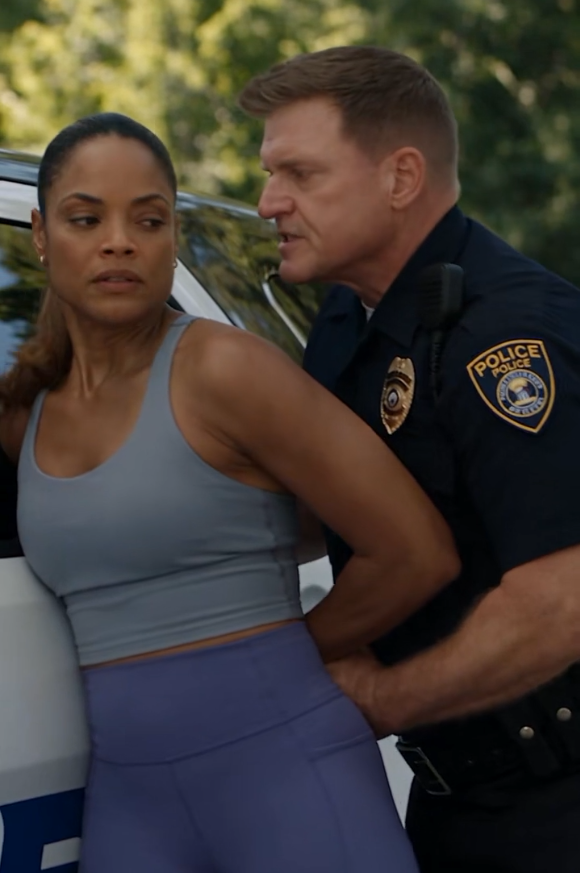
The younger officer glanced toward the street as if the actual suspect might suddenly appear and rescue him from the conversation.
The heavier officer studied me.
“You should carry identification.”
I rubbed my wrist.
“You stopped me based on a description that didn’t match.”
“It did when we stopped you.”
“It was Black female in dark athletic clothes.”
“That’s enough for an investigative detention.”
“Not by itself.”
His eyes narrowed.
It was subtle.
But I saw the change.
He was no longer hearing me as a frightened civilian.
He was hearing someone who knew vocabulary he expected to own.
The younger officer noticed it too.
“What are you, a lawyer?”
I looked at him.
“Yes.”
He smiled.
It wasn’t friendly.
“Of course.”
I reached up and touched the side of my face.
The skin felt hot.
The heavier officer stepped back.
“All right. You’re free to go.”
I didn’t move.
The younger officer said, “You heard him.”
“I did.”
“Then go.”
I looked at his badge.
Then at the heavier officer’s.
I already knew both numbers.
Still, I said them aloud.
First one.
Then the other.
The younger officer’s expression changed.
“What?”
I repeated the numbers.
The heavier officer watched me more carefully.
I said, “I know who you are.”
The younger officer gave a humorless laugh.
“You just read our badges.”
“No.”
A car passed behind me.
Its tires hissed over sun-softened pavement.
I lowered my hand from my cheek.
“For the last six months, I’ve been reviewing complaints from your department.”
The younger officer went very still.
The heavier officer’s face did not change, but the tendons in his neck tightened.
I continued.
“I’m the lead federal civil rights attorney assigned to the pattern-and-practice investigation.”
No one said anything.
The radio crackled between us.
The younger officer looked at the heavier officer.
The heavier officer looked at me.
I saw recognition arrive slowly.
Not recognition of my face.
Recognition of the investigation.
Every officer in the department knew about it.
Officially, the city called it a cooperative federal review.
Inside the precinct, according to three confidential witnesses, they called it the fishing expedition.
The heavier officer spoke first.
“You have credentials?”
“At my house.”
He looked down the street.
“Three blocks?”
“Yes.”
The younger officer muttered something under his breath.
I couldn’t hear it.
The heavier officer said, “We can verify.”
“You can.”
He hesitated.
Then he reached for his radio.
That was when I made my first important decision.
“Don’t.”
His hand stopped.
I said, “You told me I’m free to leave.”
“You are.”
“Then I’m leaving.”
I turned.
The younger officer said, “You just accused us of something?”
I looked back.
“No.”
“But you’re going to.”
I held his gaze.
“I haven’t decided what today means yet.”
That answer bothered him more than anger would have.
I walked away.
My legs felt wrong for the first half block.
Too light.
Too mechanical.
I kept my pace steady anyway.
I did not look back until I reached the corner.
The cruiser was still there.
Both officers stood beside it.
Watching me go.
Three blocks later, I unlocked my front door with the spare key I kept tied into the hidden pocket of my running leggings.
My phone showed eleven missed calls.
Four from my office.
Two from my deputy.
One from my supervisor in Washington.
The others were from numbers I didn’t recognize.
I ignored all of them.
I went to the bathroom mirror.
There was a red patch along my cheek.
My wrist had already begun to swell.
I stared at myself for a long time.
Then I walked into the kitchen.
My federal badge lay exactly where I had left it.
Beside the coffee cup.
I picked it up.
For six months, I had told witnesses that their cases mattered whether anyone believed them immediately or not.
I had told them documentation mattered.
Timing mattered.
Exact words mattered.
So I sat at my kitchen table while the memory was still fresh and wrote down every second I could remember.
The position of the cruiser.
The radio traffic.
The changing description.
The younger officer’s words.
The heavier officer’s grip.
The woman with the stroller.
The moment they were told the suspect was probably male.
The moment they released me.
And one line that I underlined twice:
The legal question is not what they did after learning who I was. The legal question is what they believed they could do before they knew.
Only after I finished did I return the first call.
My deputy answered immediately.
“Where have you been?”
“I need you to listen carefully.”
Something in my voice changed hers.
“What happened?”
“I was stopped this morning.”
A pause.
“Stopped how?”
“By the department.”
Another pause.
Longer.
Then:
“Are you hurt?”
“I’m fine.”
“That was not my question.”
I looked at the swelling around my wrist.
“No serious injury.”
“Who?”
I gave her the badge numbers.
I heard typing.
Then silence.
She knew them too.
“Those two?”
“Yes.”
“Jesus.”
“Don’t call anyone yet.”
“I’m calling our supervisor.”
“No.”
“You’re personally involved now.”
“I know.”
“That creates a problem.”
“I know.”
“You cannot keep running this case like nothing happened.”
“I know.”
She was quiet.
Then she asked the question I had been avoiding.
“What are you going to do?”
I looked at the notes spread across my kitchen table.
Six months of work had just become personal.
That was exactly why I could no longer trust my first instinct.
“I’m going to make sure whatever happens next isn’t about me.”
Part II — Pressure
By ten-thirty, my house had become an extension of the office.
My deputy arrived first.
She was compact, direct, and incapable of pretending not to notice things. She took one look at my wrist and told me to photograph it before the swelling changed.
I did.
Then my supervisor called.
He did not waste time.
“You’re recused from any decision involving those officers.”
“I expected that.”
“Possibly more than those officers.”
“That depends.”
“No. It depends on me.”
I sat at the kitchen table while my deputy leaned against the counter, arms folded.
My supervisor continued.
“You are now a fact witness in an incident involving the target department.”
“I’m aware.”
“You may have discoverable information.”
“I’m aware.”
“You may also be accused of shaping the broader investigation because of a personal grievance.”
“I’m aware of that too.”
His voice softened slightly.
“You’re saying that phrase a lot.”
“Because you’re listing things I spent the last hour thinking about.”
“Good. Then think about this one: if I take you off the entire matter, can your team finish without you?”
I looked at my deputy.
She heard enough through the speaker to know what he had asked.
“Yes,” I said.
She gave me a look.
My supervisor said, “That answer came fast.”
“It’s the right answer.”
“You built the case.”
“I built the team too.”
He was quiet.
Then he said, “I need your written account. No legal conclusions. Facts only.”