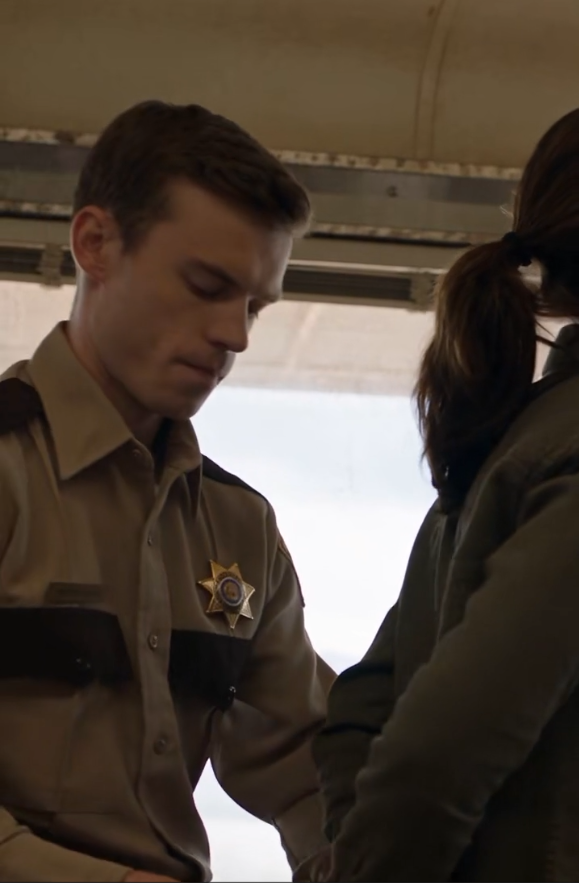
Part I — The Arrest
The first handcuff closed around my wrist before the sheriff finished telling me what crime he had invented.
Cold steel. One click, then another.
Too tight.
The younger deputy behind me smelled of sweat, gun oil, and the kind of nervousness that makes people dangerous. His shotgun barrel touched the back of my jacket as if he needed the reassurance of contact.
I kept my palms open.
Across Higgins Diner, two truck drivers sat frozen at the counter with their hands where Sheriff Boyd Miller could see them. The waitress had backed into the stainless-steel coffee station. A pot behind her had been left on the burner too long, and the bitter smell of scorched coffee mixed with dust, fryer grease, and the cheap cologne worn by DEA Agent Thomas Granger.
Nobody spoke except the men arresting me.
That suited me.
Three weeks earlier, I had been on another continent helping pull people out of a situation I still wasn't allowed to describe. Now I stood beside a sticky Formica table in Okehaven, Texas, wearing a faded olive field jacket and scuffed boots while four corrupt men tried to turn me into a frightened traveler they could rob with paperwork.
The contrast might have been funny under different circumstances.
"Turn around," Deputy One said.
I had already turned around.
He shoved the shotgun harder into my back anyway.
I could have taken it from him.
That wasn't arrogance. It was arithmetic.
His right elbow was locked. His stance was narrow. The muzzle was too close to my body. Sheriff Miller stood three steps away, heavy through the middle and balanced on his heels. Deputy Two had one hand hovering above his holstered Glock, but his attention kept drifting toward the customers. Granger had positioned himself behind the sheriff, where he could watch without being first into trouble.
Four men. Bad spacing. Poor discipline.
Plenty of options.
None of them were the right option.
So I gave them my wrists.
The deputy ratcheted the second cuff shut.
I looked at the tabletop.
Cherry filling had dried near the edge of my plate. My coffee was still steaming faintly.
Five minutes earlier, the day had been quiet.
I had been driving east with the windows cracked, no music on, letting miles of Texas flatten out in front of me. Mandatory administrative leave was supposed to keep me away from secure facilities, operational planning rooms, intelligence briefs, encrypted traffic, and people who used the word kinetic when they meant somebody might die.
I hadn't known what to do with that much silence.
So I drove.
My 1978 Ford Bronco wasn't comfortable, economical, or subtle. That was why I liked it. Dark green paint faded by sun. Manual locks. A steering wheel with enough play in it to qualify as an opinion. Colorado plates because that was where it had last been registered.
The back held camping equipment, clothes, a toolbox, and a secured Pelican case containing my personal SIG Nexter P320.
Nothing else.
Certainly not methamphetamine.
Agent Granger stepped into my peripheral vision, working a toothpick from one side of his mouth to the other.
"We got a hit on your Bronco," he said.
I said nothing.
"Anonymous tip. Vehicle matching the description transporting Schedule I narcotics across state lines."
His tone had the lazy confidence of a man reciting lines he'd used before.
Miller smiled.
Granger continued.
"We checked the vehicle. Found a duffel under the back seat. Crystal meth."
I looked at him then.
Just once.
His expression changed by less than a degree, but it changed.
He had expected outrage.
People who are falsely accused usually rush to fill silence. They explain where they've been, where they're going, what they do for a living. They produce receipts. They demand lawyers. They tell the police everything they think will prove innocence.
Sometimes innocent people talk themselves into cages.
I had spent enough of my adult life around interrogations to understand the value of an empty room.
Silence creates one.
Granger stepped closer.
"You hear me?"
I held his gaze.
Sheriff Miller came around the table until his face was close to mine.
"You have the right to remain silent," he said. "But if you want to see daylight outside a cell sometime this decade, I'd reconsider using it."
Sour coffee on his breath.
A nick along his jaw from shaving.
Tiny red veins beside his nose.
I started box breathing.
Four seconds in.
Hold.
Four seconds out.
Hold.
My pulse settled.
Miller mistook calm for defiance.
"Take her."
Granger put a hand against my shoulder and pushed.
I moved because I chose to move.
That distinction mattered to me even if nobody else in the room understood it.
They escorted me toward the door.
The waitress watched me pass. She was perhaps seventy, silver hair pinned back, both hands gripping the counter.
Our eyes met.
I didn't ask for help.
She didn't offer any.
But she looked from me to Granger, then through the front window toward my Bronco.
She had seen something.
I filed that away.
Outside, the late-afternoon heat hit hard after the diner air-conditioning.
Two sheriff's vehicles blocked the front of the Bronco.
The rear passenger door of a Ford Explorer stood open.
As Deputy One guided me toward it, I saw my truck.
The driver's door was shut.
The rear passenger side was shut.
The tailgate was shut.
No obvious damage.
That told me almost nothing.
Then I noticed something beneath the right rear tire.
A crescent of pale dust.
The Bronco had been moved.
Not far. Maybe three feet.
I had parked with the rear tire on a dark oil patch. Now the tire sat beyond it.
Somebody had put my truck in neutral or started it.
I looked at the deputy.
He caught me looking.
"Get in."
I ducked into the cage.
The door slammed.
For the next twelve minutes, I memorized the route to the Okehaven Sheriff's Office.
Left from the diner.
Right past a shuttered feed store.
Straight through one light.
Railroad tracks.
Water tower.
County annex.
One final turn.
Dispatch traffic crackled through the radio.
A livestock complaint on Route 19.
A domestic disturbance outside town.
Then a voice asked Deputy One if "the Colorado vehicle" had been secured.
He reached for the microphone.
"Affirmative."
Another voice answered, "Copy."
He glanced at me in the mirror.
I looked through him.
A minute later, he shifted in his seat.
Most people underestimate how uncomfortable silence becomes when someone else refuses to rescue them from it.
"What's your deal?" he asked.
I didn't answer.
"DEA says you were running product."
Nothing.
"You military or something?"
That made me look at him.
He saw my face and immediately looked back at the road.
Interesting.
My clothes were civilian. My hair was pulled back. No visible insignia. No tattoos that advertised a unit or branch.
He had seen the Pelican case.
Or the firearm.
Or something else in the Bronco.
He keyed the radio.
"Boss?"
Static.
Miller answered from the lead vehicle. "Go."
The deputy lowered his voice, though I could hear every word.
"She's not acting right."
"Meaning?"
"She hasn't said anything."
Miller laughed over the radio.