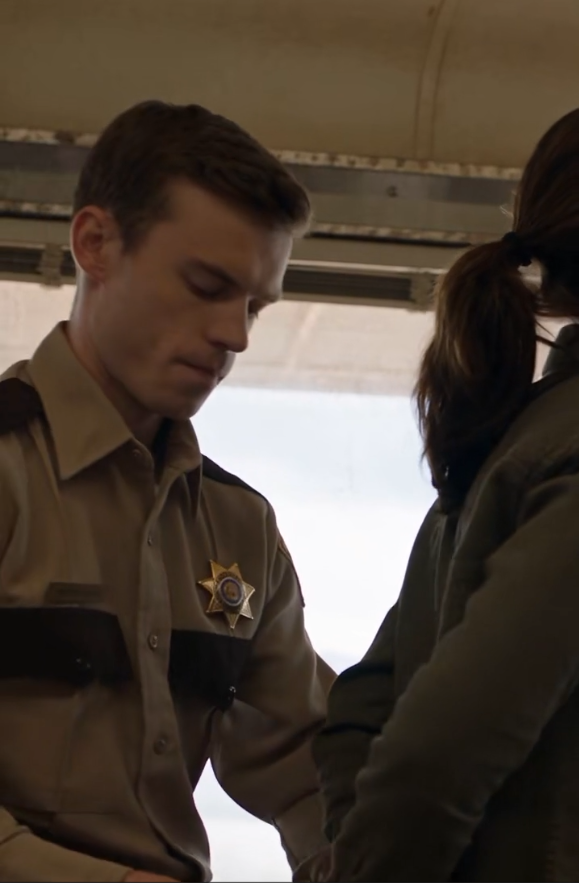
"That's not a crime yet."
"She's just sitting there."
Another burst of static.
"She's psycho, boss."
"Just drive, kid. We got a live one today. By midnight she'll sign over that Bronco for a phone call."
The transmission ended.
I turned toward the window.
There it was.
Not a drug arrest.
A transaction.
My vehicle in exchange for mercy.
Civil asset forfeiture had rules, processes, hearings, burdens of proof. What these men were doing had only the costume of law.
They didn't want a conviction.
They wanted leverage.
The sheriff's office was a squat brick building connected to an older county jail. Inside, they took my belt, boots, jacket, wallet, and watch.
They inventoried my cash.
Eight hundred and forty dollars.
Deputy Two counted it twice.
Granger stood by the door.
"Traveling heavy."
I looked at him.
He smiled.
"Cash. Gun. Drugs. Out-of-state vehicle."
He let the list hang there.
I wondered how many people had heard the same list.
How many had been tired, frightened, broke, driving alone.
How many had signed something just to go home.
They fingerprinted me.
Photographed me.
Then they put me in a small interview room instead of a holding cell.
That told me they were in a hurry.
A metal table was bolted to the floor. Two chairs. Camera in an upper corner.
Miller entered carrying a thin folder.
Granger followed with a legal pad.
Deputy One stayed outside.
Miller sat across from me.
"Let's make this easy."
He pushed a document across the table.
I read the heading.
VOLUNTARY PROPERTY DISCLAIMER.
My Bronco's make, model, year, and plate number were already typed into it.
So was a line stating that I disclaimed ownership interest in any currency or property associated with the investigation.
Prepared before arrest.
That was useful.
Miller tapped the signature line.
"You cooperate, things can move fast."
I read the page again.
Granger pulled out the chair beside him.
"You're looking at trafficking weight."
I turned to the second page.
It wasn't a plea agreement. It wasn't even an official forfeiture order.
It was a relinquishment form.
"Sign the vehicle over," Miller said. "Give us a clean statement about where the bag came from. Agent Granger can talk to the prosecutor."
I lifted my eyes.
Miller spread his hands.
"Or don't."
Still nothing.
His face hardened.
"Everybody talks eventually."
I leaned back.
Granger studied me for a long moment.
Then he said, "Let's find out who she is."
He stood.
Miller looked annoyed. "We already ran her."
"Run her deeper."
The sheriff turned toward him.
Something passed between them.
A concern.
Small, but real.
Granger left.
Miller remained sitting across from me.
For the first time since the diner, nobody spoke.
I watched the camera lens in the corner without appearing to watch it.
Then I looked at the forfeiture form again.
The document had been prepared at 3:42 p.m.
My diner receipt was in my wallet.
I had entered Higgins at 4:08.
They had prepared to take my Bronco twenty-six minutes before I arrived.
I finally spoke.
Miller leaned forward.
My voice was quiet.
"May I have a copy of this?"
His expression changed.
It was almost worth breaking my silence.
"You're worried about paperwork?"
"I asked for a copy."
His eyes narrowed.
"You want a lawyer?"
"I want a copy of the document you're asking me to sign."
He pulled it back toward himself.
"No."
I nodded once.
Then I went silent again.
Miller stared at me.
A minute later he stood, folder in hand.
At the door, he turned.
"You think you're smarter than everybody in this town?"
I looked at him.
He waited.
I let him.
Finally, he left.
The lock clicked behind him.
I sat alone under fluorescent light.
For the first time all day, I allowed myself to consider the fact that nobody in Okehaven knew who I was.
And that somewhere far outside that room, a clock had already started.
Part II — Pressure
The first person to realize I was missing would not be a friend.
It would be a duty officer.
That was the nature of my life.
After the extraction in the Horn of Africa, the people involved had been placed under temporary security protocols. Nothing theatrical. No bodyguards. No black SUVs. No armed escort following me across Texas.
Just check-ins.
A short encrypted authentication every evening while we were outside normal command channels.
It existed because the operation had touched people who did not forgive easily.
My mandatory leave was administrative, not invisible.
At 1800 Central Time, I was supposed to confirm status.
I didn't.
The first missed check wouldn't summon cavalry.
It would trigger a retry.
The second would generate a call.
The third would move from inconvenience to security concern.
By the time Sheriff Miller told his deputy I'd be signing over my Bronco by midnight, my absence was already becoming somebody else's problem.
But that didn't mean I could wait to be saved.
I had learned a long time ago that rescue is not a plan.
Information is.
So I collected it.
At 6:17, Deputy Two brought me water.
I noted the analog wall clock in the hallway.
At 6:43, I heard Granger arguing with someone in the front office.
At 7:05, a printer ran for almost three minutes.
At 7:11, Deputy One entered carrying a clear evidence bag containing my SIG Nexter.
The slide was locked back.
Magazine separate.
My expression didn't change.
He put it on the table.
"Registered to you."
I looked at the evidence label.
Item number 006.
Interesting.
"You got a permit?"
I said nothing.
He frowned.
"Serial number's clean."
Nothing.
He shifted the bag.
"We found this in a locked case."
That gave me more than he knew.
The Pelican case had been secured with two locks.
He had opened it.
I pointed at the bag.
"Who opened my case?"
He blinked.
"Search."
"Who opened it?"
"Doesn't matter."
"It will."
His jaw moved.
He gathered the bag and left.
At 7:26, Granger came in alone.
He closed the door carefully.
Then he sat.
No folder.
No legal pad.
He had taken off his jacket.
A DEA badge hung from his belt.
"Lieutenant Commander."
There it was.
I looked at him.
He smiled, but the smile wasn't the same one he'd worn in the diner.
"We finally got your military record to populate."
He made a show of looking impressed.
"Naval officer."
I said nothing.
"Interesting career."
He was fishing.
What standard law-enforcement databases could access would be thin. Rank. Service status. Basic identity. Maybe a few administrative entries.
Not DEVGRU.
Not my operational history.
Not the last three weeks.
Granger leaned back.
"You know what I think?"
I waited.
"I think you're one of those people who thinks a government ID means rules don't apply."
I nearly smiled.
Instead, I said, "You planted narcotics in my vehicle."
His face remained still.
But the toothpick stopped moving.
"I'd be careful with accusations."
"I am."
He leaned forward.
"The bag was found under your rear seat."
"By whom?"
"You want to play lawyer?"
"By whom?"
He stared at me.
Then he smiled again.
"Deputy conducted the vehicle search."
"Which deputy?"
"Doesn't matter."
"Then why won't you say?"
Granger stood.
He walked to the corner camera.