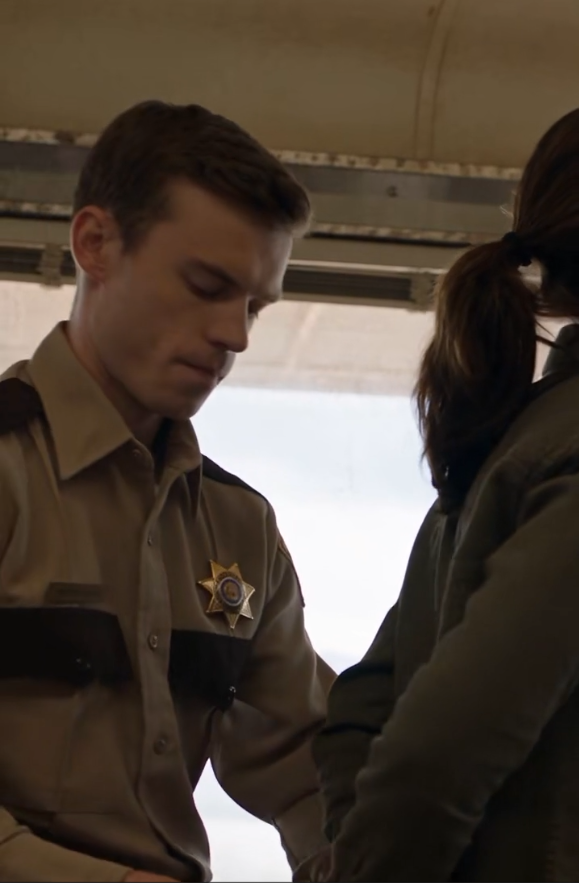
Looked up at it.
Then back at me.
"You think that thing's recording?"
I followed his gaze.
He reached toward the wall.
A tiny red light disappeared.
That was the first moment I felt something colder than anger.
Not fear.
Confirmation.
He returned to the table.
"Here's the problem with people like you," he said. "You spend enough time around serious situations, you start thinking every room works the same way."
I said nothing.
"This isn't wherever you came from."
He tapped the table.
"This is our county."
"Our?"
His eyes sharpened.
I had given him the opening deliberately.
He took it.
"People come through here every day. They speed. They carry things they shouldn't. They lie. Then they act shocked when consequences happen."
He moved closer.
"Nobody cares about one traveler from Colorado."
I looked at his badge.
Then his face.
"If that's true, why did you turn off the camera?"
The room went still.
Granger's smile vanished.
He picked up the toothpick from his mouth and set it on the table.
"You need to decide whether you're trying to be right or trying to go home."
I understood then what made him more dangerous than Miller.
The sheriff enjoyed authority.
Granger understood systems.
He knew how paperwork disappeared. How jurisdictions blurred. How one officer's statement could validate another officer's search. How an anonymous tip created probable cause, which created seizure, which created leverage.
He didn't need every piece to be true.
He needed enough pieces to look ordinary.
"I can make a call," he said. "You sign the disclaimer, we reduce the report. Personal possession. Maybe no federal referral. Maybe you walk."
"And the Bronco?"
He shrugged.
"Evidence."
"My cash?"
"Potential proceeds."
"My firearm?"
"Associated property."
There it was.
The whole business model.
I folded my hands on the table.
"I want counsel."
His face changed.
Barely.
But the conversation was over.
He turned the camera back on before opening the door.
"Of course you do."
After he left, nobody entered for almost an hour.
At 8:19, voices rose in the hallway.
I heard Miller.
Then Granger.
Then a third voice over speakerphone.
"...active duty."
Miller said, "So?"
The speaker answered too faintly to make out.
Granger said, "No. Don't call anybody yet."
That mattered.
I sat very still.
Miller lowered his voice, but anger carries.
"You said she was nobody."
"I said the plate fit the profile."
"She's an officer."
"An officer is not a senator."
"Then why's her record restricted?"
Silence.
I looked at the door.
Granger spoke next.
"Because military databases are garbage."
That was not what he believed.
At 8:31, somebody tried my interview-room door, then walked away.
At 8:42, the fluorescent lights flickered once.
At 8:55, Deputy One appeared.
He looked different.
Less nervous.
More worried.
"Stand up."
I stood.
He cuffed my hands in front this time.
Not as tight.
He led me toward the holding cells.
We passed the booking desk.
My wallet lay open inside a plastic property tray.
Beside it was a photocopy of my military identification.
Miller stood near the front entrance, phone pressed to his ear.
"No, sir," he was saying. "Routine narcotics arrest."
He saw me.
Turned away.
Deputy One pushed open the cell door.
Inside was a steel bunk and stainless toilet.
I stepped in.
Before he closed it, I said, "What's your name?"
His hand stopped on the bars.
He looked at me.
I hadn't asked because I needed it.
His nameplate had been visible all day.
I asked because I wanted him to understand that I had been paying attention.
He knew.
"I didn't search your truck," he said quietly.
Then he shut the door.
That was the first crack.
At 9:14, somebody in the front office answered a phone.
At 9:16, a second phone rang.
At 9:19, Miller shouted, "Tell them she's being processed."
At 9:22, the outer door opened.
Boots crossed tile.
Voices.
Then silence.
I stood beside the bars.
Deputy Two walked past quickly.
He didn't look at me.
A minute later Granger appeared.
He stopped outside the cell.
No smile now.
"Who are you?"
I looked at him.
"You know my name."
"I know your name."
He stepped closer.
"Who the hell are you?"
I said nothing.
His jaw tightened.
For a second, I saw the future moving behind his eyes.
Not mine.
His.
He was recalculating.
At 9:27, Sheriff Miller came down the hall.
His face had lost color.
"Get her back in interview."
Granger turned.
"Why?"
"Now."
They moved me into the same room.
The camera was on.
Miller remained standing.
Granger sat.
Nobody offered me the forfeiture form.
Miller said, "We received an inquiry."
I waited.
"Department of the Navy."
No response.
"They're asking about your detention status."
I looked at the camera.
Then at him.
"Answer them."
Miller's nostrils flared.
"We're not discussing an active investigation with outside parties."
"Then why tell me?"
He didn't answer.
Granger did.
"Because this can still be handled quietly."
I almost admired the instinct.
Even now.
Even after somebody outside their town had noticed.
He still believed every problem could become a negotiation.
"Handled how?"
Miller and Granger exchanged a look.
Granger spoke.
"You sign a statement acknowledging the narcotics were discovered during a lawful search. We release you pending review. Vehicle stays impounded."
"No."
"Think carefully."
"I am."
Miller put both palms on the table.
"This county doesn't care who signs your paycheck."
"Good."
He stared at me.
"Good?"
"It'll make the paperwork simpler."
Something in Deputy One's earlier fear had now spread to the sheriff.
Miller straightened.
Granger leaned back.
"What paperwork?"
I looked directly at him.
"The part where you explain why a property disclaimer for my vehicle was generated before I entered the diner."
Neither man moved.
I continued.
"Three forty-two p.m."
Granger's face emptied.
Miller looked at him.
That glance told me the document was Granger's creation.
Not Miller's.
Good.
I said, "My receipt shows I entered Higgins at four-oh-eight."
Miller turned back to me.
"You don't have your receipt."
"It's in my wallet."
A pause.
"Which your booking officer inventoried."
Granger stood.
"Interview's over."
"Yes," I said. "It is."
They left me alone.
This time, neither one remembered to turn off the camera.
Part III — The Reversal
At 10:03 p.m., the Okehaven Sheriff's Office stopped behaving like it belonged to Sheriff Boyd Miller.
I heard it happen before I saw it.
The front door opened.
Nobody shouted.
No heavy boots charged down the corridor.
No tactical team announced itself.
Instead, a calm male voice asked for the sheriff.
There was something about professional calm that frightened amateurs more than aggression ever could.
Miller answered from the lobby.
"This is my facility."
The voice replied, "Then this should be easy."
Another voice introduced itself, too distant for me to catch the agency.
Then a third.
Chairs moved.
A printer started.
Somebody asked where the evidence log was kept.
Granger walked past the interview-room window at speed.
He had put his jacket back on.
Two minutes later, he walked past again in the opposite direction.
Miller did not.
At 10:11, the door opened.
The man who entered wore a dark suit with no theatrics attached to it. Mid-forties. Government haircut. Government shoes. The tired posture of someone who spent more time in airports than he wanted.