Part I — The Trap
The handcuffs snapped around my wrists with a cold metallic click, and the young deputy behind me made the first mistake that mattered.
He apologized under his breath.
Not enough for Sheriff Boyd Miller to hear. Not enough for Thomas Granger, the DEA agent standing near the door, to notice.
But I heard it.
“Sorry.”
One word.
Quiet. Instinctive.
Then the deputy seemed to remember who was watching him and shoved my hands slightly higher behind my back.
I didn't react.
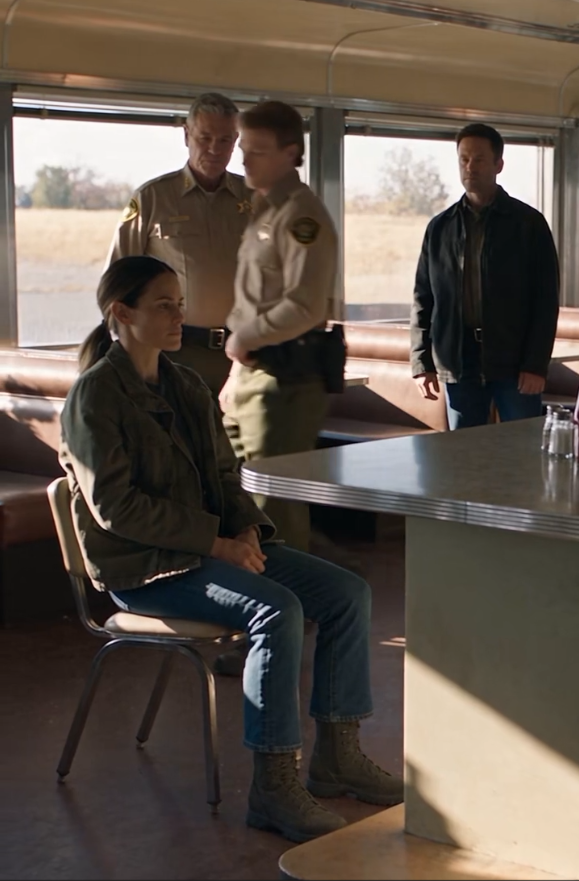
Three armed deputies had entered Higgins Diner less than two minutes earlier expecting panic. They had come in fast, boots hammering the checkered floor, voices raised, weapons visible, feeding off the fear they created.
The two truckers at the counter had lifted their hands immediately.
The elderly waitress had backed against the coffee machines.
I had taken one more sip of black coffee.
That had bothered them more than screaming would have.
Outside the dirty windows, late-afternoon sunlight stretched across Okehaven, Texas, a place that looked as if the interstate had forgotten it thirty years earlier. The town consisted of an aging courthouse, a feed store, two churches, several boarded storefronts, Higgins Diner, and enough cracked pavement to make every passing vehicle slow down whether the driver intended to or not.
My 1978 Ford Bronco sat in the parking lot beneath a faded Coca-Cola sign.
Colorado plates.
Old paint.
Camping gear visible through the rear windows.
To men like Miller and Granger, it probably looked like opportunity.
“Tell me again,” Sheriff Miller said.
He stood inches from me now, broad shoulders stretching his tan uniform, brass star bright against a shirt darkened by sweat at the collar.
I looked at him.
He waited.
I said nothing.
His mouth tightened.
“Name.”
The young deputy had already taken my driver's license.
Miller knew my name.
He wanted compliance.
“Alice Reese,” I said.
It was the first thing I'd said since they entered the diner.
My voice came out level.
Miller glanced at Granger as if they'd won something.
Granger smiled around the toothpick between his teeth.
“There she is,” he said. “She can talk.”
I turned my eyes toward him.
Thomas Granger was in his mid-forties, narrow-faced and slightly soft around the middle, with close-cut dark hair beginning to gray near the temples. He wore khaki pants, a dark sport coat, and an untucked button-down shirt. His DEA credentials hung from a chain around his neck.
The badge was real.
So was the arrogance.
He held up a clear evidence bag.
Inside was crystalline material.
“Recognize this?”
I looked at the bag.
Not the contents.
The packaging.
There was a thin strip of adhesive residue near the bottom seam, almost invisible beneath Granger's fingers. Faint lettering remained on it.
Government evidence tape.
Old tape.
Removed once already.
Interesting.
“We found a duffel under the rear seat of your Bronco,” Granger continued. “A lot more where this came from.”
He expected denial.
I gave him none.
Sheriff Miller shifted closer.
“You drive through my county carrying that much poison, you've got a serious problem.”
My wrists hurt where the cuffs had been ratcheted too tight.
I ignored it.
“Search warrant?” I asked.
Miller's expression changed by half a degree.
Granger's didn't.
“Probable cause.”
“From?”
“Anonymous tip.”
“What did the caller say?”
Granger gave a short laugh.
“You don't get to interview us.”
“No,” I said. “I suppose I don't.”
The waitress stared at me from behind the counter.
Miller noticed.
“Everybody stay where you are until we're finished.”
He turned back to me.
“You want to tell us where you're headed?”
“No.”
“Where'd you come from?”
“No.”
His jaw worked.
I wasn't refusing out of bravado.
Every unnecessary word was a gift.
For the last twelve years, my professional life had depended on understanding how quickly people revealed themselves when silence made them uncomfortable.
I had seen it in interrogation rooms overseas.
I had seen it across negotiation tables.
I had seen it during mission planning when a senior officer filled a pause because he couldn't stand uncertainty.
Silence created pressure.
Pressure created mistakes.
Sheriff Miller was already making them.
He nodded toward the door.
“Take her.”
The young deputy gripped my upper arm.
His hand wasn't rough.
The second deputy stepped forward to help him.
Granger stopped him.
“One's enough.”
Another mistake.
People who expected resistance used numbers.
People who believed the outcome was predetermined got lazy.
They walked me through the diner.
At the doorway, I glanced back once.
The waitress was still watching.
So were the truckers.
Witnesses.
Granger saw me look.
“Don't worry,” he said. “Nobody here saw anything that'll help you.”
That sentence mattered too.
Outside, the Texas heat hit like an open oven.
The parking lot smelled of hot asphalt and gasoline. Cicadas screamed from somewhere behind the diner.
My Bronco's rear passenger door stood open.
I had locked it.
The cargo area had been disturbed.
My olive canvas duffel lay half open on the ground beside the vehicle.
The black Pelican case that contained my SIG Nexter P320 and several pieces of controlled communications equipment was still beneath a wool blanket in the rear.
At least it appeared untouched.
For now.
The young deputy guided me toward a Ford Explorer.
I stopped.
“What's in that case?” Granger asked behind me.
I turned my head.
He was looking toward the Bronco.
“Personal property.”
“Locked?”
“Yes.”
“What kind of personal property needs a case like that?”
“The kind I lock.”
He smiled.
Miller didn't.
“Put her in the car.”
The deputy opened the rear door.
Before I got inside, I looked directly at Granger.
“If you open that case,” I said, “document it carefully.”
For the first time, his expression lost its lazy amusement.
Only for a second.
“What does that mean?”
“It means exactly what I said.”
Then I got into the rear cage.
The door slammed.
As we pulled away, I watched Granger through the back window.
He stood beside my Bronco with Sheriff Miller.
Both men were looking at the Pelican case.
I began box breathing.
Four seconds in.
Hold.
Four seconds out.
Hold.
My pulse settled.
The deputy checked me in the mirror.
Once.
Twice.
Three times.
The radio crackled.
Miller's voice came from the lead vehicle.
“Unit Four, status?”
The deputy keyed his microphone.
“Transporting one female. Ten-seven at county in approximately eight.”
“Copy.”
He released the button.
I watched the road.
Right onto Highway 19.
Past an abandoned tire shop.
Left at a water tower painted with the town name.
Railroad crossing.
Two minutes along a frontage road.
Another left.
I memorized everything.
The deputy noticed.
“You from Colorado?”
I looked at his reflection.
He couldn't have been older than twenty-eight.
“License says Colorado.”
I didn't answer.
He swallowed.
“You got family there?”
Silence.
“Look, ma'am, this'll go easier if you cooperate.”
“That what they told you?”
His eyes flicked toward the mirror.
“What?”
“When they hired you.”
He looked forward again.
We drove another twenty seconds.
Then he said, quieter, “I don't know what you're talking about.”
Maybe he didn't.
That was worth remembering.
The sheriff's office occupied a squat tan building behind the county courthouse. A chain-link fence surrounded the rear lot. Three patrol vehicles sat beside an impound gate.